Izabela Orlandi Môro, Gabriel Marinheiro, Marianna Leite, Gabriel de Almeida Monteiro, Agostinho C Pinheiro, João Paulo Mota Telles
{"title":"非轻微缺血性卒中患者的双重抗血小板治疗与单一抗血小板治疗:一项荟萃分析","authors":"Izabela Orlandi Môro, Gabriel Marinheiro, Marianna Leite, Gabriel de Almeida Monteiro, Agostinho C Pinheiro, João Paulo Mota Telles","doi":"10.1055/s-0045-1802551","DOIUrl":null,"url":null,"abstract":"<p><strong>Background: </strong> Patients with ischemic stroke present a higher risk of stroke recurrence, neurological deterioration, and death. The benefit of dual antiplatelet therapy (DAPT) over single antiplatelet therapy (SAPT) among patients with minor ischemic stroke is well established; however, robust evidence is lacking for those with nonminor stroke.</p><p><strong>Objective: </strong> To describe the benefits and risks of DAPT versus SAPT in patients with nonminor ischemic stroke.</p><p><strong>Methods: </strong> We searched the PubMed, Embase, and Cochrane Library databases for articles published from inception to April 2024. Data were collected from randomized clinical trials and observational studies comparing DAPT to SAPT following nonminor ischemic stroke, defined by a score ≥ 4 on the National Institutes of Health Stroke Scale (NIHSS).</p><p><strong>Results: </strong> In total, 6 studies were included, comprising 12,480 patients. The NIHSS score at baseline from the selected studies ranged from 4 to 15. There was no significant difference between DAPT and SAPT for recurrent stroke (risk ratio [RR] = 0.91; 95% confidence interval [95%CI] = 0.82-1.01; <i>p</i> = 0.09; I<sup>2</sup> = 0%), ischemic stroke (RR = 0.89; 95%CI = 0.80-1.00; <i>p</i> = 0.05; I<sup>2</sup> = 0%) or hemorrhagic stroke (RR = 1.23; 95%CI = 0.41-3.99; <i>p</i> = 0.66; I<sup>2</sup> = 27%). Major bleeding was not significantly increased in the DAPT group compared with the SAPT group (RR = 0.87; 95%CI = 0.29-2.66; <i>p</i> = 0.81; I<sup>2</sup> = 44%). The overall analysis did not show a significant difference in all-cause mortality (RR = 0.72; 95%CI = 0.50-1.02; <i>p</i> = 0.07; I<sup>2</sup> = 0%).</p><p><strong>Conclusion: </strong> There was no difference between DAPT and SAPT regarding recurrent stroke, ischemic stroke, hemorrhagic stroke, major bleeding, or overall mortality.</p>","PeriodicalId":8694,"journal":{"name":"Arquivos de neuro-psiquiatria","volume":"83 2","pages":"1-10"},"PeriodicalIF":1.6000,"publicationDate":"2025-02-01","publicationTypes":"Journal Article","fieldsOfStudy":null,"isOpenAccess":false,"openAccessPdf":"https://www.ncbi.nlm.nih.gov/pmc/articles/PMC11850082/pdf/","citationCount":"0","resultStr":"{\"title\":\"Dual versus single antiplatelet therapy in patients with nonminor ischemic stroke: a meta-analysis.\",\"authors\":\"Izabela Orlandi Môro, Gabriel Marinheiro, Marianna Leite, Gabriel de Almeida Monteiro, Agostinho C Pinheiro, João Paulo Mota Telles\",\"doi\":\"10.1055/s-0045-1802551\",\"DOIUrl\":null,\"url\":null,\"abstract\":\"<p><strong>Background: </strong> Patients with ischemic stroke present a higher risk of stroke recurrence, neurological deterioration, and death. The benefit of dual antiplatelet therapy (DAPT) over single antiplatelet therapy (SAPT) among patients with minor ischemic stroke is well established; however, robust evidence is lacking for those with nonminor stroke.</p><p><strong>Objective: </strong> To describe the benefits and risks of DAPT versus SAPT in patients with nonminor ischemic stroke.</p><p><strong>Methods: </strong> We searched the PubMed, Embase, and Cochrane Library databases for articles published from inception to April 2024. Data were collected from randomized clinical trials and observational studies comparing DAPT to SAPT following nonminor ischemic stroke, defined by a score ≥ 4 on the National Institutes of Health Stroke Scale (NIHSS).</p><p><strong>Results: </strong> In total, 6 studies were included, comprising 12,480 patients. The NIHSS score at baseline from the selected studies ranged from 4 to 15. There was no significant difference between DAPT and SAPT for recurrent stroke (risk ratio [RR] = 0.91; 95% confidence interval [95%CI] = 0.82-1.01; <i>p</i> = 0.09; I<sup>2</sup> = 0%), ischemic stroke (RR = 0.89; 95%CI = 0.80-1.00; <i>p</i> = 0.05; I<sup>2</sup> = 0%) or hemorrhagic stroke (RR = 1.23; 95%CI = 0.41-3.99; <i>p</i> = 0.66; I<sup>2</sup> = 27%). Major bleeding was not significantly increased in the DAPT group compared with the SAPT group (RR = 0.87; 95%CI = 0.29-2.66; <i>p</i> = 0.81; I<sup>2</sup> = 44%). The overall analysis did not show a significant difference in all-cause mortality (RR = 0.72; 95%CI = 0.50-1.02; <i>p</i> = 0.07; I<sup>2</sup> = 0%).</p><p><strong>Conclusion: </strong> There was no difference between DAPT and SAPT regarding recurrent stroke, ischemic stroke, hemorrhagic stroke, major bleeding, or overall mortality.</p>\",\"PeriodicalId\":8694,\"journal\":{\"name\":\"Arquivos de neuro-psiquiatria\",\"volume\":\"83 2\",\"pages\":\"1-10\"},\"PeriodicalIF\":1.6000,\"publicationDate\":\"2025-02-01\",\"publicationTypes\":\"Journal Article\",\"fieldsOfStudy\":null,\"isOpenAccess\":false,\"openAccessPdf\":\"https://www.ncbi.nlm.nih.gov/pmc/articles/PMC11850082/pdf/\",\"citationCount\":\"0\",\"resultStr\":null,\"platform\":\"Semanticscholar\",\"paperid\":null,\"PeriodicalName\":\"Arquivos de neuro-psiquiatria\",\"FirstCategoryId\":\"3\",\"ListUrlMain\":\"https://doi.org/10.1055/s-0045-1802551\",\"RegionNum\":4,\"RegionCategory\":\"医学\",\"ArticlePicture\":[],\"TitleCN\":null,\"AbstractTextCN\":null,\"PMCID\":null,\"EPubDate\":\"2025/2/24 0:00:00\",\"PubModel\":\"Epub\",\"JCR\":\"Q4\",\"JCRName\":\"NEUROSCIENCES\",\"Score\":null,\"Total\":0}","platform":"Semanticscholar","paperid":null,"PeriodicalName":"Arquivos de neuro-psiquiatria","FirstCategoryId":"3","ListUrlMain":"https://doi.org/10.1055/s-0045-1802551","RegionNum":4,"RegionCategory":"医学","ArticlePicture":[],"TitleCN":null,"AbstractTextCN":null,"PMCID":null,"EPubDate":"2025/2/24 0:00:00","PubModel":"Epub","JCR":"Q4","JCRName":"NEUROSCIENCES","Score":null,"Total":0}
Dual versus single antiplatelet therapy in patients with nonminor ischemic stroke: a meta-analysis.
Background: Patients with ischemic stroke present a higher risk of stroke recurrence, neurological deterioration, and death. The benefit of dual antiplatelet therapy (DAPT) over single antiplatelet therapy (SAPT) among patients with minor ischemic stroke is well established; however, robust evidence is lacking for those with nonminor stroke.
Objective: To describe the benefits and risks of DAPT versus SAPT in patients with nonminor ischemic stroke.
Methods: We searched the PubMed, Embase, and Cochrane Library databases for articles published from inception to April 2024. Data were collected from randomized clinical trials and observational studies comparing DAPT to SAPT following nonminor ischemic stroke, defined by a score ≥ 4 on the National Institutes of Health Stroke Scale (NIHSS).
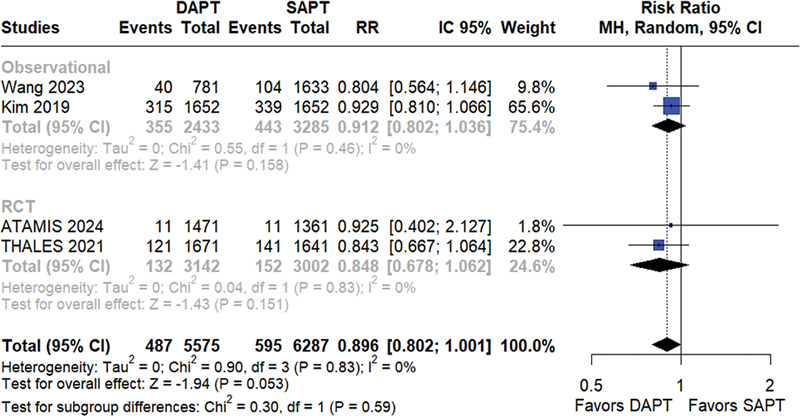
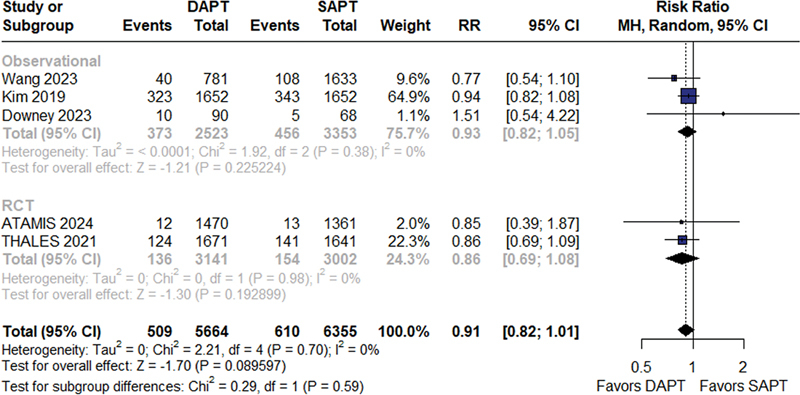
Results: In total, 6 studies were included, comprising 12,480 patients. The NIHSS score at baseline from the selected studies ranged from 4 to 15. There was no significant difference between DAPT and SAPT for recurrent stroke (risk ratio [RR] = 0.91; 95% confidence interval [95%CI] = 0.82-1.01; p = 0.09; I2 = 0%), ischemic stroke (RR = 0.89; 95%CI = 0.80-1.00; p = 0.05; I2 = 0%) or hemorrhagic stroke (RR = 1.23; 95%CI = 0.41-3.99; p = 0.66; I2 = 27%). Major bleeding was not significantly increased in the DAPT group compared with the SAPT group (RR = 0.87; 95%CI = 0.29-2.66; p = 0.81; I2 = 44%). The overall analysis did not show a significant difference in all-cause mortality (RR = 0.72; 95%CI = 0.50-1.02; p = 0.07; I2 = 0%).
Conclusion: There was no difference between DAPT and SAPT regarding recurrent stroke, ischemic stroke, hemorrhagic stroke, major bleeding, or overall mortality.
期刊介绍:
Arquivos de Neuro-Psiquiatria is the official journal of the Brazilian Academy of Neurology. The mission of the journal is to provide neurologists, specialists and researchers in Neurology and related fields with open access to original articles (clinical and translational research), editorials, reviews, historical papers, neuroimages and letters about published manuscripts. It also publishes the consensus and guidelines on Neurology, as well as educational and scientific material from the different scientific departments of the Brazilian Academy of Neurology.
The ultimate goals of the journal are to contribute to advance knowledge in the areas of Neurology and Neuroscience, and to provide valuable material for training and continuing education for neurologists and other health professionals working in the area. These goals might contribute to improving care for patients with neurological diseases. We aim to be the best Neuroscience journal in Latin America within the peer review system.





 京公网安备 11010802042870号
京ICP备2023020795号-1
京公网安备 11010802042870号
京ICP备2023020795号-1

 分享
分享
 求助内容:
求助内容: 应助结果提醒方式:
 扫码关注我们
