Ying Tang, Yinfeng Qiu, Panpan Zhang, Lu Wang, Juan Fan, Wenyuan Zhou, Jin Li, Yongchun Gu
{"title":"恒下颌第一、第二磨牙近根解剖危险区的显微计算机断层扫描研究。","authors":"Ying Tang, Yinfeng Qiu, Panpan Zhang, Lu Wang, Juan Fan, Wenyuan Zhou, Jin Li, Yongchun Gu","doi":"10.1186/s12903-025-05675-2","DOIUrl":null,"url":null,"abstract":"<p><strong>Background: </strong>To investigate the geometric characteristics of the danger zone in the mesial roots of mandibular molars using micro-computed tomography (micro-CT).</p><p><strong>Methods: </strong>A total of 75 extracted mandibular first (50 were 2-rooted [2RM1] and 25 were 3-rooted [3RM1]) and 35 2-rooted mandibular second molars (2RM2) were collected and evaluated using micro-CT. The morphological aspects of the mesial roots associated with the danger zone (the canal curvature, minimum mesial [MWT] and distal canal wall thickness [DWT], depth and level of root concavities) were evaluated. One-way analysis of variance (ANOVA) was used for multiple group comparisons. Student's t-test or paired t-test was used to test the means between two groups.</p><p><strong>Results: </strong>All mesial roots curved severely (81.8%, 90/110) or moderately (18.2%, 20/110) towards the furcation side, and the mean angle was 25.3 ± 7.2 degrees. The presence of a distolingual root only had limited influence on the geometricgeometry of the mesial root. In the majority of cases, the mean DWT was less than the MWT, and statistical significance (all p < 0.05) was detected at 0-3 mm (MB and ML of 3RM1), 0-4 mm (MB of 2RM1, and MB and ML of 2RM2), 0-5 mm (single mesial canals of mandibular first and second molars), and 0-6 mm (ML of 2RM1) below furcation. The mean depth of distal concavities is always greater (all p < 0.05) than the mesial ones at each root level. Generally, the mean depth of distal concavities increased apically in the cervical portion, reaching the maximum value at 2 mm below furcation, and then declined gradually in the apical portion.</p><p><strong>Conclusions: </strong>The mesial roots of mandibular first and second molars often exhibit severe distal curvature, with a mean Schneider's angle of 25.3 degrees, and the thinnest dentin wall is typically on the distal side. Distal root concavities are significantly deeper than mesial ones, with the maximum depth generally located 2 mm below the furcation. When identifying the danger zone, factors such as DWT should not be considered in isolation. Canal curvature, distal root concavities, and the type of instrument used are also critical in affecting the likelihood and location of strip perforation, though their precise roles warrant further investigations.</p>","PeriodicalId":9072,"journal":{"name":"BMC Oral Health","volume":"25 1","pages":"297"},"PeriodicalIF":3.1000,"publicationDate":"2025-02-24","publicationTypes":"Journal Article","fieldsOfStudy":null,"isOpenAccess":false,"openAccessPdf":"https://www.ncbi.nlm.nih.gov/pmc/articles/PMC11852544/pdf/","citationCount":"0","resultStr":"{\"title\":\"A micro- computed tomographic study of the anatomic danger zone in mesial roots of permanent mandibular first and second molars.\",\"authors\":\"Ying Tang, Yinfeng Qiu, Panpan Zhang, Lu Wang, Juan Fan, Wenyuan Zhou, Jin Li, Yongchun Gu\",\"doi\":\"10.1186/s12903-025-05675-2\",\"DOIUrl\":null,\"url\":null,\"abstract\":\"<p><strong>Background: </strong>To investigate the geometric characteristics of the danger zone in the mesial roots of mandibular molars using micro-computed tomography (micro-CT).</p><p><strong>Methods: </strong>A total of 75 extracted mandibular first (50 were 2-rooted [2RM1] and 25 were 3-rooted [3RM1]) and 35 2-rooted mandibular second molars (2RM2) were collected and evaluated using micro-CT. The morphological aspects of the mesial roots associated with the danger zone (the canal curvature, minimum mesial [MWT] and distal canal wall thickness [DWT], depth and level of root concavities) were evaluated. One-way analysis of variance (ANOVA) was used for multiple group comparisons. Student's t-test or paired t-test was used to test the means between two groups.</p><p><strong>Results: </strong>All mesial roots curved severely (81.8%, 90/110) or moderately (18.2%, 20/110) towards the furcation side, and the mean angle was 25.3 ± 7.2 degrees. The presence of a distolingual root only had limited influence on the geometricgeometry of the mesial root. In the majority of cases, the mean DWT was less than the MWT, and statistical significance (all p < 0.05) was detected at 0-3 mm (MB and ML of 3RM1), 0-4 mm (MB of 2RM1, and MB and ML of 2RM2), 0-5 mm (single mesial canals of mandibular first and second molars), and 0-6 mm (ML of 2RM1) below furcation. The mean depth of distal concavities is always greater (all p < 0.05) than the mesial ones at each root level. Generally, the mean depth of distal concavities increased apically in the cervical portion, reaching the maximum value at 2 mm below furcation, and then declined gradually in the apical portion.</p><p><strong>Conclusions: </strong>The mesial roots of mandibular first and second molars often exhibit severe distal curvature, with a mean Schneider's angle of 25.3 degrees, and the thinnest dentin wall is typically on the distal side. Distal root concavities are significantly deeper than mesial ones, with the maximum depth generally located 2 mm below the furcation. When identifying the danger zone, factors such as DWT should not be considered in isolation. Canal curvature, distal root concavities, and the type of instrument used are also critical in affecting the likelihood and location of strip perforation, though their precise roles warrant further investigations.</p>\",\"PeriodicalId\":9072,\"journal\":{\"name\":\"BMC Oral Health\",\"volume\":\"25 1\",\"pages\":\"297\"},\"PeriodicalIF\":3.1000,\"publicationDate\":\"2025-02-24\",\"publicationTypes\":\"Journal Article\",\"fieldsOfStudy\":null,\"isOpenAccess\":false,\"openAccessPdf\":\"https://www.ncbi.nlm.nih.gov/pmc/articles/PMC11852544/pdf/\",\"citationCount\":\"0\",\"resultStr\":null,\"platform\":\"Semanticscholar\",\"paperid\":null,\"PeriodicalName\":\"BMC Oral Health\",\"FirstCategoryId\":\"3\",\"ListUrlMain\":\"https://doi.org/10.1186/s12903-025-05675-2\",\"RegionNum\":2,\"RegionCategory\":\"医学\",\"ArticlePicture\":[],\"TitleCN\":null,\"AbstractTextCN\":null,\"PMCID\":null,\"EPubDate\":\"\",\"PubModel\":\"\",\"JCR\":\"Q1\",\"JCRName\":\"DENTISTRY, ORAL SURGERY & MEDICINE\",\"Score\":null,\"Total\":0}","platform":"Semanticscholar","paperid":null,"PeriodicalName":"BMC Oral Health","FirstCategoryId":"3","ListUrlMain":"https://doi.org/10.1186/s12903-025-05675-2","RegionNum":2,"RegionCategory":"医学","ArticlePicture":[],"TitleCN":null,"AbstractTextCN":null,"PMCID":null,"EPubDate":"","PubModel":"","JCR":"Q1","JCRName":"DENTISTRY, ORAL SURGERY & MEDICINE","Score":null,"Total":0}
A micro- computed tomographic study of the anatomic danger zone in mesial roots of permanent mandibular first and second molars.
Background: To investigate the geometric characteristics of the danger zone in the mesial roots of mandibular molars using micro-computed tomography (micro-CT).
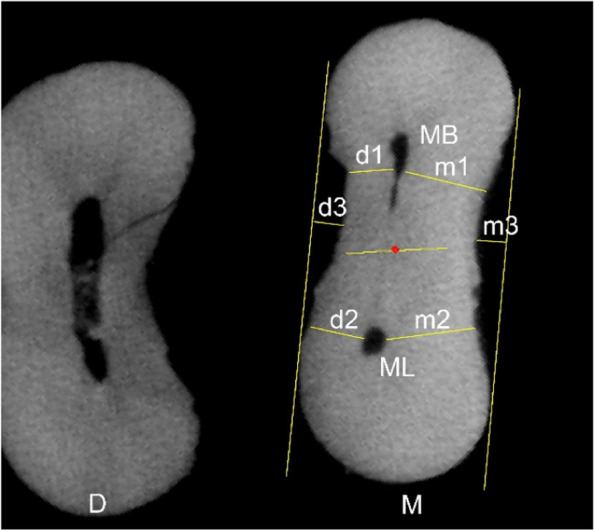
Methods: A total of 75 extracted mandibular first (50 were 2-rooted [2RM1] and 25 were 3-rooted [3RM1]) and 35 2-rooted mandibular second molars (2RM2) were collected and evaluated using micro-CT. The morphological aspects of the mesial roots associated with the danger zone (the canal curvature, minimum mesial [MWT] and distal canal wall thickness [DWT], depth and level of root concavities) were evaluated. One-way analysis of variance (ANOVA) was used for multiple group comparisons. Student's t-test or paired t-test was used to test the means between two groups.
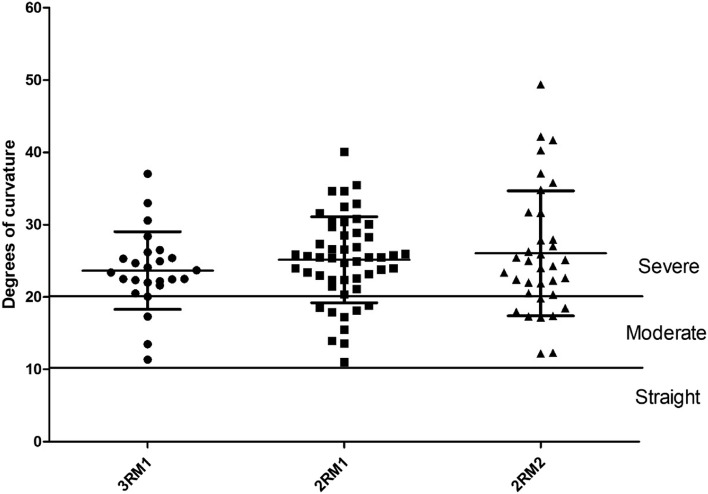
Results: All mesial roots curved severely (81.8%, 90/110) or moderately (18.2%, 20/110) towards the furcation side, and the mean angle was 25.3 ± 7.2 degrees. The presence of a distolingual root only had limited influence on the geometricgeometry of the mesial root. In the majority of cases, the mean DWT was less than the MWT, and statistical significance (all p < 0.05) was detected at 0-3 mm (MB and ML of 3RM1), 0-4 mm (MB of 2RM1, and MB and ML of 2RM2), 0-5 mm (single mesial canals of mandibular first and second molars), and 0-6 mm (ML of 2RM1) below furcation. The mean depth of distal concavities is always greater (all p < 0.05) than the mesial ones at each root level. Generally, the mean depth of distal concavities increased apically in the cervical portion, reaching the maximum value at 2 mm below furcation, and then declined gradually in the apical portion.
Conclusions: The mesial roots of mandibular first and second molars often exhibit severe distal curvature, with a mean Schneider's angle of 25.3 degrees, and the thinnest dentin wall is typically on the distal side. Distal root concavities are significantly deeper than mesial ones, with the maximum depth generally located 2 mm below the furcation. When identifying the danger zone, factors such as DWT should not be considered in isolation. Canal curvature, distal root concavities, and the type of instrument used are also critical in affecting the likelihood and location of strip perforation, though their precise roles warrant further investigations.
期刊介绍:
BMC Oral Health is an open access, peer-reviewed journal that considers articles on all aspects of the prevention, diagnosis and management of disorders of the mouth, teeth and gums, as well as related molecular genetics, pathophysiology, and epidemiology.






 京公网安备 11010802042870号
京ICP备2023020795号-1
京公网安备 11010802042870号
京ICP备2023020795号-1

 分享
分享
 求助内容:
求助内容: 应助结果提醒方式:
 扫码关注我们
