{"title":"意识障碍的功能神经影像学:走向临床应用。","authors":"Karnig Kazazian, Martin M Monti, Adrian M Owen","doi":"10.1093/brain/awaf075","DOIUrl":null,"url":null,"abstract":"<p><p>Functional neuroimaging has provided several new tools for improving both the diagnosis and prognosis in patients with disorders of consciousness. These tools are now being used to detect residual and covert awareness in behaviourally non-responsive patients with an acquired severe brain injury and predict which patients are likely to recover. Despite endorsement of advanced imaging by multiple clinical bodies, widespread implementation of imaging techniques such as functional MRI (fMRI), EEG and PET in both acute and prolonged disorders of consciousness patients has been hindered by perceived costs, technological barriers, and lack of expertise needed to acquire, interpret and implement these methods. In this review we provide a comprehensive overview of neuroimaging in disorders of consciousness, the different technical approaches employed (i.e. fMRI, EEG, PET), the imaging paradigms used (active, passive, resting state) and the types of inferences that have been made about residual cortical function based on those paradigms (e.g. perception, awareness, communication). Next, we outline how these barriers might be overcome, discuss which select patients stand to benefit the most from these neuroimaging techniques, and consider when, during their clinical trajectory, imaging tests are likely to be most useful. Moreover, we make recommendations that will help clinicians decide which advanced imaging technologies and protocols are likely to be most appropriate in any particular clinical case. Finally, we describe how these techniques can be implemented in routine clinical care to augment current clinical tools and outline future directions for the field as a whole.</p>","PeriodicalId":9063,"journal":{"name":"Brain","volume":" ","pages":"2283-2298"},"PeriodicalIF":11.7000,"publicationDate":"2025-07-07","publicationTypes":"Journal Article","fieldsOfStudy":null,"isOpenAccess":false,"openAccessPdf":"https://www.ncbi.nlm.nih.gov/pmc/articles/PMC12233511/pdf/","citationCount":"0","resultStr":"{\"title\":\"Functional neuroimaging in disorders of consciousness: towards clinical implementation.\",\"authors\":\"Karnig Kazazian, Martin M Monti, Adrian M Owen\",\"doi\":\"10.1093/brain/awaf075\",\"DOIUrl\":null,\"url\":null,\"abstract\":\"<p><p>Functional neuroimaging has provided several new tools for improving both the diagnosis and prognosis in patients with disorders of consciousness. These tools are now being used to detect residual and covert awareness in behaviourally non-responsive patients with an acquired severe brain injury and predict which patients are likely to recover. Despite endorsement of advanced imaging by multiple clinical bodies, widespread implementation of imaging techniques such as functional MRI (fMRI), EEG and PET in both acute and prolonged disorders of consciousness patients has been hindered by perceived costs, technological barriers, and lack of expertise needed to acquire, interpret and implement these methods. In this review we provide a comprehensive overview of neuroimaging in disorders of consciousness, the different technical approaches employed (i.e. fMRI, EEG, PET), the imaging paradigms used (active, passive, resting state) and the types of inferences that have been made about residual cortical function based on those paradigms (e.g. perception, awareness, communication). Next, we outline how these barriers might be overcome, discuss which select patients stand to benefit the most from these neuroimaging techniques, and consider when, during their clinical trajectory, imaging tests are likely to be most useful. Moreover, we make recommendations that will help clinicians decide which advanced imaging technologies and protocols are likely to be most appropriate in any particular clinical case. Finally, we describe how these techniques can be implemented in routine clinical care to augment current clinical tools and outline future directions for the field as a whole.</p>\",\"PeriodicalId\":9063,\"journal\":{\"name\":\"Brain\",\"volume\":\" \",\"pages\":\"2283-2298\"},\"PeriodicalIF\":11.7000,\"publicationDate\":\"2025-07-07\",\"publicationTypes\":\"Journal Article\",\"fieldsOfStudy\":null,\"isOpenAccess\":false,\"openAccessPdf\":\"https://www.ncbi.nlm.nih.gov/pmc/articles/PMC12233511/pdf/\",\"citationCount\":\"0\",\"resultStr\":null,\"platform\":\"Semanticscholar\",\"paperid\":null,\"PeriodicalName\":\"Brain\",\"FirstCategoryId\":\"3\",\"ListUrlMain\":\"https://doi.org/10.1093/brain/awaf075\",\"RegionNum\":1,\"RegionCategory\":\"医学\",\"ArticlePicture\":[],\"TitleCN\":null,\"AbstractTextCN\":null,\"PMCID\":null,\"EPubDate\":\"\",\"PubModel\":\"\",\"JCR\":\"Q1\",\"JCRName\":\"CLINICAL NEUROLOGY\",\"Score\":null,\"Total\":0}","platform":"Semanticscholar","paperid":null,"PeriodicalName":"Brain","FirstCategoryId":"3","ListUrlMain":"https://doi.org/10.1093/brain/awaf075","RegionNum":1,"RegionCategory":"医学","ArticlePicture":[],"TitleCN":null,"AbstractTextCN":null,"PMCID":null,"EPubDate":"","PubModel":"","JCR":"Q1","JCRName":"CLINICAL NEUROLOGY","Score":null,"Total":0}
Functional neuroimaging in disorders of consciousness: towards clinical implementation.
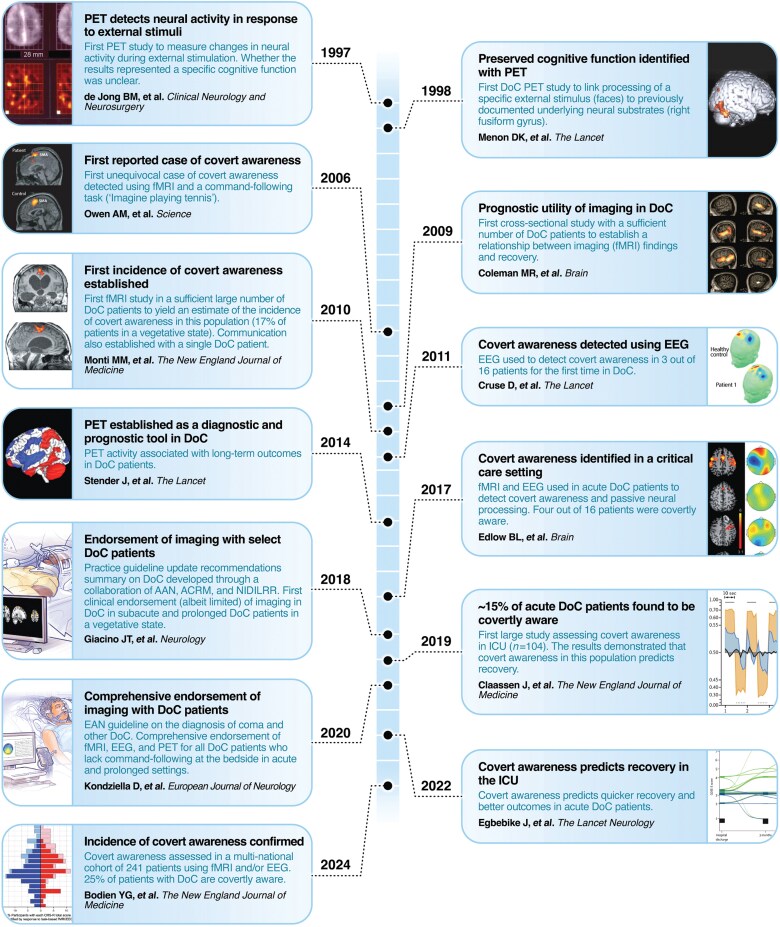
Functional neuroimaging has provided several new tools for improving both the diagnosis and prognosis in patients with disorders of consciousness. These tools are now being used to detect residual and covert awareness in behaviourally non-responsive patients with an acquired severe brain injury and predict which patients are likely to recover. Despite endorsement of advanced imaging by multiple clinical bodies, widespread implementation of imaging techniques such as functional MRI (fMRI), EEG and PET in both acute and prolonged disorders of consciousness patients has been hindered by perceived costs, technological barriers, and lack of expertise needed to acquire, interpret and implement these methods. In this review we provide a comprehensive overview of neuroimaging in disorders of consciousness, the different technical approaches employed (i.e. fMRI, EEG, PET), the imaging paradigms used (active, passive, resting state) and the types of inferences that have been made about residual cortical function based on those paradigms (e.g. perception, awareness, communication). Next, we outline how these barriers might be overcome, discuss which select patients stand to benefit the most from these neuroimaging techniques, and consider when, during their clinical trajectory, imaging tests are likely to be most useful. Moreover, we make recommendations that will help clinicians decide which advanced imaging technologies and protocols are likely to be most appropriate in any particular clinical case. Finally, we describe how these techniques can be implemented in routine clinical care to augment current clinical tools and outline future directions for the field as a whole.
期刊介绍:
Brain, a journal focused on clinical neurology and translational neuroscience, has been publishing landmark papers since 1878. The journal aims to expand its scope by including studies that shed light on disease mechanisms and conducting innovative clinical trials for brain disorders. With a wide range of topics covered, the Editorial Board represents the international readership and diverse coverage of the journal. Accepted articles are promptly posted online, typically within a few weeks of acceptance. As of 2022, Brain holds an impressive impact factor of 14.5, according to the Journal Citation Reports.




 京公网安备 11010802042870号
京ICP备2023020795号-1
京公网安备 11010802042870号
京ICP备2023020795号-1

 分享
分享
 求助内容:
求助内容: 应助结果提醒方式:
 扫码关注我们
