{"title":"老年危重症患者营养风险指数与败血症的关系:一项回顾性队列研究","authors":"Yujiao Jin, Tianyun Zhou, Chenshu Hou, Huihui Zhang, Binbin Xu","doi":"10.1186/s40001-025-02389-7","DOIUrl":null,"url":null,"abstract":"<p><strong>Objective: </strong>To investigate the relationship between the geriatric nutritional risk index (GNRI) and sepsis in elderly critically ill patients.</p><p><strong>Methods: </strong>We extracted data from the MIMIC-IV database for patients aged 65 and older who were first-time admissions to the Intensive Care Unit. The GNRI, derived from serum albumin, height, and weight, served as the exposure variable. The main outcome was the occurrence of sepsis. We utilized multivariable logistic regression to evaluate the association between GNRI and sepsis. Additionally, we employed restricted cubic splines to evaluate the potential nonlinear relationship between GNRI and the incidence of sepsis.</p><p><strong>Results: </strong>The study included 3,535 elderly patients, with 2,005 (56.7%) developing sepsis. Septic patients had significantly lower GNRI values (median: 99 vs. 101, P = 0.021) and a higher prevalence of malnutrition risk (GNRI ≤ 98) (47.5% vs. 43.5%, P = 0.018). The analysis employing restricted cubic splines identified a U-shaped association between GNRI and sepsis (P for non-linearity = 0.004), with an inflection point at 105.4. To the left of this inflection point, GNRI was significantly negatively associated with sepsis (OR = 0.987, 95% CI 0.978-0.996, P = 0.005), while the right side showed a positive correlation (OR = 1.011, 95% CI 1.000-1.022, P = 0.044).</p><p><strong>Conclusion: </strong>The study reveals a U-shaped association between GNRI and sepsis in elderly critically ill patients. Both low and high GNRI values are associated with increased sepsis risk, with a turning point at 105.4. These findings highlight GNRI's utility as a screening tool for identifying sepsis risk in elderly ICU patients.</p>","PeriodicalId":11949,"journal":{"name":"European Journal of Medical Research","volume":"30 1","pages":"130"},"PeriodicalIF":4.8000,"publicationDate":"2025-02-24","publicationTypes":"Journal Article","fieldsOfStudy":null,"isOpenAccess":false,"openAccessPdf":"https://www.ncbi.nlm.nih.gov/pmc/articles/PMC11849206/pdf/","citationCount":"0","resultStr":"{\"title\":\"Relationship between the geriatric nutritional risk index and sepsis in elderly critically ill patients: a retrospective cohort study.\",\"authors\":\"Yujiao Jin, Tianyun Zhou, Chenshu Hou, Huihui Zhang, Binbin Xu\",\"doi\":\"10.1186/s40001-025-02389-7\",\"DOIUrl\":null,\"url\":null,\"abstract\":\"<p><strong>Objective: </strong>To investigate the relationship between the geriatric nutritional risk index (GNRI) and sepsis in elderly critically ill patients.</p><p><strong>Methods: </strong>We extracted data from the MIMIC-IV database for patients aged 65 and older who were first-time admissions to the Intensive Care Unit. The GNRI, derived from serum albumin, height, and weight, served as the exposure variable. The main outcome was the occurrence of sepsis. We utilized multivariable logistic regression to evaluate the association between GNRI and sepsis. Additionally, we employed restricted cubic splines to evaluate the potential nonlinear relationship between GNRI and the incidence of sepsis.</p><p><strong>Results: </strong>The study included 3,535 elderly patients, with 2,005 (56.7%) developing sepsis. Septic patients had significantly lower GNRI values (median: 99 vs. 101, P = 0.021) and a higher prevalence of malnutrition risk (GNRI ≤ 98) (47.5% vs. 43.5%, P = 0.018). The analysis employing restricted cubic splines identified a U-shaped association between GNRI and sepsis (P for non-linearity = 0.004), with an inflection point at 105.4. To the left of this inflection point, GNRI was significantly negatively associated with sepsis (OR = 0.987, 95% CI 0.978-0.996, P = 0.005), while the right side showed a positive correlation (OR = 1.011, 95% CI 1.000-1.022, P = 0.044).</p><p><strong>Conclusion: </strong>The study reveals a U-shaped association between GNRI and sepsis in elderly critically ill patients. Both low and high GNRI values are associated with increased sepsis risk, with a turning point at 105.4. These findings highlight GNRI's utility as a screening tool for identifying sepsis risk in elderly ICU patients.</p>\",\"PeriodicalId\":11949,\"journal\":{\"name\":\"European Journal of Medical Research\",\"volume\":\"30 1\",\"pages\":\"130\"},\"PeriodicalIF\":4.8000,\"publicationDate\":\"2025-02-24\",\"publicationTypes\":\"Journal Article\",\"fieldsOfStudy\":null,\"isOpenAccess\":false,\"openAccessPdf\":\"https://www.ncbi.nlm.nih.gov/pmc/articles/PMC11849206/pdf/\",\"citationCount\":\"0\",\"resultStr\":null,\"platform\":\"Semanticscholar\",\"paperid\":null,\"PeriodicalName\":\"European Journal of Medical Research\",\"FirstCategoryId\":\"3\",\"ListUrlMain\":\"https://doi.org/10.1186/s40001-025-02389-7\",\"RegionNum\":3,\"RegionCategory\":\"医学\",\"ArticlePicture\":[],\"TitleCN\":null,\"AbstractTextCN\":null,\"PMCID\":null,\"EPubDate\":\"\",\"PubModel\":\"\",\"JCR\":\"Q2\",\"JCRName\":\"MEDICINE, RESEARCH & EXPERIMENTAL\",\"Score\":null,\"Total\":0}","platform":"Semanticscholar","paperid":null,"PeriodicalName":"European Journal of Medical Research","FirstCategoryId":"3","ListUrlMain":"https://doi.org/10.1186/s40001-025-02389-7","RegionNum":3,"RegionCategory":"医学","ArticlePicture":[],"TitleCN":null,"AbstractTextCN":null,"PMCID":null,"EPubDate":"","PubModel":"","JCR":"Q2","JCRName":"MEDICINE, RESEARCH & EXPERIMENTAL","Score":null,"Total":0}
引用次数: 0
摘要
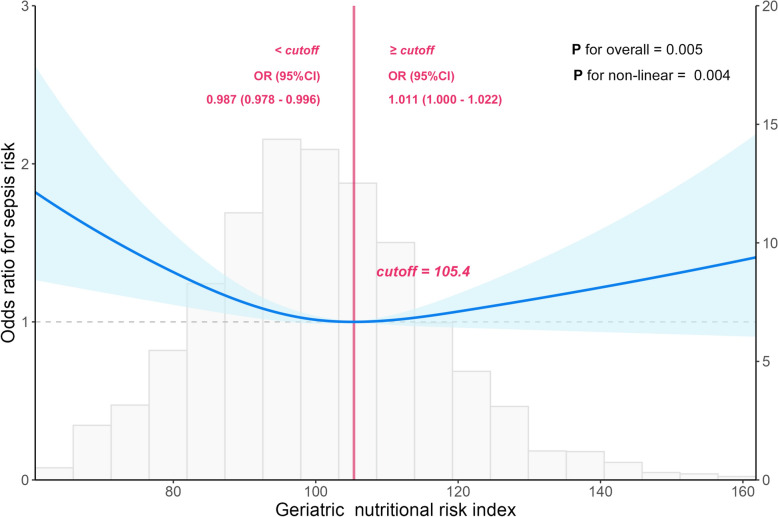
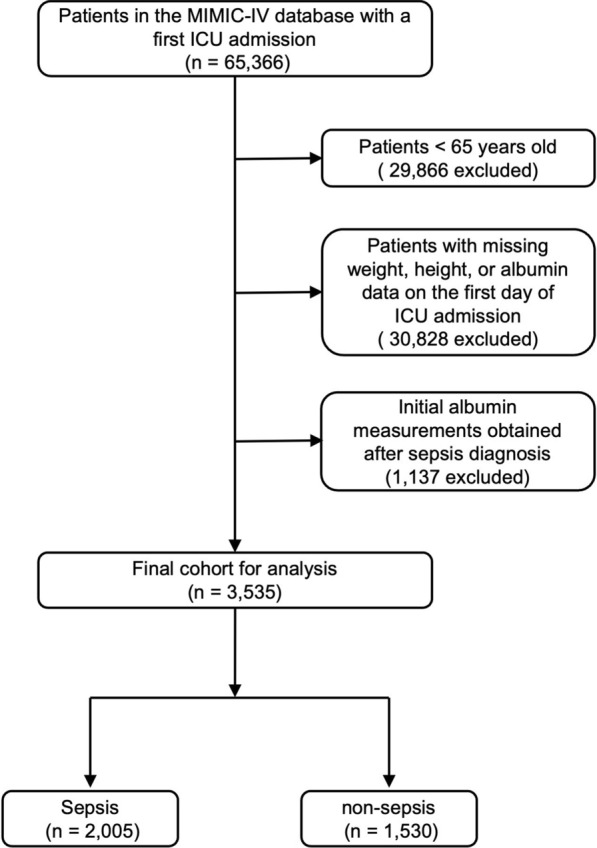
目的:探讨老年危重症患者老年营养风险指数(GNRI)与脓毒症的关系。方法:我们从MIMIC-IV数据库中提取65岁及以上首次入住重症监护室的患者的数据。由血清白蛋白、身高和体重得出的GNRI作为暴露变量。主要结果为脓毒症的发生。我们使用多变量逻辑回归来评估GNRI与败血症之间的关系。此外,我们采用限制三次样条来评估GNRI与脓毒症发生率之间潜在的非线性关系。结果:该研究包括3535例老年患者,其中2005例(56.7%)发生败血症。脓毒症患者的GNRI值较低(中位数:99比101,P = 0.021),营养不良风险发生率较高(GNRI≤98)(47.5%比43.5%,P = 0.018)。采用限制性三次样条分析发现GNRI与败血症之间呈u型关联(非线性P = 0.004),拐点为105.4。该拐点左侧GNRI与脓毒症呈显著负相关(OR = 0.987, 95% CI 0.978 ~ 0.996, P = 0.005),右侧GNRI与脓毒症呈正相关(OR = 1.011, 95% CI 1.000 ~ 1.022, P = 0.044)。结论:本研究显示高龄危重患者GNRI与败血症呈u型相关。低和高GNRI值都与脓毒症风险增加相关,转折点为105.4。这些发现强调了GNRI作为识别老年ICU患者脓毒症风险的筛查工具的实用性。
Relationship between the geriatric nutritional risk index and sepsis in elderly critically ill patients: a retrospective cohort study.
Objective: To investigate the relationship between the geriatric nutritional risk index (GNRI) and sepsis in elderly critically ill patients.
Methods: We extracted data from the MIMIC-IV database for patients aged 65 and older who were first-time admissions to the Intensive Care Unit. The GNRI, derived from serum albumin, height, and weight, served as the exposure variable. The main outcome was the occurrence of sepsis. We utilized multivariable logistic regression to evaluate the association between GNRI and sepsis. Additionally, we employed restricted cubic splines to evaluate the potential nonlinear relationship between GNRI and the incidence of sepsis.
Results: The study included 3,535 elderly patients, with 2,005 (56.7%) developing sepsis. Septic patients had significantly lower GNRI values (median: 99 vs. 101, P = 0.021) and a higher prevalence of malnutrition risk (GNRI ≤ 98) (47.5% vs. 43.5%, P = 0.018). The analysis employing restricted cubic splines identified a U-shaped association between GNRI and sepsis (P for non-linearity = 0.004), with an inflection point at 105.4. To the left of this inflection point, GNRI was significantly negatively associated with sepsis (OR = 0.987, 95% CI 0.978-0.996, P = 0.005), while the right side showed a positive correlation (OR = 1.011, 95% CI 1.000-1.022, P = 0.044).
Conclusion: The study reveals a U-shaped association between GNRI and sepsis in elderly critically ill patients. Both low and high GNRI values are associated with increased sepsis risk, with a turning point at 105.4. These findings highlight GNRI's utility as a screening tool for identifying sepsis risk in elderly ICU patients.
期刊介绍:
European Journal of Medical Research publishes translational and clinical research of international interest across all medical disciplines, enabling clinicians and other researchers to learn about developments and innovations within these disciplines and across the boundaries between disciplines. The journal publishes high quality research and reviews and aims to ensure that the results of all well-conducted research are published, regardless of their outcome.





 京公网安备 11010802042870号
京ICP备2023020795号-1
京公网安备 11010802042870号
京ICP备2023020795号-1

 分享
分享
 求助内容:
求助内容: 应助结果提醒方式:
 扫码关注我们
