Viola Freigang, Karolina Müller, Antonio Ernstberger, Volker Alt, Anne Herrmann-Johns, Florian Baumann
{"title":"影响重大创伤后生活质量的性别特异性因素:一项前瞻性多中心登记队列研究的结果。","authors":"Viola Freigang, Karolina Müller, Antonio Ernstberger, Volker Alt, Anne Herrmann-Johns, Florian Baumann","doi":"10.3390/healthcare13040437","DOIUrl":null,"url":null,"abstract":"<p><p><b>Background</b>: Major trauma is a leading cause of severe disability and mortality. The influence of patient sex on outcome after severe trauma is a topic of ongoing discussion. We present a prospective multicenter study on the effects of trauma severity on health-related quality of life (HRQoL) of female patients. We hypothesized that the impairment of HRQoL after major trauma between the sexes depends not only on sex itself but also on age. <b>Methods</b>: This multicenter prospective registry-based observational study compared sex-based differences in HRQoL of patients who sustained major trauma Injury Severity Score (ISS ≥ 16). The HRQoL was assessed using the EQ-5D-3L (European Quality of Life 5-Dimension 3-Level Version) score over 2 years post-trauma. <b>Results</b>: We included 416 patients (116 female/300 male) with an ISS > 16 (median ISS 22 IQR 18/30). All patients had a lower HRQoL after trauma than the population norm. Increased AIS (Abbreviated Injury Scale) face and extremity scores and ASA (American Society of Anesthesiologists) scores showed a significant decrease in HRQoL. Even though the groups of female and male patients were comparable in injury severity, female patients reported significantly more problems on the anxiety and depression scales than male patients 6 months (<i>p</i> = 0.003) and 24 months (<i>p</i> = 0.044) after trauma (6 months: female 46% vs. male 30%; 24 months: female 44% vs. male 32%). We observed the greatest improvement in the EQ Index over time in patients between 16 and 39 years of age, especially female patients (0.78 to 0.87 in females under 39 years of age, compared to males in the same age group 0.76 to 0.81). Females over 65 years of age initially presented the lowest EQ Index of 0.62. It remained significantly lower over time and was lower compared to male patients of the same age group (female EQ Index after 24 months was 0.68 compared to men over the age of 65 who presented an EQ Index of 0.75). <b>Conclusions</b>: All patients included in this study presented a lower HRQoL after trauma than the population norm. Female patients under 39 years of age reported the most improvement. Females over 65 years of age showed a limited HRQoL, which remained significantly lower over time. Female patients reported significantly more anxiety and depression after major trauma than male patients. Thus, further development and methodologically rigorous testing of ortho-geriatric initiatives, psychosocial support, and prevention measures are required to improve the care after major trauma, particularly for the female elderly.</p>","PeriodicalId":12977,"journal":{"name":"Healthcare","volume":"13 4","pages":""},"PeriodicalIF":2.7000,"publicationDate":"2025-02-18","publicationTypes":"Journal Article","fieldsOfStudy":null,"isOpenAccess":false,"openAccessPdf":"https://www.ncbi.nlm.nih.gov/pmc/articles/PMC11855850/pdf/","citationCount":"0","resultStr":"{\"title\":\"Sex-Specific Factors Affecting Quality of Life After Major Trauma: Results of a Prospective Multicenter Registry-Based Cohort Study.\",\"authors\":\"Viola Freigang, Karolina Müller, Antonio Ernstberger, Volker Alt, Anne Herrmann-Johns, Florian Baumann\",\"doi\":\"10.3390/healthcare13040437\",\"DOIUrl\":null,\"url\":null,\"abstract\":\"<p><p><b>Background</b>: Major trauma is a leading cause of severe disability and mortality. The influence of patient sex on outcome after severe trauma is a topic of ongoing discussion. We present a prospective multicenter study on the effects of trauma severity on health-related quality of life (HRQoL) of female patients. We hypothesized that the impairment of HRQoL after major trauma between the sexes depends not only on sex itself but also on age. <b>Methods</b>: This multicenter prospective registry-based observational study compared sex-based differences in HRQoL of patients who sustained major trauma Injury Severity Score (ISS ≥ 16). The HRQoL was assessed using the EQ-5D-3L (European Quality of Life 5-Dimension 3-Level Version) score over 2 years post-trauma. <b>Results</b>: We included 416 patients (116 female/300 male) with an ISS > 16 (median ISS 22 IQR 18/30). All patients had a lower HRQoL after trauma than the population norm. Increased AIS (Abbreviated Injury Scale) face and extremity scores and ASA (American Society of Anesthesiologists) scores showed a significant decrease in HRQoL. Even though the groups of female and male patients were comparable in injury severity, female patients reported significantly more problems on the anxiety and depression scales than male patients 6 months (<i>p</i> = 0.003) and 24 months (<i>p</i> = 0.044) after trauma (6 months: female 46% vs. male 30%; 24 months: female 44% vs. male 32%). We observed the greatest improvement in the EQ Index over time in patients between 16 and 39 years of age, especially female patients (0.78 to 0.87 in females under 39 years of age, compared to males in the same age group 0.76 to 0.81). Females over 65 years of age initially presented the lowest EQ Index of 0.62. It remained significantly lower over time and was lower compared to male patients of the same age group (female EQ Index after 24 months was 0.68 compared to men over the age of 65 who presented an EQ Index of 0.75). <b>Conclusions</b>: All patients included in this study presented a lower HRQoL after trauma than the population norm. Female patients under 39 years of age reported the most improvement. Females over 65 years of age showed a limited HRQoL, which remained significantly lower over time. Female patients reported significantly more anxiety and depression after major trauma than male patients. Thus, further development and methodologically rigorous testing of ortho-geriatric initiatives, psychosocial support, and prevention measures are required to improve the care after major trauma, particularly for the female elderly.</p>\",\"PeriodicalId\":12977,\"journal\":{\"name\":\"Healthcare\",\"volume\":\"13 4\",\"pages\":\"\"},\"PeriodicalIF\":2.7000,\"publicationDate\":\"2025-02-18\",\"publicationTypes\":\"Journal Article\",\"fieldsOfStudy\":null,\"isOpenAccess\":false,\"openAccessPdf\":\"https://www.ncbi.nlm.nih.gov/pmc/articles/PMC11855850/pdf/\",\"citationCount\":\"0\",\"resultStr\":null,\"platform\":\"Semanticscholar\",\"paperid\":null,\"PeriodicalName\":\"Healthcare\",\"FirstCategoryId\":\"3\",\"ListUrlMain\":\"https://doi.org/10.3390/healthcare13040437\",\"RegionNum\":4,\"RegionCategory\":\"医学\",\"ArticlePicture\":[],\"TitleCN\":null,\"AbstractTextCN\":null,\"PMCID\":null,\"EPubDate\":\"\",\"PubModel\":\"\",\"JCR\":\"Q2\",\"JCRName\":\"HEALTH CARE SCIENCES & SERVICES\",\"Score\":null,\"Total\":0}","platform":"Semanticscholar","paperid":null,"PeriodicalName":"Healthcare","FirstCategoryId":"3","ListUrlMain":"https://doi.org/10.3390/healthcare13040437","RegionNum":4,"RegionCategory":"医学","ArticlePicture":[],"TitleCN":null,"AbstractTextCN":null,"PMCID":null,"EPubDate":"","PubModel":"","JCR":"Q2","JCRName":"HEALTH CARE SCIENCES & SERVICES","Score":null,"Total":0}
Sex-Specific Factors Affecting Quality of Life After Major Trauma: Results of a Prospective Multicenter Registry-Based Cohort Study.
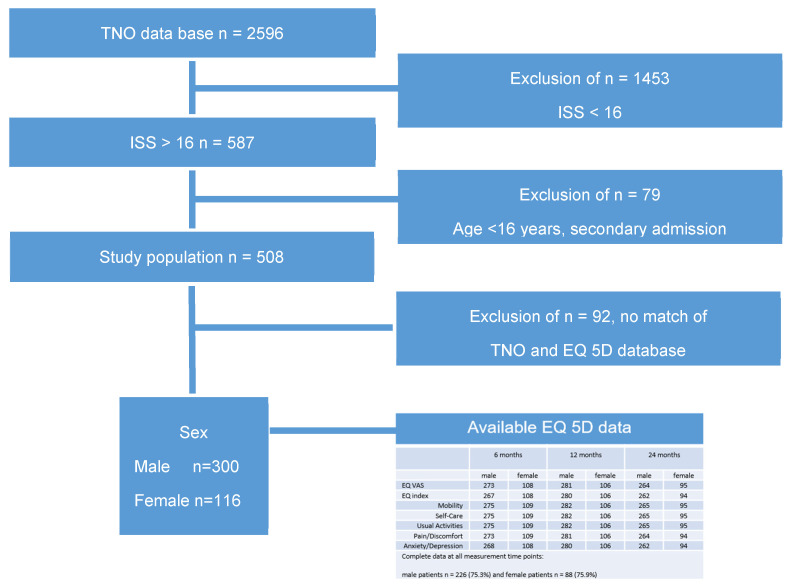
Background: Major trauma is a leading cause of severe disability and mortality. The influence of patient sex on outcome after severe trauma is a topic of ongoing discussion. We present a prospective multicenter study on the effects of trauma severity on health-related quality of life (HRQoL) of female patients. We hypothesized that the impairment of HRQoL after major trauma between the sexes depends not only on sex itself but also on age. Methods: This multicenter prospective registry-based observational study compared sex-based differences in HRQoL of patients who sustained major trauma Injury Severity Score (ISS ≥ 16). The HRQoL was assessed using the EQ-5D-3L (European Quality of Life 5-Dimension 3-Level Version) score over 2 years post-trauma. Results: We included 416 patients (116 female/300 male) with an ISS > 16 (median ISS 22 IQR 18/30). All patients had a lower HRQoL after trauma than the population norm. Increased AIS (Abbreviated Injury Scale) face and extremity scores and ASA (American Society of Anesthesiologists) scores showed a significant decrease in HRQoL. Even though the groups of female and male patients were comparable in injury severity, female patients reported significantly more problems on the anxiety and depression scales than male patients 6 months (p = 0.003) and 24 months (p = 0.044) after trauma (6 months: female 46% vs. male 30%; 24 months: female 44% vs. male 32%). We observed the greatest improvement in the EQ Index over time in patients between 16 and 39 years of age, especially female patients (0.78 to 0.87 in females under 39 years of age, compared to males in the same age group 0.76 to 0.81). Females over 65 years of age initially presented the lowest EQ Index of 0.62. It remained significantly lower over time and was lower compared to male patients of the same age group (female EQ Index after 24 months was 0.68 compared to men over the age of 65 who presented an EQ Index of 0.75). Conclusions: All patients included in this study presented a lower HRQoL after trauma than the population norm. Female patients under 39 years of age reported the most improvement. Females over 65 years of age showed a limited HRQoL, which remained significantly lower over time. Female patients reported significantly more anxiety and depression after major trauma than male patients. Thus, further development and methodologically rigorous testing of ortho-geriatric initiatives, psychosocial support, and prevention measures are required to improve the care after major trauma, particularly for the female elderly.
期刊介绍:
Healthcare (ISSN 2227-9032) is an international, peer-reviewed, open access journal (free for readers), which publishes original theoretical and empirical work in the interdisciplinary area of all aspects of medicine and health care research. Healthcare publishes Original Research Articles, Reviews, Case Reports, Research Notes and Short Communications. We encourage researchers to publish their experimental and theoretical results in as much detail as possible. For theoretical papers, full details of proofs must be provided so that the results can be checked; for experimental papers, full experimental details must be provided so that the results can be reproduced. Additionally, electronic files or software regarding the full details of the calculations, experimental procedure, etc., can be deposited along with the publication as “Supplementary Material”.






 京公网安备 11010802042870号
京ICP备2023020795号-1
京公网安备 11010802042870号
京ICP备2023020795号-1

 分享
分享
 求助内容:
求助内容: 应助结果提醒方式:
 扫码关注我们
