{"title":"单片氧化锆陶瓷颜色变化的影响因素述评","authors":"Ebru Binici Aygün, Esra Kaynak Öztürk, Ayşe Bilge Tülü, Bilge Turhan Bal, Seçil Karakoca Nemli, Merve Bankoğlu Güngör","doi":"10.3390/jfb16020058","DOIUrl":null,"url":null,"abstract":"<p><p>Zirconia restorations are widely used in dentistry due to their high esthetic expectations and physical durability. However, zirconia's opaque white color can compromise esthetics. Therefore, zirconia is often veneered with porcelain, but fractures may occur in the veneer layer. Monolithic zirconia restorations, which do not require porcelain veneering and offer higher translucency, have been developed to address this issue. Zirconia exists in three main crystal phases: monoclinic, tetragonal, and cubic. Metal oxides such as yttrium are added to stabilize the tetragonal phase at room temperature. 3Y-TZP contains 3 mol% yttrium and provides high mechanical strength but has poor optical properties. Recently, 4Y-PSZ and 5Y-PSZ ceramics, which offer better optical properties but lower mechanical strength, have been introduced. This review examines the factors affecting the color change in monolithic zirconia ceramics. These factors are categorized into six main groups: cement type and color, restoration thickness, substrate color, sintering, aging, and zirconia type. Cement type and color are crucial in determining the final shade, especially in thin restorations. Increased restoration thickness reduces the influence of the substrate color while the sintering temperature and process improve optical properties. These findings emphasize the importance of material selection and application processes in ensuring esthetic harmony in zirconia restorations. This review aims to bridge gaps in the literature by providing valuable insights that guide clinicians in selecting and applying zirconia materials to meet both esthetic and functional requirements in restorative dentistry.</p>","PeriodicalId":15767,"journal":{"name":"Journal of Functional Biomaterials","volume":"16 2","pages":""},"PeriodicalIF":5.2000,"publicationDate":"2025-02-11","publicationTypes":"Journal Article","fieldsOfStudy":null,"isOpenAccess":false,"openAccessPdf":"https://www.ncbi.nlm.nih.gov/pmc/articles/PMC11855960/pdf/","citationCount":"0","resultStr":"{\"title\":\"Factors Affecting the Color Change of Monolithic Zirconia Ceramics: A Narrative Review.\",\"authors\":\"Ebru Binici Aygün, Esra Kaynak Öztürk, Ayşe Bilge Tülü, Bilge Turhan Bal, Seçil Karakoca Nemli, Merve Bankoğlu Güngör\",\"doi\":\"10.3390/jfb16020058\",\"DOIUrl\":null,\"url\":null,\"abstract\":\"<p><p>Zirconia restorations are widely used in dentistry due to their high esthetic expectations and physical durability. However, zirconia's opaque white color can compromise esthetics. Therefore, zirconia is often veneered with porcelain, but fractures may occur in the veneer layer. Monolithic zirconia restorations, which do not require porcelain veneering and offer higher translucency, have been developed to address this issue. Zirconia exists in three main crystal phases: monoclinic, tetragonal, and cubic. Metal oxides such as yttrium are added to stabilize the tetragonal phase at room temperature. 3Y-TZP contains 3 mol% yttrium and provides high mechanical strength but has poor optical properties. Recently, 4Y-PSZ and 5Y-PSZ ceramics, which offer better optical properties but lower mechanical strength, have been introduced. This review examines the factors affecting the color change in monolithic zirconia ceramics. These factors are categorized into six main groups: cement type and color, restoration thickness, substrate color, sintering, aging, and zirconia type. Cement type and color are crucial in determining the final shade, especially in thin restorations. Increased restoration thickness reduces the influence of the substrate color while the sintering temperature and process improve optical properties. These findings emphasize the importance of material selection and application processes in ensuring esthetic harmony in zirconia restorations. This review aims to bridge gaps in the literature by providing valuable insights that guide clinicians in selecting and applying zirconia materials to meet both esthetic and functional requirements in restorative dentistry.</p>\",\"PeriodicalId\":15767,\"journal\":{\"name\":\"Journal of Functional Biomaterials\",\"volume\":\"16 2\",\"pages\":\"\"},\"PeriodicalIF\":5.2000,\"publicationDate\":\"2025-02-11\",\"publicationTypes\":\"Journal Article\",\"fieldsOfStudy\":null,\"isOpenAccess\":false,\"openAccessPdf\":\"https://www.ncbi.nlm.nih.gov/pmc/articles/PMC11855960/pdf/\",\"citationCount\":\"0\",\"resultStr\":null,\"platform\":\"Semanticscholar\",\"paperid\":null,\"PeriodicalName\":\"Journal of Functional Biomaterials\",\"FirstCategoryId\":\"5\",\"ListUrlMain\":\"https://doi.org/10.3390/jfb16020058\",\"RegionNum\":3,\"RegionCategory\":\"医学\",\"ArticlePicture\":[],\"TitleCN\":null,\"AbstractTextCN\":null,\"PMCID\":null,\"EPubDate\":\"\",\"PubModel\":\"\",\"JCR\":\"Q1\",\"JCRName\":\"ENGINEERING, BIOMEDICAL\",\"Score\":null,\"Total\":0}","platform":"Semanticscholar","paperid":null,"PeriodicalName":"Journal of Functional Biomaterials","FirstCategoryId":"5","ListUrlMain":"https://doi.org/10.3390/jfb16020058","RegionNum":3,"RegionCategory":"医学","ArticlePicture":[],"TitleCN":null,"AbstractTextCN":null,"PMCID":null,"EPubDate":"","PubModel":"","JCR":"Q1","JCRName":"ENGINEERING, BIOMEDICAL","Score":null,"Total":0}
Factors Affecting the Color Change of Monolithic Zirconia Ceramics: A Narrative Review.
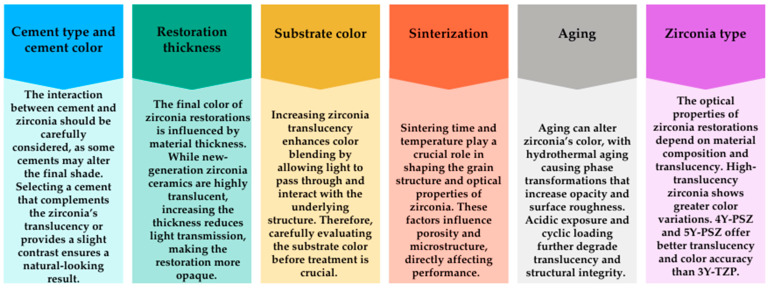
Zirconia restorations are widely used in dentistry due to their high esthetic expectations and physical durability. However, zirconia's opaque white color can compromise esthetics. Therefore, zirconia is often veneered with porcelain, but fractures may occur in the veneer layer. Monolithic zirconia restorations, which do not require porcelain veneering and offer higher translucency, have been developed to address this issue. Zirconia exists in three main crystal phases: monoclinic, tetragonal, and cubic. Metal oxides such as yttrium are added to stabilize the tetragonal phase at room temperature. 3Y-TZP contains 3 mol% yttrium and provides high mechanical strength but has poor optical properties. Recently, 4Y-PSZ and 5Y-PSZ ceramics, which offer better optical properties but lower mechanical strength, have been introduced. This review examines the factors affecting the color change in monolithic zirconia ceramics. These factors are categorized into six main groups: cement type and color, restoration thickness, substrate color, sintering, aging, and zirconia type. Cement type and color are crucial in determining the final shade, especially in thin restorations. Increased restoration thickness reduces the influence of the substrate color while the sintering temperature and process improve optical properties. These findings emphasize the importance of material selection and application processes in ensuring esthetic harmony in zirconia restorations. This review aims to bridge gaps in the literature by providing valuable insights that guide clinicians in selecting and applying zirconia materials to meet both esthetic and functional requirements in restorative dentistry.
期刊介绍:
Journal of Functional Biomaterials (JFB, ISSN 2079-4983) is an international and interdisciplinary scientific journal that publishes regular research papers (articles), reviews and short communications about applications of materials for biomedical use. JFB covers subjects from chemistry, pharmacy, biology, physics over to engineering. The journal focuses on the preparation, performance and use of functional biomaterials in biomedical devices and their behaviour in physiological environments. Our aim is to encourage scientists to publish their results in as much detail as possible. Therefore, there is no restriction on the length of the papers. The full experimental details must be provided so that the results can be reproduced. Several topical special issues will be published. Scope: adhesion, adsorption, biocompatibility, biohybrid materials, bio-inert materials, biomaterials, biomedical devices, biomimetic materials, bone repair, cardiovascular devices, ceramics, composite materials, dental implants, dental materials, drug delivery systems, functional biopolymers, glasses, hyper branched polymers, molecularly imprinted polymers (MIPs), nanomedicine, nanoparticles, nanotechnology, natural materials, self-assembly smart materials, stimuli responsive materials, surface modification, tissue devices, tissue engineering, tissue-derived materials, urological devices.






 京公网安备 11010802042870号
京ICP备2023020795号-1
京公网安备 11010802042870号
京ICP备2023020795号-1

 分享
分享
 求助内容:
求助内容: 应助结果提醒方式:
 扫码关注我们
