Heloiza A Boaventura, Lidiane A Queirós, José Francisco A Silva, Tarryn A Goble, Kelly Pazolini, Allan F Marciano, Eliane D Quintela
{"title":"巴西适宜使用爪哇冬虫夏草防治粉虱地理区域的温度依赖模型和空间预测。","authors":"Heloiza A Boaventura, Lidiane A Queirós, José Francisco A Silva, Tarryn A Goble, Kelly Pazolini, Allan F Marciano, Eliane D Quintela","doi":"10.3390/jof11020125","DOIUrl":null,"url":null,"abstract":"<p><p>Lalguard C99 WP, based on the <i>Cordyceps javanica</i> BRM 27666 strain, is registered in Brazil for whitefly control. Spatial prediction is crucial for optimizing its field use and efficacy. In this study, the optimal temperature for mycelial growth and conidial production of <i>C. javanica is</i> 25-30 °C, with no growth at 33-35 °C. The highest nymphal mortality occurred at 25 and 30 °C, showing lower LT<sub>50</sub> values at 30 °C. Mycelial growth was similar at 15, 20, 25, 30, and 35 °C when the fungus was exposed for 6 h and then transferred to a 27.4 °C environment; however, growth was slower at 35 °C with daily 6 h exposure alternating over 18 h at room temperature (mean of 28.5 °C). When the second instar whitefly nymphs were exposed for 6 h or 6 h daily at 15, 20, 25, 30, and 35 °C, followed by 7 days at fluctuating temperatures (mean of 28.4-30.2 °C), nymphal mortality was similar across temperatures. Although other abiotic factors (solar radiation, humidity, rainfall, etc.) must be considered for fungal efficacy, spatial predictions based on fluctuating temperatures indicated that <i>C. javanica</i> is suitable for use throughout Brazil, though its performance varied at constant temperatures in different locations.</p>","PeriodicalId":15878,"journal":{"name":"Journal of Fungi","volume":"11 2","pages":""},"PeriodicalIF":4.2000,"publicationDate":"2025-02-08","publicationTypes":"Journal Article","fieldsOfStudy":null,"isOpenAccess":false,"openAccessPdf":"https://www.ncbi.nlm.nih.gov/pmc/articles/PMC11856224/pdf/","citationCount":"0","resultStr":"{\"title\":\"Temperature-Dependent Modeling and Spatial Predictions for Identifying Geographical Areas in Brazil Suitable for the Use of <i>Cordyceps javanica</i> in Whitefly Control.\",\"authors\":\"Heloiza A Boaventura, Lidiane A Queirós, José Francisco A Silva, Tarryn A Goble, Kelly Pazolini, Allan F Marciano, Eliane D Quintela\",\"doi\":\"10.3390/jof11020125\",\"DOIUrl\":null,\"url\":null,\"abstract\":\"<p><p>Lalguard C99 WP, based on the <i>Cordyceps javanica</i> BRM 27666 strain, is registered in Brazil for whitefly control. Spatial prediction is crucial for optimizing its field use and efficacy. In this study, the optimal temperature for mycelial growth and conidial production of <i>C. javanica is</i> 25-30 °C, with no growth at 33-35 °C. The highest nymphal mortality occurred at 25 and 30 °C, showing lower LT<sub>50</sub> values at 30 °C. Mycelial growth was similar at 15, 20, 25, 30, and 35 °C when the fungus was exposed for 6 h and then transferred to a 27.4 °C environment; however, growth was slower at 35 °C with daily 6 h exposure alternating over 18 h at room temperature (mean of 28.5 °C). When the second instar whitefly nymphs were exposed for 6 h or 6 h daily at 15, 20, 25, 30, and 35 °C, followed by 7 days at fluctuating temperatures (mean of 28.4-30.2 °C), nymphal mortality was similar across temperatures. Although other abiotic factors (solar radiation, humidity, rainfall, etc.) must be considered for fungal efficacy, spatial predictions based on fluctuating temperatures indicated that <i>C. javanica</i> is suitable for use throughout Brazil, though its performance varied at constant temperatures in different locations.</p>\",\"PeriodicalId\":15878,\"journal\":{\"name\":\"Journal of Fungi\",\"volume\":\"11 2\",\"pages\":\"\"},\"PeriodicalIF\":4.2000,\"publicationDate\":\"2025-02-08\",\"publicationTypes\":\"Journal Article\",\"fieldsOfStudy\":null,\"isOpenAccess\":false,\"openAccessPdf\":\"https://www.ncbi.nlm.nih.gov/pmc/articles/PMC11856224/pdf/\",\"citationCount\":\"0\",\"resultStr\":null,\"platform\":\"Semanticscholar\",\"paperid\":null,\"PeriodicalName\":\"Journal of Fungi\",\"FirstCategoryId\":\"99\",\"ListUrlMain\":\"https://doi.org/10.3390/jof11020125\",\"RegionNum\":2,\"RegionCategory\":\"生物学\",\"ArticlePicture\":[],\"TitleCN\":null,\"AbstractTextCN\":null,\"PMCID\":null,\"EPubDate\":\"\",\"PubModel\":\"\",\"JCR\":\"Q2\",\"JCRName\":\"MICROBIOLOGY\",\"Score\":null,\"Total\":0}","platform":"Semanticscholar","paperid":null,"PeriodicalName":"Journal of Fungi","FirstCategoryId":"99","ListUrlMain":"https://doi.org/10.3390/jof11020125","RegionNum":2,"RegionCategory":"生物学","ArticlePicture":[],"TitleCN":null,"AbstractTextCN":null,"PMCID":null,"EPubDate":"","PubModel":"","JCR":"Q2","JCRName":"MICROBIOLOGY","Score":null,"Total":0}
Temperature-Dependent Modeling and Spatial Predictions for Identifying Geographical Areas in Brazil Suitable for the Use of Cordyceps javanica in Whitefly Control.
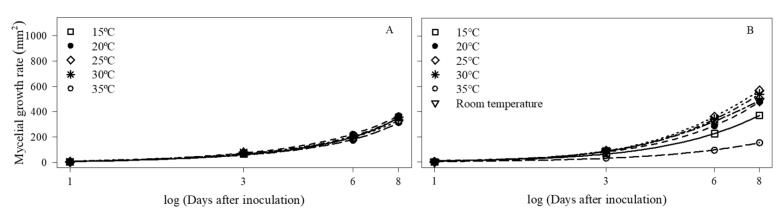
Lalguard C99 WP, based on the Cordyceps javanica BRM 27666 strain, is registered in Brazil for whitefly control. Spatial prediction is crucial for optimizing its field use and efficacy. In this study, the optimal temperature for mycelial growth and conidial production of C. javanica is 25-30 °C, with no growth at 33-35 °C. The highest nymphal mortality occurred at 25 and 30 °C, showing lower LT50 values at 30 °C. Mycelial growth was similar at 15, 20, 25, 30, and 35 °C when the fungus was exposed for 6 h and then transferred to a 27.4 °C environment; however, growth was slower at 35 °C with daily 6 h exposure alternating over 18 h at room temperature (mean of 28.5 °C). When the second instar whitefly nymphs were exposed for 6 h or 6 h daily at 15, 20, 25, 30, and 35 °C, followed by 7 days at fluctuating temperatures (mean of 28.4-30.2 °C), nymphal mortality was similar across temperatures. Although other abiotic factors (solar radiation, humidity, rainfall, etc.) must be considered for fungal efficacy, spatial predictions based on fluctuating temperatures indicated that C. javanica is suitable for use throughout Brazil, though its performance varied at constant temperatures in different locations.
期刊介绍:
Journal of Fungi (ISSN 2309-608X) is an international, peer-reviewed scientific open access journal that provides an advanced forum for studies related to pathogenic fungi, fungal biology, and all other aspects of fungal research. The journal publishes reviews, regular research papers, and communications in quarterly issues. Our aim is to encourage scientists to publish their experimental and theoretical results in as much detail as possible. Therefore, there is no restriction on paper length. Full experimental details must be provided so that the results can be reproduced.






 京公网安备 11010802042870号
京ICP备2023020795号-1
京公网安备 11010802042870号
京ICP备2023020795号-1

 分享
分享
 求助内容:
求助内容: 应助结果提醒方式:
 扫码关注我们
