Kevin X Liu, Mia Salans, Teresa P Easwaran, Christina Phuong, Kee Kiat Yeo, Hesham Elhalawani, Paul J Catalano, Kathryn Dusenbery, Karen J Marcus, Stephanie A Terezakis, Daphne A Haas-Kogan, Steve E Braunstein
{"title":"儿童和青少年室管膜瘤术后光子放疗剂量与疾病控制和抢救治疗的关系:一项多机构调查","authors":"Kevin X Liu, Mia Salans, Teresa P Easwaran, Christina Phuong, Kee Kiat Yeo, Hesham Elhalawani, Paul J Catalano, Kathryn Dusenbery, Karen J Marcus, Stephanie A Terezakis, Daphne A Haas-Kogan, Steve E Braunstein","doi":"10.1007/s11060-025-04975-5","DOIUrl":null,"url":null,"abstract":"<p><strong>Purpose: </strong>We characterized the association between photon radiation dose (< 59.4 versus ≥ 59.4 Gy) and outcomes in intracranial ependymoma. We also examined factors associated with survival after relapse.</p><p><strong>Methods: </strong>This multi-institutional retrospective study included patients age ≤ 21 years who received postoperative definitive-intent photon radiotherapy for posterior fossa ependymoma between 1997 and 2021. Clinical characteristics were obtained from medical records. Five-year overall (OS) and progression-free (PFS) survival were estimated using the Kaplan-Meier method. Factors associated with progression after radiotherapy, including dose < 59.4 versus ≥ 59.4 Gy, were analyzed using Fine and Gray's proportional subhazards model. Factors associated with post-relapse survival were explored using the Cox proportional-hazards model.</p><p><strong>Results: </strong>We identified 45 patients meeting inclusion criteria; 48.9% received ≥ 59.4 Gy. There was no difference in 5-year OS or PFS between those who received < 59.4 Gy versus ≥ 59.4 (OS 49.0% vs. 82.9%, p = 0.11; PFS 36.4% vs. 63.9%, p = 0.08); however, there was a trend towards worse 5-year OS and PFS among patients with grade 2 ependymoma who received < 59.4 Gy (OS 48.8% vs. 88.9%, p = 0.06, PFS 40.0% vs. 83.1%, p = 0.08). Only age > 4 years at diagnosis (subdistribution hazard ratio [SHR]: 0.40, p = 0.03) was associated lower risk of progression. Following radiotherapy, 24 patients relapsed. Receipt of salvage systemic therapy was associated with worse post-relapse OS on multivariable analysis (HR = 2.84, p = 0.04).</p><p><strong>Conclusion: </strong>Underlying biological factors such as age and molecular subtype may hold greater prognostic significance than radiation dose in pediatric ependymoma. Regardless, recurrences are common and outcomes remain poor. Further research into optimal management of relapsed disease is critical.</p>","PeriodicalId":16425,"journal":{"name":"Journal of Neuro-Oncology","volume":" ","pages":"167-177"},"PeriodicalIF":3.4000,"publicationDate":"2025-05-01","publicationTypes":"Journal Article","fieldsOfStudy":null,"isOpenAccess":false,"openAccessPdf":"https://www.ncbi.nlm.nih.gov/pmc/articles/PMC12040991/pdf/","citationCount":"0","resultStr":"{\"title\":\"The association between postoperative photon radiotherapy dose and disease control and salvage treatment in pediatric and adolescent ependymoma: a multi-institutional investigation.\",\"authors\":\"Kevin X Liu, Mia Salans, Teresa P Easwaran, Christina Phuong, Kee Kiat Yeo, Hesham Elhalawani, Paul J Catalano, Kathryn Dusenbery, Karen J Marcus, Stephanie A Terezakis, Daphne A Haas-Kogan, Steve E Braunstein\",\"doi\":\"10.1007/s11060-025-04975-5\",\"DOIUrl\":null,\"url\":null,\"abstract\":\"<p><strong>Purpose: </strong>We characterized the association between photon radiation dose (< 59.4 versus ≥ 59.4 Gy) and outcomes in intracranial ependymoma. We also examined factors associated with survival after relapse.</p><p><strong>Methods: </strong>This multi-institutional retrospective study included patients age ≤ 21 years who received postoperative definitive-intent photon radiotherapy for posterior fossa ependymoma between 1997 and 2021. Clinical characteristics were obtained from medical records. Five-year overall (OS) and progression-free (PFS) survival were estimated using the Kaplan-Meier method. Factors associated with progression after radiotherapy, including dose < 59.4 versus ≥ 59.4 Gy, were analyzed using Fine and Gray's proportional subhazards model. Factors associated with post-relapse survival were explored using the Cox proportional-hazards model.</p><p><strong>Results: </strong>We identified 45 patients meeting inclusion criteria; 48.9% received ≥ 59.4 Gy. There was no difference in 5-year OS or PFS between those who received < 59.4 Gy versus ≥ 59.4 (OS 49.0% vs. 82.9%, p = 0.11; PFS 36.4% vs. 63.9%, p = 0.08); however, there was a trend towards worse 5-year OS and PFS among patients with grade 2 ependymoma who received < 59.4 Gy (OS 48.8% vs. 88.9%, p = 0.06, PFS 40.0% vs. 83.1%, p = 0.08). Only age > 4 years at diagnosis (subdistribution hazard ratio [SHR]: 0.40, p = 0.03) was associated lower risk of progression. Following radiotherapy, 24 patients relapsed. Receipt of salvage systemic therapy was associated with worse post-relapse OS on multivariable analysis (HR = 2.84, p = 0.04).</p><p><strong>Conclusion: </strong>Underlying biological factors such as age and molecular subtype may hold greater prognostic significance than radiation dose in pediatric ependymoma. Regardless, recurrences are common and outcomes remain poor. Further research into optimal management of relapsed disease is critical.</p>\",\"PeriodicalId\":16425,\"journal\":{\"name\":\"Journal of Neuro-Oncology\",\"volume\":\" \",\"pages\":\"167-177\"},\"PeriodicalIF\":3.4000,\"publicationDate\":\"2025-05-01\",\"publicationTypes\":\"Journal Article\",\"fieldsOfStudy\":null,\"isOpenAccess\":false,\"openAccessPdf\":\"https://www.ncbi.nlm.nih.gov/pmc/articles/PMC12040991/pdf/\",\"citationCount\":\"0\",\"resultStr\":null,\"platform\":\"Semanticscholar\",\"paperid\":null,\"PeriodicalName\":\"Journal of Neuro-Oncology\",\"FirstCategoryId\":\"3\",\"ListUrlMain\":\"https://doi.org/10.1007/s11060-025-04975-5\",\"RegionNum\":2,\"RegionCategory\":\"医学\",\"ArticlePicture\":[],\"TitleCN\":null,\"AbstractTextCN\":null,\"PMCID\":null,\"EPubDate\":\"2025/2/25 0:00:00\",\"PubModel\":\"Epub\",\"JCR\":\"Q2\",\"JCRName\":\"CLINICAL NEUROLOGY\",\"Score\":null,\"Total\":0}","platform":"Semanticscholar","paperid":null,"PeriodicalName":"Journal of Neuro-Oncology","FirstCategoryId":"3","ListUrlMain":"https://doi.org/10.1007/s11060-025-04975-5","RegionNum":2,"RegionCategory":"医学","ArticlePicture":[],"TitleCN":null,"AbstractTextCN":null,"PMCID":null,"EPubDate":"2025/2/25 0:00:00","PubModel":"Epub","JCR":"Q2","JCRName":"CLINICAL NEUROLOGY","Score":null,"Total":0}
引用次数: 0
摘要
目的:我们描述了光子辐射剂量之间的关系(方法:这项多机构回顾性研究纳入了1997年至2021年间接受后窝室管膜瘤术后明确意图光子放疗的年龄≤21岁的患者。临床特征从病历中获得。使用Kaplan-Meier方法估计5年总生存期(OS)和无进展生存期(PFS)。放疗后进展相关因素,包括剂量结果:我们确定了45例符合纳入标准的患者;48.9%接受≥59.4 Gy。诊断时接受4年治疗的患者的5年OS和PFS无差异(亚分布风险比[SHR]: 0.40, p = 0.03),进展风险较低。放疗后24例复发。多变量分析显示,接受补救性全身治疗与复发后较差的OS相关(HR = 2.84, p = 0.04)。结论:儿童室管膜瘤的潜在生物学因素如年龄和分子亚型可能比放射剂量具有更大的预后意义。无论如何,复发是常见的,结果仍然很差。进一步研究复发疾病的最佳管理是至关重要的。
The association between postoperative photon radiotherapy dose and disease control and salvage treatment in pediatric and adolescent ependymoma: a multi-institutional investigation.
Purpose: We characterized the association between photon radiation dose (< 59.4 versus ≥ 59.4 Gy) and outcomes in intracranial ependymoma. We also examined factors associated with survival after relapse.
Methods: This multi-institutional retrospective study included patients age ≤ 21 years who received postoperative definitive-intent photon radiotherapy for posterior fossa ependymoma between 1997 and 2021. Clinical characteristics were obtained from medical records. Five-year overall (OS) and progression-free (PFS) survival were estimated using the Kaplan-Meier method. Factors associated with progression after radiotherapy, including dose < 59.4 versus ≥ 59.4 Gy, were analyzed using Fine and Gray's proportional subhazards model. Factors associated with post-relapse survival were explored using the Cox proportional-hazards model.
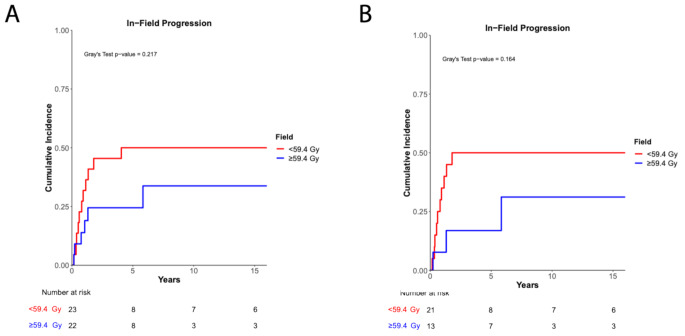
Results: We identified 45 patients meeting inclusion criteria; 48.9% received ≥ 59.4 Gy. There was no difference in 5-year OS or PFS between those who received < 59.4 Gy versus ≥ 59.4 (OS 49.0% vs. 82.9%, p = 0.11; PFS 36.4% vs. 63.9%, p = 0.08); however, there was a trend towards worse 5-year OS and PFS among patients with grade 2 ependymoma who received < 59.4 Gy (OS 48.8% vs. 88.9%, p = 0.06, PFS 40.0% vs. 83.1%, p = 0.08). Only age > 4 years at diagnosis (subdistribution hazard ratio [SHR]: 0.40, p = 0.03) was associated lower risk of progression. Following radiotherapy, 24 patients relapsed. Receipt of salvage systemic therapy was associated with worse post-relapse OS on multivariable analysis (HR = 2.84, p = 0.04).
Conclusion: Underlying biological factors such as age and molecular subtype may hold greater prognostic significance than radiation dose in pediatric ependymoma. Regardless, recurrences are common and outcomes remain poor. Further research into optimal management of relapsed disease is critical.
期刊介绍:
The Journal of Neuro-Oncology is a multi-disciplinary journal encompassing basic, applied, and clinical investigations in all research areas as they relate to cancer and the central nervous system. It provides a single forum for communication among neurologists, neurosurgeons, radiotherapists, medical oncologists, neuropathologists, neurodiagnosticians, and laboratory-based oncologists conducting relevant research. The Journal of Neuro-Oncology does not seek to isolate the field, but rather to focus the efforts of many disciplines in one publication through a format which pulls together these diverse interests. More than any other field of oncology, cancer of the central nervous system requires multi-disciplinary approaches. To alleviate having to scan dozens of journals of cell biology, pathology, laboratory and clinical endeavours, JNO is a periodical in which current, high-quality, relevant research in all aspects of neuro-oncology may be found.





 京公网安备 11010802042870号
京ICP备2023020795号-1
京公网安备 11010802042870号
京ICP备2023020795号-1

 分享
分享
 求助内容:
求助内容: 应助结果提醒方式:
 扫码关注我们
