Dandan Peng, Yajing Zhu, Lu Liu, Jianfeng Zhang, Peng Huang, Shaowen Bai, Xinyao Wang, Kun Yang
{"title":"非洲血吸虫病负担和趋势分析:来自2021年全球疾病负担研究的见解。","authors":"Dandan Peng, Yajing Zhu, Lu Liu, Jianfeng Zhang, Peng Huang, Shaowen Bai, Xinyao Wang, Kun Yang","doi":"10.3390/tropicalmed10020042","DOIUrl":null,"url":null,"abstract":"<p><p>Schistosomiasis remains a major public health concern in Africa, despite global efforts to eliminate the disease by 2030. This study estimates the burden, trends, and inequalities of schistosomiasis in Africa from 1990 to 2021, and projects future prevalence to inform the WHO's elimination strategies. Data from the Global Burden of Disease Study (GBD 2021) were used to calculate annual average percentage change (AAPC) and annual percentage change (APC), with spatial global autocorrelation analysis performed to examine temporal and spatial trends. Five modeling algorithms were constructed to predict disease burden in Africa from 2022 to 2041. The age-standardized prevalences rate (ASPR) of schistosomiasis in Africa decreased from 18,495.51 per 100,000 in 1990 to 9,461.76 per 100,000 in 2021. The total number of cases, disability-adjusted life-years (DALYs), and mortality accounted for 84.25%, 87.92% and 87.28% of the global totals, respectively. ARIMA modeling predicts that by 2030, the ASPR will reach 3.99%. Despite progress, the burden remains significant, and intensified efforts are needed, particularly in high-burden regions like West Africa, to meet the WHO's 2030 elimination targets.</p>","PeriodicalId":23330,"journal":{"name":"Tropical Medicine and Infectious Disease","volume":"10 2","pages":""},"PeriodicalIF":3.1000,"publicationDate":"2025-02-03","publicationTypes":"Journal Article","fieldsOfStudy":null,"isOpenAccess":false,"openAccessPdf":"https://www.ncbi.nlm.nih.gov/pmc/articles/PMC11860299/pdf/","citationCount":"0","resultStr":"{\"title\":\"Schistosomiasis Burden and Trend Analysis in Africa: Insights from the Global Burden of Disease Study 2021.\",\"authors\":\"Dandan Peng, Yajing Zhu, Lu Liu, Jianfeng Zhang, Peng Huang, Shaowen Bai, Xinyao Wang, Kun Yang\",\"doi\":\"10.3390/tropicalmed10020042\",\"DOIUrl\":null,\"url\":null,\"abstract\":\"<p><p>Schistosomiasis remains a major public health concern in Africa, despite global efforts to eliminate the disease by 2030. This study estimates the burden, trends, and inequalities of schistosomiasis in Africa from 1990 to 2021, and projects future prevalence to inform the WHO's elimination strategies. Data from the Global Burden of Disease Study (GBD 2021) were used to calculate annual average percentage change (AAPC) and annual percentage change (APC), with spatial global autocorrelation analysis performed to examine temporal and spatial trends. Five modeling algorithms were constructed to predict disease burden in Africa from 2022 to 2041. The age-standardized prevalences rate (ASPR) of schistosomiasis in Africa decreased from 18,495.51 per 100,000 in 1990 to 9,461.76 per 100,000 in 2021. The total number of cases, disability-adjusted life-years (DALYs), and mortality accounted for 84.25%, 87.92% and 87.28% of the global totals, respectively. ARIMA modeling predicts that by 2030, the ASPR will reach 3.99%. Despite progress, the burden remains significant, and intensified efforts are needed, particularly in high-burden regions like West Africa, to meet the WHO's 2030 elimination targets.</p>\",\"PeriodicalId\":23330,\"journal\":{\"name\":\"Tropical Medicine and Infectious Disease\",\"volume\":\"10 2\",\"pages\":\"\"},\"PeriodicalIF\":3.1000,\"publicationDate\":\"2025-02-03\",\"publicationTypes\":\"Journal Article\",\"fieldsOfStudy\":null,\"isOpenAccess\":false,\"openAccessPdf\":\"https://www.ncbi.nlm.nih.gov/pmc/articles/PMC11860299/pdf/\",\"citationCount\":\"0\",\"resultStr\":null,\"platform\":\"Semanticscholar\",\"paperid\":null,\"PeriodicalName\":\"Tropical Medicine and Infectious Disease\",\"FirstCategoryId\":\"3\",\"ListUrlMain\":\"https://doi.org/10.3390/tropicalmed10020042\",\"RegionNum\":4,\"RegionCategory\":\"医学\",\"ArticlePicture\":[],\"TitleCN\":null,\"AbstractTextCN\":null,\"PMCID\":null,\"EPubDate\":\"\",\"PubModel\":\"\",\"JCR\":\"Q2\",\"JCRName\":\"INFECTIOUS DISEASES\",\"Score\":null,\"Total\":0}","platform":"Semanticscholar","paperid":null,"PeriodicalName":"Tropical Medicine and Infectious Disease","FirstCategoryId":"3","ListUrlMain":"https://doi.org/10.3390/tropicalmed10020042","RegionNum":4,"RegionCategory":"医学","ArticlePicture":[],"TitleCN":null,"AbstractTextCN":null,"PMCID":null,"EPubDate":"","PubModel":"","JCR":"Q2","JCRName":"INFECTIOUS DISEASES","Score":null,"Total":0}
Schistosomiasis Burden and Trend Analysis in Africa: Insights from the Global Burden of Disease Study 2021.
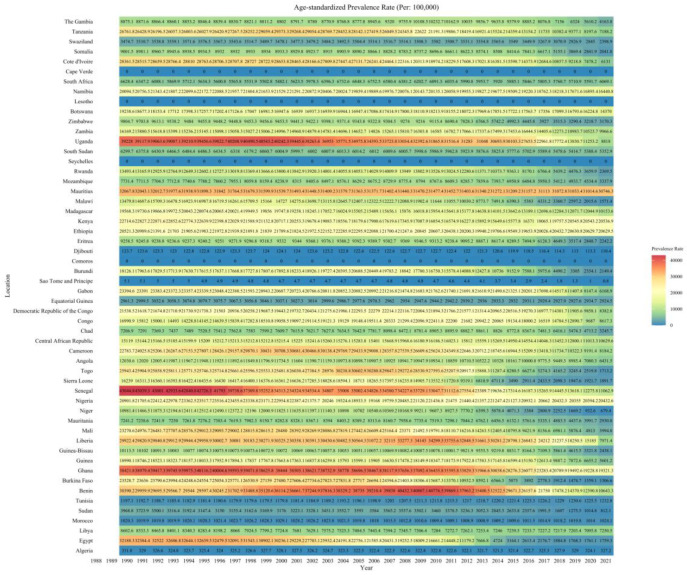
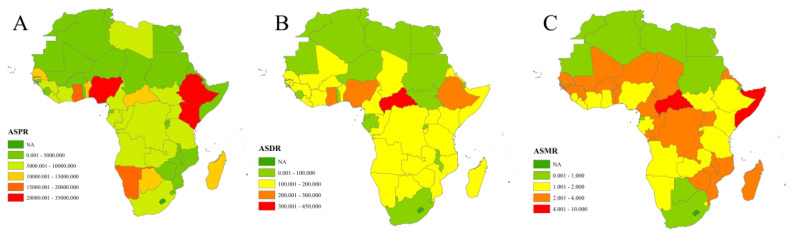
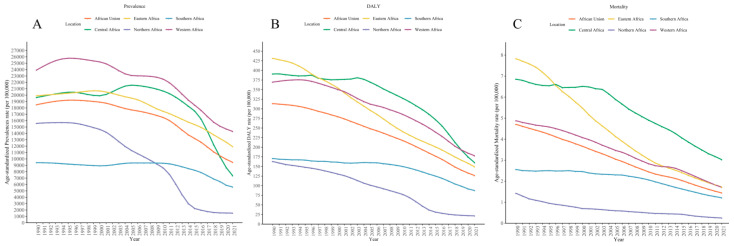
Schistosomiasis remains a major public health concern in Africa, despite global efforts to eliminate the disease by 2030. This study estimates the burden, trends, and inequalities of schistosomiasis in Africa from 1990 to 2021, and projects future prevalence to inform the WHO's elimination strategies. Data from the Global Burden of Disease Study (GBD 2021) were used to calculate annual average percentage change (AAPC) and annual percentage change (APC), with spatial global autocorrelation analysis performed to examine temporal and spatial trends. Five modeling algorithms were constructed to predict disease burden in Africa from 2022 to 2041. The age-standardized prevalences rate (ASPR) of schistosomiasis in Africa decreased from 18,495.51 per 100,000 in 1990 to 9,461.76 per 100,000 in 2021. The total number of cases, disability-adjusted life-years (DALYs), and mortality accounted for 84.25%, 87.92% and 87.28% of the global totals, respectively. ARIMA modeling predicts that by 2030, the ASPR will reach 3.99%. Despite progress, the burden remains significant, and intensified efforts are needed, particularly in high-burden regions like West Africa, to meet the WHO's 2030 elimination targets.





 京公网安备 11010802042870号
京ICP备2023020795号-1
京公网安备 11010802042870号
京ICP备2023020795号-1

 分享
分享
 求助内容:
求助内容: 应助结果提醒方式:
 扫码关注我们
