Yebo Feng;Jun Li;Jelena Mirkovic;Cong Wu;Chong Wang;Hao Ren;Jiahua Xu;Yang Liu
{"title":"揭开互联网的面纱:细粒度网络流量分析综述","authors":"Yebo Feng;Jun Li;Jelena Mirkovic;Cong Wu;Chong Wang;Hao Ren;Jiahua Xu;Yang Liu","doi":"10.1109/COMST.2025.3545541","DOIUrl":null,"url":null,"abstract":"Fine-grained traffic analysis (FGTA), as an advanced form of traffic analysis (TA), aims to analyze network traffic to deduce fine-grained information on or above the application layer, such as application-layer activities, fine-grained user behavior, or message content, even in the presence of traffic encryption or traffic obfuscation. Different from traditional TA, FGTA approaches are usually based on complicated processing pipelines or sophisticated data mining techniques such as deep learning or high-dimensional clustering, enabling them to discover subtle differences between different network traffic groups. Nowadays, with the increasingly complex Internet architecture, the increasingly frequent transmission of user data, and the widespread use of traffic encryption, FGTA is becoming an essential tool for both network administrators and attackers to gain different levels of visibility over the network. It plays a critical role in intrusion and anomaly detection, quality of experience investigation, user activity inference, website fingerprinting, location estimation, etc. To help scholars and developers research and advance this technology, in this survey paper, we examine the literature that deals with FGTA, investigating the frontier developments in this domain. By comprehensively surveying different approaches toward FGTA, we introduce their input traffic data, elaborate on their operating principles by different use cases, indicate their limitations and countermeasures, and raise several promising future research avenues.","PeriodicalId":55029,"journal":{"name":"IEEE Communications Surveys and Tutorials","volume":"27 6","pages":"3672-3709"},"PeriodicalIF":50.6000,"publicationDate":"2025-02-25","publicationTypes":"Journal Article","fieldsOfStudy":null,"isOpenAccess":false,"openAccessPdf":"","citationCount":"0","resultStr":"{\"title\":\"Unmasking the Internet: A Survey of Fine-Grained Network Traffic Analysis\",\"authors\":\"Yebo Feng;Jun Li;Jelena Mirkovic;Cong Wu;Chong Wang;Hao Ren;Jiahua Xu;Yang Liu\",\"doi\":\"10.1109/COMST.2025.3545541\",\"DOIUrl\":null,\"url\":null,\"abstract\":\"Fine-grained traffic analysis (FGTA), as an advanced form of traffic analysis (TA), aims to analyze network traffic to deduce fine-grained information on or above the application layer, such as application-layer activities, fine-grained user behavior, or message content, even in the presence of traffic encryption or traffic obfuscation. Different from traditional TA, FGTA approaches are usually based on complicated processing pipelines or sophisticated data mining techniques such as deep learning or high-dimensional clustering, enabling them to discover subtle differences between different network traffic groups. Nowadays, with the increasingly complex Internet architecture, the increasingly frequent transmission of user data, and the widespread use of traffic encryption, FGTA is becoming an essential tool for both network administrators and attackers to gain different levels of visibility over the network. It plays a critical role in intrusion and anomaly detection, quality of experience investigation, user activity inference, website fingerprinting, location estimation, etc. To help scholars and developers research and advance this technology, in this survey paper, we examine the literature that deals with FGTA, investigating the frontier developments in this domain. By comprehensively surveying different approaches toward FGTA, we introduce their input traffic data, elaborate on their operating principles by different use cases, indicate their limitations and countermeasures, and raise several promising future research avenues.\",\"PeriodicalId\":55029,\"journal\":{\"name\":\"IEEE Communications Surveys and Tutorials\",\"volume\":\"27 6\",\"pages\":\"3672-3709\"},\"PeriodicalIF\":50.6000,\"publicationDate\":\"2025-02-25\",\"publicationTypes\":\"Journal Article\",\"fieldsOfStudy\":null,\"isOpenAccess\":false,\"openAccessPdf\":\"\",\"citationCount\":\"0\",\"resultStr\":null,\"platform\":\"Semanticscholar\",\"paperid\":null,\"PeriodicalName\":\"IEEE Communications Surveys and Tutorials\",\"FirstCategoryId\":\"94\",\"ListUrlMain\":\"https://ieeexplore.ieee.org/document/10902364/\",\"RegionNum\":1,\"RegionCategory\":\"计算机科学\",\"ArticlePicture\":[],\"TitleCN\":null,\"AbstractTextCN\":null,\"PMCID\":null,\"EPubDate\":\"\",\"PubModel\":\"\",\"JCR\":\"Q1\",\"JCRName\":\"COMPUTER SCIENCE, INFORMATION SYSTEMS\",\"Score\":null,\"Total\":0}","platform":"Semanticscholar","paperid":null,"PeriodicalName":"IEEE Communications Surveys and Tutorials","FirstCategoryId":"94","ListUrlMain":"https://ieeexplore.ieee.org/document/10902364/","RegionNum":1,"RegionCategory":"计算机科学","ArticlePicture":[],"TitleCN":null,"AbstractTextCN":null,"PMCID":null,"EPubDate":"","PubModel":"","JCR":"Q1","JCRName":"COMPUTER SCIENCE, INFORMATION SYSTEMS","Score":null,"Total":0}
Unmasking the Internet: A Survey of Fine-Grained Network Traffic Analysis
Fine-grained traffic analysis (FGTA), as an advanced form of traffic analysis (TA), aims to analyze network traffic to deduce fine-grained information on or above the application layer, such as application-layer activities, fine-grained user behavior, or message content, even in the presence of traffic encryption or traffic obfuscation. Different from traditional TA, FGTA approaches are usually based on complicated processing pipelines or sophisticated data mining techniques such as deep learning or high-dimensional clustering, enabling them to discover subtle differences between different network traffic groups. Nowadays, with the increasingly complex Internet architecture, the increasingly frequent transmission of user data, and the widespread use of traffic encryption, FGTA is becoming an essential tool for both network administrators and attackers to gain different levels of visibility over the network. It plays a critical role in intrusion and anomaly detection, quality of experience investigation, user activity inference, website fingerprinting, location estimation, etc. To help scholars and developers research and advance this technology, in this survey paper, we examine the literature that deals with FGTA, investigating the frontier developments in this domain. By comprehensively surveying different approaches toward FGTA, we introduce their input traffic data, elaborate on their operating principles by different use cases, indicate their limitations and countermeasures, and raise several promising future research avenues.
期刊介绍:
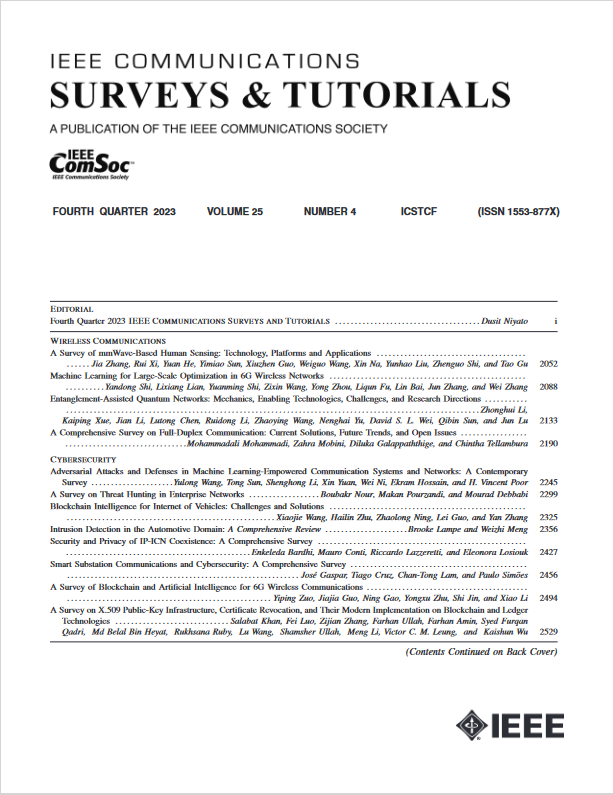
IEEE Communications Surveys & Tutorials is an online journal published by the IEEE Communications Society for tutorials and surveys covering all aspects of the communications field. Telecommunications technology is progressing at a rapid pace, and the IEEE Communications Society is committed to providing researchers and other professionals the information and tools to stay abreast. IEEE Communications Surveys and Tutorials focuses on integrating and adding understanding to the existing literature on communications, putting results in context. Whether searching for in-depth information about a familiar area or an introduction into a new area, IEEE Communications Surveys & Tutorials aims to be the premier source of peer-reviewed, comprehensive tutorials and surveys, and pointers to further sources. IEEE Communications Surveys & Tutorials publishes only articles exclusively written for IEEE Communications Surveys & Tutorials and go through a rigorous review process before their publication in the quarterly issues.
A tutorial article in the IEEE Communications Surveys & Tutorials should be designed to help the reader to become familiar with and learn something specific about a chosen topic. In contrast, the term survey, as applied here, is defined to mean a survey of the literature. A survey article in IEEE Communications Surveys & Tutorials should provide a comprehensive review of developments in a selected area, covering its development from its inception to its current state and beyond, and illustrating its development through liberal citations from the literature. Both tutorials and surveys should be tutorial in nature and should be written in a style comprehensible to readers outside the specialty of the article.




 京公网安备 11010802042870号
京ICP备2023020795号-1
京公网安备 11010802042870号
京ICP备2023020795号-1

 分享
分享
 求助内容:
求助内容: 应助结果提醒方式:
 扫码关注我们
