Yang Ju*, Guolong Zhang, Guangjie Wu, Feng Guo, Hongwei Zhou, Kai Wang and Suping Peng,
{"title":"致密砂岩超临界CO2压裂的三维裂缝网络形态和破裂压力:高温和地应力差的影响","authors":"Yang Ju*, Guolong Zhang, Guangjie Wu, Feng Guo, Hongwei Zhou, Kai Wang and Suping Peng, ","doi":"10.1021/acs.energyfuels.4c05194","DOIUrl":null,"url":null,"abstract":"<p >Supercritical CO<sub>2</sub> (SC-CO<sub>2</sub>) fracturing is a key technology for the development of unconventional tight reservoirs. With an increase in the extraction depth, both the temperature and the in situ stress of the reservoirs rise rapidly. Understanding and characterizing the effects of high temperature and in situ stress on fracture propagation during SC-CO<sub>2</sub> fracturing are crucial for optimizing this technique. However, few SC-CO<sub>2</sub> fracturing experiments under true triaxial loading conditions with temperatures up to 200 °C have been conducted. In this study, true triaxial fracturing tests were conducted on artificial tight reservoir sandstone specimens to explore the influence of different high temperatures and in situ stress differentials on SC-CO<sub>2</sub> fracturing behaviors. Using computed tomography and the U-net artificial intelligence algorithm, the 3D morphology of fracture networks and the breakdown pressure were quantitatively analyzed. Experimental results show that thermal shock induced by the temperature difference between the fracturing fluid and the rock matrix significantly affected the breakdown pressure and enhanced the complexity of fracture networks. Compared to conventional hydraulic fracturing, SC-CO<sub>2</sub> fracturing generated more complex and tortuous fracture networks, reducing the breakdown pressure by 16–24%. As the temperature increased, the number of branch fractures within the SC-CO<sub>2</sub> fracture network substantially increased, boosting fracture complexity by 8–9%, approximately. In contrast, as the horizontal stress differential increased, the complexity of SC-CO<sub>2</sub> fractures gradually decreased by 4–6%. These findings provide important insights into the mechanisms of fracture network propagation in SC-CO<sub>2</sub> fracturing of unconventional tight reservoirs at different depths.</p>","PeriodicalId":35,"journal":{"name":"Energy & Fuels","volume":"39 8","pages":"3820–3833 3820–3833"},"PeriodicalIF":5.3000,"publicationDate":"2025-02-16","publicationTypes":"Journal Article","fieldsOfStudy":null,"isOpenAccess":false,"openAccessPdf":"","citationCount":"0","resultStr":"{\"title\":\"3D Fracture Network Morphologies and Breakdown Pressure in Supercritical CO2 Fracturing of Tight Sandstones: Effects of High Temperatures and In Situ Stress Differentials\",\"authors\":\"Yang Ju*, Guolong Zhang, Guangjie Wu, Feng Guo, Hongwei Zhou, Kai Wang and Suping Peng, \",\"doi\":\"10.1021/acs.energyfuels.4c05194\",\"DOIUrl\":null,\"url\":null,\"abstract\":\"<p >Supercritical CO<sub>2</sub> (SC-CO<sub>2</sub>) fracturing is a key technology for the development of unconventional tight reservoirs. With an increase in the extraction depth, both the temperature and the in situ stress of the reservoirs rise rapidly. Understanding and characterizing the effects of high temperature and in situ stress on fracture propagation during SC-CO<sub>2</sub> fracturing are crucial for optimizing this technique. However, few SC-CO<sub>2</sub> fracturing experiments under true triaxial loading conditions with temperatures up to 200 °C have been conducted. In this study, true triaxial fracturing tests were conducted on artificial tight reservoir sandstone specimens to explore the influence of different high temperatures and in situ stress differentials on SC-CO<sub>2</sub> fracturing behaviors. Using computed tomography and the U-net artificial intelligence algorithm, the 3D morphology of fracture networks and the breakdown pressure were quantitatively analyzed. Experimental results show that thermal shock induced by the temperature difference between the fracturing fluid and the rock matrix significantly affected the breakdown pressure and enhanced the complexity of fracture networks. Compared to conventional hydraulic fracturing, SC-CO<sub>2</sub> fracturing generated more complex and tortuous fracture networks, reducing the breakdown pressure by 16–24%. As the temperature increased, the number of branch fractures within the SC-CO<sub>2</sub> fracture network substantially increased, boosting fracture complexity by 8–9%, approximately. In contrast, as the horizontal stress differential increased, the complexity of SC-CO<sub>2</sub> fractures gradually decreased by 4–6%. These findings provide important insights into the mechanisms of fracture network propagation in SC-CO<sub>2</sub> fracturing of unconventional tight reservoirs at different depths.</p>\",\"PeriodicalId\":35,\"journal\":{\"name\":\"Energy & Fuels\",\"volume\":\"39 8\",\"pages\":\"3820–3833 3820–3833\"},\"PeriodicalIF\":5.3000,\"publicationDate\":\"2025-02-16\",\"publicationTypes\":\"Journal Article\",\"fieldsOfStudy\":null,\"isOpenAccess\":false,\"openAccessPdf\":\"\",\"citationCount\":\"0\",\"resultStr\":null,\"platform\":\"Semanticscholar\",\"paperid\":null,\"PeriodicalName\":\"Energy & Fuels\",\"FirstCategoryId\":\"5\",\"ListUrlMain\":\"https://pubs.acs.org/doi/10.1021/acs.energyfuels.4c05194\",\"RegionNum\":3,\"RegionCategory\":\"工程技术\",\"ArticlePicture\":[],\"TitleCN\":null,\"AbstractTextCN\":null,\"PMCID\":null,\"EPubDate\":\"\",\"PubModel\":\"\",\"JCR\":\"Q2\",\"JCRName\":\"ENERGY & FUELS\",\"Score\":null,\"Total\":0}","platform":"Semanticscholar","paperid":null,"PeriodicalName":"Energy & Fuels","FirstCategoryId":"5","ListUrlMain":"https://pubs.acs.org/doi/10.1021/acs.energyfuels.4c05194","RegionNum":3,"RegionCategory":"工程技术","ArticlePicture":[],"TitleCN":null,"AbstractTextCN":null,"PMCID":null,"EPubDate":"","PubModel":"","JCR":"Q2","JCRName":"ENERGY & FUELS","Score":null,"Total":0}
3D Fracture Network Morphologies and Breakdown Pressure in Supercritical CO2 Fracturing of Tight Sandstones: Effects of High Temperatures and In Situ Stress Differentials
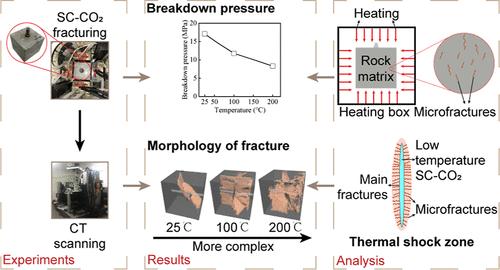
Supercritical CO2 (SC-CO2) fracturing is a key technology for the development of unconventional tight reservoirs. With an increase in the extraction depth, both the temperature and the in situ stress of the reservoirs rise rapidly. Understanding and characterizing the effects of high temperature and in situ stress on fracture propagation during SC-CO2 fracturing are crucial for optimizing this technique. However, few SC-CO2 fracturing experiments under true triaxial loading conditions with temperatures up to 200 °C have been conducted. In this study, true triaxial fracturing tests were conducted on artificial tight reservoir sandstone specimens to explore the influence of different high temperatures and in situ stress differentials on SC-CO2 fracturing behaviors. Using computed tomography and the U-net artificial intelligence algorithm, the 3D morphology of fracture networks and the breakdown pressure were quantitatively analyzed. Experimental results show that thermal shock induced by the temperature difference between the fracturing fluid and the rock matrix significantly affected the breakdown pressure and enhanced the complexity of fracture networks. Compared to conventional hydraulic fracturing, SC-CO2 fracturing generated more complex and tortuous fracture networks, reducing the breakdown pressure by 16–24%. As the temperature increased, the number of branch fractures within the SC-CO2 fracture network substantially increased, boosting fracture complexity by 8–9%, approximately. In contrast, as the horizontal stress differential increased, the complexity of SC-CO2 fractures gradually decreased by 4–6%. These findings provide important insights into the mechanisms of fracture network propagation in SC-CO2 fracturing of unconventional tight reservoirs at different depths.
期刊介绍:
Energy & Fuels publishes reports of research in the technical area defined by the intersection of the disciplines of chemistry and chemical engineering and the application domain of non-nuclear energy and fuels. This includes research directed at the formation of, exploration for, and production of fossil fuels and biomass; the properties and structure or molecular composition of both raw fuels and refined products; the chemistry involved in the processing and utilization of fuels; fuel cells and their applications; and the analytical and instrumental techniques used in investigations of the foregoing areas.




 京公网安备 11010802042870号
京ICP备2023020795号-1
京公网安备 11010802042870号
京ICP备2023020795号-1

 分享
分享
 求助内容:
求助内容: 应助结果提醒方式:
 扫码关注我们
