Kambiz Kadkhodayan, Sagar Pathak, Saurabh Chandan, Abdullah Abassi, Artur Viana, Maham Hayat, Mustafa A Arain, Natalie Cosgrove, Deepanshu Jain, Dennis Yang, Muhammad Khalid Hasan, Shayan Irani
{"title":"在Roux-en-Y胃旁路术行BAE-ERCP的患者中,eus引导的汇合是一种可行的挽救胆道插管失败的技术。","authors":"Kambiz Kadkhodayan, Sagar Pathak, Saurabh Chandan, Abdullah Abassi, Artur Viana, Maham Hayat, Mustafa A Arain, Natalie Cosgrove, Deepanshu Jain, Dennis Yang, Muhammad Khalid Hasan, Shayan Irani","doi":"10.1055/a-2509-7500","DOIUrl":null,"url":null,"abstract":"<p><strong>Background and study aims: </strong>Biliary cannulation via balloon-assisted-ERCP (BAE-ERCP) can be challenging. Patients with Roux-en-Y gastric bypass (RYGB) have among the lowest reported BAE-ERCP success rates when compared with other types of surgically altered anatomy. We explored the role of EUS-guided rendezvous (EUS-RV) as a rescue technique when BAE-ERCP fails.</p><p><strong>Patients and methods: </strong>Consecutive patients with RYGB underwent BAE-ERCP for both benign and malignant indications. Among them, patients in whom BAE-ERCP failed despite use of conventional advanced biliary cannulation techniques underwent EUS-RV if the ampulla could be reached.</p><p><strong>Results: </strong>Forty-three consecutive patients with RYGB underwent BAE-ERCP. The procedure was successful in 30 patients (69.7%). Among the 13 patients with failed ERCP, EUS-RV was performed in five. Technical success was achieved in all five patients (100%), thereby increasing the overall BAE-ERCP success to 35 patients (81.3%). There were no major procedure-related adverse events on immediate and 3-month follow-up. Average total procedure time for failed BAE-ERCP followed by EUS-RV was 129 minutes (range 47-205 minutes).</p><p><strong>Conclusions: </strong>EUS-RV in patients with RYGB has high technical and clinical success and can be a viable alternative to more invasive options when BAE-ERCP fails using traditional cannulation techniques.</p>","PeriodicalId":11671,"journal":{"name":"Endoscopy International Open","volume":"13 ","pages":"a25097500"},"PeriodicalIF":2.9000,"publicationDate":"2025-02-05","publicationTypes":"Journal Article","fieldsOfStudy":null,"isOpenAccess":false,"openAccessPdf":"https://www.ncbi.nlm.nih.gov/pmc/articles/PMC11855226/pdf/","citationCount":"0","resultStr":"{\"title\":\"EUS-guided rendezvous is a viable salvage technique for failed billiary cannulation in patients with Roux-en-Y gastric bypass undergoing BAE-ERCP.\",\"authors\":\"Kambiz Kadkhodayan, Sagar Pathak, Saurabh Chandan, Abdullah Abassi, Artur Viana, Maham Hayat, Mustafa A Arain, Natalie Cosgrove, Deepanshu Jain, Dennis Yang, Muhammad Khalid Hasan, Shayan Irani\",\"doi\":\"10.1055/a-2509-7500\",\"DOIUrl\":null,\"url\":null,\"abstract\":\"<p><strong>Background and study aims: </strong>Biliary cannulation via balloon-assisted-ERCP (BAE-ERCP) can be challenging. Patients with Roux-en-Y gastric bypass (RYGB) have among the lowest reported BAE-ERCP success rates when compared with other types of surgically altered anatomy. We explored the role of EUS-guided rendezvous (EUS-RV) as a rescue technique when BAE-ERCP fails.</p><p><strong>Patients and methods: </strong>Consecutive patients with RYGB underwent BAE-ERCP for both benign and malignant indications. Among them, patients in whom BAE-ERCP failed despite use of conventional advanced biliary cannulation techniques underwent EUS-RV if the ampulla could be reached.</p><p><strong>Results: </strong>Forty-three consecutive patients with RYGB underwent BAE-ERCP. The procedure was successful in 30 patients (69.7%). Among the 13 patients with failed ERCP, EUS-RV was performed in five. Technical success was achieved in all five patients (100%), thereby increasing the overall BAE-ERCP success to 35 patients (81.3%). There were no major procedure-related adverse events on immediate and 3-month follow-up. Average total procedure time for failed BAE-ERCP followed by EUS-RV was 129 minutes (range 47-205 minutes).</p><p><strong>Conclusions: </strong>EUS-RV in patients with RYGB has high technical and clinical success and can be a viable alternative to more invasive options when BAE-ERCP fails using traditional cannulation techniques.</p>\",\"PeriodicalId\":11671,\"journal\":{\"name\":\"Endoscopy International Open\",\"volume\":\"13 \",\"pages\":\"a25097500\"},\"PeriodicalIF\":2.9000,\"publicationDate\":\"2025-02-05\",\"publicationTypes\":\"Journal Article\",\"fieldsOfStudy\":null,\"isOpenAccess\":false,\"openAccessPdf\":\"https://www.ncbi.nlm.nih.gov/pmc/articles/PMC11855226/pdf/\",\"citationCount\":\"0\",\"resultStr\":null,\"platform\":\"Semanticscholar\",\"paperid\":null,\"PeriodicalName\":\"Endoscopy International Open\",\"FirstCategoryId\":\"1085\",\"ListUrlMain\":\"https://doi.org/10.1055/a-2509-7500\",\"RegionNum\":0,\"RegionCategory\":null,\"ArticlePicture\":[],\"TitleCN\":null,\"AbstractTextCN\":null,\"PMCID\":null,\"EPubDate\":\"2025/1/1 0:00:00\",\"PubModel\":\"eCollection\",\"JCR\":\"Q3\",\"JCRName\":\"GASTROENTEROLOGY & HEPATOLOGY\",\"Score\":null,\"Total\":0}","platform":"Semanticscholar","paperid":null,"PeriodicalName":"Endoscopy International Open","FirstCategoryId":"1085","ListUrlMain":"https://doi.org/10.1055/a-2509-7500","RegionNum":0,"RegionCategory":null,"ArticlePicture":[],"TitleCN":null,"AbstractTextCN":null,"PMCID":null,"EPubDate":"2025/1/1 0:00:00","PubModel":"eCollection","JCR":"Q3","JCRName":"GASTROENTEROLOGY & HEPATOLOGY","Score":null,"Total":0}
EUS-guided rendezvous is a viable salvage technique for failed billiary cannulation in patients with Roux-en-Y gastric bypass undergoing BAE-ERCP.
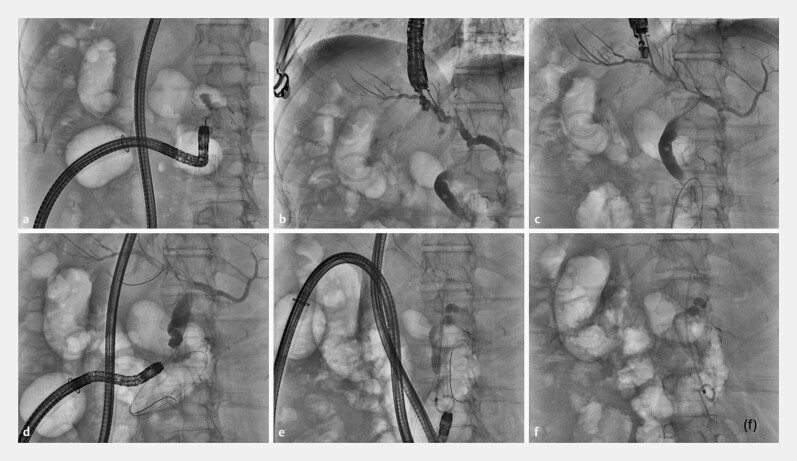
Background and study aims: Biliary cannulation via balloon-assisted-ERCP (BAE-ERCP) can be challenging. Patients with Roux-en-Y gastric bypass (RYGB) have among the lowest reported BAE-ERCP success rates when compared with other types of surgically altered anatomy. We explored the role of EUS-guided rendezvous (EUS-RV) as a rescue technique when BAE-ERCP fails.
Patients and methods: Consecutive patients with RYGB underwent BAE-ERCP for both benign and malignant indications. Among them, patients in whom BAE-ERCP failed despite use of conventional advanced biliary cannulation techniques underwent EUS-RV if the ampulla could be reached.
Results: Forty-three consecutive patients with RYGB underwent BAE-ERCP. The procedure was successful in 30 patients (69.7%). Among the 13 patients with failed ERCP, EUS-RV was performed in five. Technical success was achieved in all five patients (100%), thereby increasing the overall BAE-ERCP success to 35 patients (81.3%). There were no major procedure-related adverse events on immediate and 3-month follow-up. Average total procedure time for failed BAE-ERCP followed by EUS-RV was 129 minutes (range 47-205 minutes).
Conclusions: EUS-RV in patients with RYGB has high technical and clinical success and can be a viable alternative to more invasive options when BAE-ERCP fails using traditional cannulation techniques.






 京公网安备 11010802042870号
京ICP备2023020795号-1
京公网安备 11010802042870号
京ICP备2023020795号-1

 分享
分享
 求助内容:
求助内容: 应助结果提醒方式:
 扫码关注我们
