Andrea G Rockall, Bibb Allen, Maura J Brown, Tarek El-Diasty, Jan Fletcher, Rachel F Gerson, Stacy Goergen, Amanda P Marrero González, Thomas M Grist, Kate Hanneman, Christopher P Hess, Evelyn Lai Ming Ho, Dina H Salama, Julia Schoen, Sarah Sheard
{"title":"放射学的可持续性:ACR、AOSR、ASR、CAR、CIR、ESR、ESRNM、ISR、IS3R、RANZCR和RSNA的立场文件和行动呼吁。","authors":"Andrea G Rockall, Bibb Allen, Maura J Brown, Tarek El-Diasty, Jan Fletcher, Rachel F Gerson, Stacy Goergen, Amanda P Marrero González, Thomas M Grist, Kate Hanneman, Christopher P Hess, Evelyn Lai Ming Ho, Dina H Salama, Julia Schoen, Sarah Sheard","doi":"10.1007/s00330-025-11413-7","DOIUrl":null,"url":null,"abstract":"<p><p>The urgency for climate action is recognized by international government and healthcare organizations, including the United Nations (UN) and World Health Organization (WHO). Climate change, biodiversity loss, and pollution negatively impact all life on earth. All populations are impacted but not equally; the most vulnerable are at the highest risk, an inequity further exacerbated by differences in access to healthcare globally. The delivery of healthcare exacerbates the planetary health crisis through greenhouse gas emissions, largely due to combustion of fossil fuels for medical equipment production and operation, creation of medical and non-medical waste, and contamination of water supplies. As representatives of radiology societies from across the globe who work closely with industry, and both governmental and non-governmental leaders in multiple capacities, we advocate together for urgent, impactful, and measurable changes to the way we deliver care by further engaging our members, policymakers, industry partners, and our patients. Simultaneous challenges, including global health disparities, resource allocation, and access to care, must inform these efforts. Climate literacy should be increasingly added to radiology training programs. More research is required to understand and measure the environmental impact of radiological services and inform mitigation, adaptation and monitoring efforts. Deeper collaboration with industry partners is necessary to support innovations in the supply chain, energy utilization, and circular economy. Many solutions have been proposed and are already available, but we must understand and address barriers to the implementation of current and future sustainable innovations. Finally, there is a compelling need to partner with patients, to ensure that trust in the excellence of clinical care is maintained during the transition to sustainable radiology. By fostering a culture of global cooperation and rapid sharing of solutions amongst the broader imaging community, we can transform radiological practice to mitigate its environmental impact, adapt and develop resilience to current and future climate and environmental threats, and simultaneously improve access to care. KEY POINTS: Question What actions can professional societies take to improve the environmental sustainability of radiology? Findings Better understanding of resource usage in radiology is needed; action is required to address regional and global disparities in access to care which stand to be exacerbated by climate change. Clinical relevance Radiological societies need to advocate for urgent, impactful, and measurable changes to mitigate the environmental impact of radiological practice. Research and education, as well as adaptation and resilience to current and future climate and environmental threats, must be prioritized while simultaneously improving access to care.</p>","PeriodicalId":12076,"journal":{"name":"European Radiology","volume":" ","pages":"5427-5436"},"PeriodicalIF":4.7000,"publicationDate":"2025-09-01","publicationTypes":"Journal Article","fieldsOfStudy":null,"isOpenAccess":false,"openAccessPdf":"https://www.ncbi.nlm.nih.gov/pmc/articles/PMC12350511/pdf/","citationCount":"0","resultStr":"{\"title\":\"Sustainability in radiology: position paper and call to action from ACR, AOSR, ASR, CAR, CIR, ESR, ESRNM, ISR, IS3R, RANZCR, and RSNA.\",\"authors\":\"Andrea G Rockall, Bibb Allen, Maura J Brown, Tarek El-Diasty, Jan Fletcher, Rachel F Gerson, Stacy Goergen, Amanda P Marrero González, Thomas M Grist, Kate Hanneman, Christopher P Hess, Evelyn Lai Ming Ho, Dina H Salama, Julia Schoen, Sarah Sheard\",\"doi\":\"10.1007/s00330-025-11413-7\",\"DOIUrl\":null,\"url\":null,\"abstract\":\"<p><p>The urgency for climate action is recognized by international government and healthcare organizations, including the United Nations (UN) and World Health Organization (WHO). Climate change, biodiversity loss, and pollution negatively impact all life on earth. All populations are impacted but not equally; the most vulnerable are at the highest risk, an inequity further exacerbated by differences in access to healthcare globally. The delivery of healthcare exacerbates the planetary health crisis through greenhouse gas emissions, largely due to combustion of fossil fuels for medical equipment production and operation, creation of medical and non-medical waste, and contamination of water supplies. As representatives of radiology societies from across the globe who work closely with industry, and both governmental and non-governmental leaders in multiple capacities, we advocate together for urgent, impactful, and measurable changes to the way we deliver care by further engaging our members, policymakers, industry partners, and our patients. Simultaneous challenges, including global health disparities, resource allocation, and access to care, must inform these efforts. Climate literacy should be increasingly added to radiology training programs. More research is required to understand and measure the environmental impact of radiological services and inform mitigation, adaptation and monitoring efforts. Deeper collaboration with industry partners is necessary to support innovations in the supply chain, energy utilization, and circular economy. Many solutions have been proposed and are already available, but we must understand and address barriers to the implementation of current and future sustainable innovations. Finally, there is a compelling need to partner with patients, to ensure that trust in the excellence of clinical care is maintained during the transition to sustainable radiology. By fostering a culture of global cooperation and rapid sharing of solutions amongst the broader imaging community, we can transform radiological practice to mitigate its environmental impact, adapt and develop resilience to current and future climate and environmental threats, and simultaneously improve access to care. KEY POINTS: Question What actions can professional societies take to improve the environmental sustainability of radiology? Findings Better understanding of resource usage in radiology is needed; action is required to address regional and global disparities in access to care which stand to be exacerbated by climate change. Clinical relevance Radiological societies need to advocate for urgent, impactful, and measurable changes to mitigate the environmental impact of radiological practice. Research and education, as well as adaptation and resilience to current and future climate and environmental threats, must be prioritized while simultaneously improving access to care.</p>\",\"PeriodicalId\":12076,\"journal\":{\"name\":\"European Radiology\",\"volume\":\" \",\"pages\":\"5427-5436\"},\"PeriodicalIF\":4.7000,\"publicationDate\":\"2025-09-01\",\"publicationTypes\":\"Journal Article\",\"fieldsOfStudy\":null,\"isOpenAccess\":false,\"openAccessPdf\":\"https://www.ncbi.nlm.nih.gov/pmc/articles/PMC12350511/pdf/\",\"citationCount\":\"0\",\"resultStr\":null,\"platform\":\"Semanticscholar\",\"paperid\":null,\"PeriodicalName\":\"European Radiology\",\"FirstCategoryId\":\"3\",\"ListUrlMain\":\"https://doi.org/10.1007/s00330-025-11413-7\",\"RegionNum\":2,\"RegionCategory\":\"医学\",\"ArticlePicture\":[],\"TitleCN\":null,\"AbstractTextCN\":null,\"PMCID\":null,\"EPubDate\":\"2025/2/26 0:00:00\",\"PubModel\":\"Epub\",\"JCR\":\"Q1\",\"JCRName\":\"RADIOLOGY, NUCLEAR MEDICINE & MEDICAL IMAGING\",\"Score\":null,\"Total\":0}","platform":"Semanticscholar","paperid":null,"PeriodicalName":"European Radiology","FirstCategoryId":"3","ListUrlMain":"https://doi.org/10.1007/s00330-025-11413-7","RegionNum":2,"RegionCategory":"医学","ArticlePicture":[],"TitleCN":null,"AbstractTextCN":null,"PMCID":null,"EPubDate":"2025/2/26 0:00:00","PubModel":"Epub","JCR":"Q1","JCRName":"RADIOLOGY, NUCLEAR MEDICINE & MEDICAL IMAGING","Score":null,"Total":0}
Sustainability in radiology: position paper and call to action from ACR, AOSR, ASR, CAR, CIR, ESR, ESRNM, ISR, IS3R, RANZCR, and RSNA.
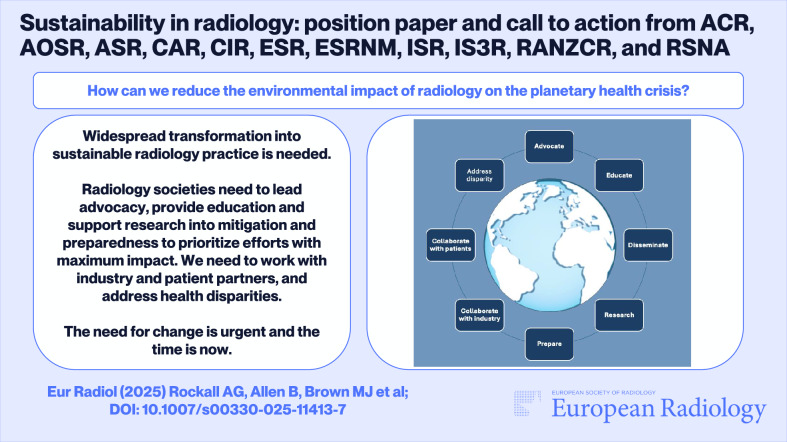
The urgency for climate action is recognized by international government and healthcare organizations, including the United Nations (UN) and World Health Organization (WHO). Climate change, biodiversity loss, and pollution negatively impact all life on earth. All populations are impacted but not equally; the most vulnerable are at the highest risk, an inequity further exacerbated by differences in access to healthcare globally. The delivery of healthcare exacerbates the planetary health crisis through greenhouse gas emissions, largely due to combustion of fossil fuels for medical equipment production and operation, creation of medical and non-medical waste, and contamination of water supplies. As representatives of radiology societies from across the globe who work closely with industry, and both governmental and non-governmental leaders in multiple capacities, we advocate together for urgent, impactful, and measurable changes to the way we deliver care by further engaging our members, policymakers, industry partners, and our patients. Simultaneous challenges, including global health disparities, resource allocation, and access to care, must inform these efforts. Climate literacy should be increasingly added to radiology training programs. More research is required to understand and measure the environmental impact of radiological services and inform mitigation, adaptation and monitoring efforts. Deeper collaboration with industry partners is necessary to support innovations in the supply chain, energy utilization, and circular economy. Many solutions have been proposed and are already available, but we must understand and address barriers to the implementation of current and future sustainable innovations. Finally, there is a compelling need to partner with patients, to ensure that trust in the excellence of clinical care is maintained during the transition to sustainable radiology. By fostering a culture of global cooperation and rapid sharing of solutions amongst the broader imaging community, we can transform radiological practice to mitigate its environmental impact, adapt and develop resilience to current and future climate and environmental threats, and simultaneously improve access to care. KEY POINTS: Question What actions can professional societies take to improve the environmental sustainability of radiology? Findings Better understanding of resource usage in radiology is needed; action is required to address regional and global disparities in access to care which stand to be exacerbated by climate change. Clinical relevance Radiological societies need to advocate for urgent, impactful, and measurable changes to mitigate the environmental impact of radiological practice. Research and education, as well as adaptation and resilience to current and future climate and environmental threats, must be prioritized while simultaneously improving access to care.
期刊介绍:
European Radiology (ER) continuously updates scientific knowledge in radiology by publication of strong original articles and state-of-the-art reviews written by leading radiologists. A well balanced combination of review articles, original papers, short communications from European radiological congresses and information on society matters makes ER an indispensable source for current information in this field.
This is the Journal of the European Society of Radiology, and the official journal of a number of societies.
From 2004-2008 supplements to European Radiology were published under its companion, European Radiology Supplements, ISSN 1613-3749.





 京公网安备 11010802042870号
京ICP备2023020795号-1
京公网安备 11010802042870号
京ICP备2023020795号-1

 分享
分享
 求助内容:
求助内容: 应助结果提醒方式:
 扫码关注我们
