{"title":"精益MAFLD的危险因素分析及预测模型构建:中国健康体检人群的横断面研究。","authors":"Ruya Zhu, Caicai Xu, Suwen Jiang, Jianping Xia, Boming Wu, Sijia Zhang, Jing Zhou, Hongliang Liu, Hongshan Li, Jianjun Lou","doi":"10.1186/s40001-025-02373-1","DOIUrl":null,"url":null,"abstract":"<p><strong>Aim: </strong>Cardiovascular disease morbidity and mortality rates are high in patients with metabolic dysfunction-associated fatty liver disease (MAFLD). The objective of this study was to analyze the risk factors and differences between lean MAFLD and overweight MAFLD, and establish and validate a nomogram model for predicting lean MAFLD.</p><p><strong>Methods: </strong>This retrospective cross-sectional study included 4363 participants who underwent annual health checkup at Yuyao from 2019 to 2022. The study population was stratified into three groups: non-MAFLD, lean MAFLD (defined as the presence of fatty liver changes as determined by ultrasound in individuals with a BMI < 25 kg/m<sup>2</sup>), and overweight MAFLD (BMI ≥ 25.0 kg/m<sup>2</sup>). Subsequent modeling analysis was conducted in a population that included healthy subjects with < 25 kg/m<sup>2</sup> (n = 2104) and subjects with lean MAFLD (n = 849). The study population was randomly split (7:3 ratio) to a training vs. a validation cohort. Risk factors for lean MAFLD was identify by multivariate regression of the training cohort, and used to construct a nomogram to estimate the probability of lean MAFLD. Model performance was examined using the receiver operating characteristic (ROC) curve analysis and k-fold cross-validation (k = 5). Decision curve analysis (DCA) was applied to evaluate the clinical usefulness of the prediction model.</p><p><strong>Results: </strong>The multivariate regression analysis indicated that the triglycerides and glucose index (TyG) was the most significant risk factor for lean MAFLD (OR: 4.03, 95% CI 2.806-5.786). The restricted cubic spline curves (RCS) regression model demonstrated that the relationships between systolic pressure (SBP), alanine aminotransferase (ALT), serum urate (UA), total cholesterol (TCHO), triglyceride (TG), triglyceride glucose (TyG) index, high density lipoprotein cholesterol (HDLC), and MAFLD were nonlinear and the cutoff values for lean MAFLD and overweight MAFLD were different. The nomogram was constructed based on seven predictors: glycosylated hemoglobin A1c (HbA1c), serum ferritin (SF), ALT, UA, BMI, TyG index, and age. In the validation cohort, the area under the ROC curve was 0.866 (95% CI 0.842-0.891), with 83.8% sensitivity and 76.6% specificity at the optimal cutoff. The PPV and NPV was 63.3% and 90.8%, respectively. Furthermore, we used fivefold cross-validation and the average area under the ROC curve was 0.866 (Figure S3). The calibration curves for the model's predictions and the actual outcomes were in good agreement. The DCA findings demonstrated that the nomogram model was clinically useful throughout a broad threshold probability range.</p><p><strong>Conclusions: </strong>Lean and overweight MAFLD exhibit distinct metabolic profiles. The nomogram model developed in this study is designed to assist clinicians in the early identification of high-risk individuals with lean MAFLD, including those with a normal BMI but at metabolic risk, as well as those with abnormal blood lipid, glucose, uric acid or transaminase levels. In addition, this model enhances screening efforts in communities and medical screening centers, ultimately ensuring more timely and effective medical services for patients.</p>","PeriodicalId":11949,"journal":{"name":"European Journal of Medical Research","volume":"30 1","pages":"137"},"PeriodicalIF":4.8000,"publicationDate":"2025-02-25","publicationTypes":"Journal Article","fieldsOfStudy":null,"isOpenAccess":false,"openAccessPdf":"https://www.ncbi.nlm.nih.gov/pmc/articles/PMC11863909/pdf/","citationCount":"0","resultStr":"{\"title\":\"Risk factor analysis and predictive model construction of lean MAFLD: a cross-sectional study of a health check-up population in China.\",\"authors\":\"Ruya Zhu, Caicai Xu, Suwen Jiang, Jianping Xia, Boming Wu, Sijia Zhang, Jing Zhou, Hongliang Liu, Hongshan Li, Jianjun Lou\",\"doi\":\"10.1186/s40001-025-02373-1\",\"DOIUrl\":null,\"url\":null,\"abstract\":\"<p><strong>Aim: </strong>Cardiovascular disease morbidity and mortality rates are high in patients with metabolic dysfunction-associated fatty liver disease (MAFLD). The objective of this study was to analyze the risk factors and differences between lean MAFLD and overweight MAFLD, and establish and validate a nomogram model for predicting lean MAFLD.</p><p><strong>Methods: </strong>This retrospective cross-sectional study included 4363 participants who underwent annual health checkup at Yuyao from 2019 to 2022. The study population was stratified into three groups: non-MAFLD, lean MAFLD (defined as the presence of fatty liver changes as determined by ultrasound in individuals with a BMI < 25 kg/m<sup>2</sup>), and overweight MAFLD (BMI ≥ 25.0 kg/m<sup>2</sup>). Subsequent modeling analysis was conducted in a population that included healthy subjects with < 25 kg/m<sup>2</sup> (n = 2104) and subjects with lean MAFLD (n = 849). The study population was randomly split (7:3 ratio) to a training vs. a validation cohort. Risk factors for lean MAFLD was identify by multivariate regression of the training cohort, and used to construct a nomogram to estimate the probability of lean MAFLD. Model performance was examined using the receiver operating characteristic (ROC) curve analysis and k-fold cross-validation (k = 5). Decision curve analysis (DCA) was applied to evaluate the clinical usefulness of the prediction model.</p><p><strong>Results: </strong>The multivariate regression analysis indicated that the triglycerides and glucose index (TyG) was the most significant risk factor for lean MAFLD (OR: 4.03, 95% CI 2.806-5.786). The restricted cubic spline curves (RCS) regression model demonstrated that the relationships between systolic pressure (SBP), alanine aminotransferase (ALT), serum urate (UA), total cholesterol (TCHO), triglyceride (TG), triglyceride glucose (TyG) index, high density lipoprotein cholesterol (HDLC), and MAFLD were nonlinear and the cutoff values for lean MAFLD and overweight MAFLD were different. The nomogram was constructed based on seven predictors: glycosylated hemoglobin A1c (HbA1c), serum ferritin (SF), ALT, UA, BMI, TyG index, and age. In the validation cohort, the area under the ROC curve was 0.866 (95% CI 0.842-0.891), with 83.8% sensitivity and 76.6% specificity at the optimal cutoff. The PPV and NPV was 63.3% and 90.8%, respectively. Furthermore, we used fivefold cross-validation and the average area under the ROC curve was 0.866 (Figure S3). The calibration curves for the model's predictions and the actual outcomes were in good agreement. The DCA findings demonstrated that the nomogram model was clinically useful throughout a broad threshold probability range.</p><p><strong>Conclusions: </strong>Lean and overweight MAFLD exhibit distinct metabolic profiles. The nomogram model developed in this study is designed to assist clinicians in the early identification of high-risk individuals with lean MAFLD, including those with a normal BMI but at metabolic risk, as well as those with abnormal blood lipid, glucose, uric acid or transaminase levels. In addition, this model enhances screening efforts in communities and medical screening centers, ultimately ensuring more timely and effective medical services for patients.</p>\",\"PeriodicalId\":11949,\"journal\":{\"name\":\"European Journal of Medical Research\",\"volume\":\"30 1\",\"pages\":\"137\"},\"PeriodicalIF\":4.8000,\"publicationDate\":\"2025-02-25\",\"publicationTypes\":\"Journal Article\",\"fieldsOfStudy\":null,\"isOpenAccess\":false,\"openAccessPdf\":\"https://www.ncbi.nlm.nih.gov/pmc/articles/PMC11863909/pdf/\",\"citationCount\":\"0\",\"resultStr\":null,\"platform\":\"Semanticscholar\",\"paperid\":null,\"PeriodicalName\":\"European Journal of Medical Research\",\"FirstCategoryId\":\"3\",\"ListUrlMain\":\"https://doi.org/10.1186/s40001-025-02373-1\",\"RegionNum\":3,\"RegionCategory\":\"医学\",\"ArticlePicture\":[],\"TitleCN\":null,\"AbstractTextCN\":null,\"PMCID\":null,\"EPubDate\":\"\",\"PubModel\":\"\",\"JCR\":\"Q2\",\"JCRName\":\"MEDICINE, RESEARCH & EXPERIMENTAL\",\"Score\":null,\"Total\":0}","platform":"Semanticscholar","paperid":null,"PeriodicalName":"European Journal of Medical Research","FirstCategoryId":"3","ListUrlMain":"https://doi.org/10.1186/s40001-025-02373-1","RegionNum":3,"RegionCategory":"医学","ArticlePicture":[],"TitleCN":null,"AbstractTextCN":null,"PMCID":null,"EPubDate":"","PubModel":"","JCR":"Q2","JCRName":"MEDICINE, RESEARCH & EXPERIMENTAL","Score":null,"Total":0}
引用次数: 0
摘要
目的:代谢功能障碍相关脂肪肝(MAFLD)患者心血管疾病发病率和死亡率高。本研究的目的是分析精益型MAFLD与超重型MAFLD的危险因素及差异,建立并验证预测精益型MAFLD的nomogram模型。方法:本回顾性横断面研究纳入了2019年至2022年在余姚市进行年度健康检查的4363名参与者。研究人群被分为三组:非MAFLD、瘦型MAFLD(定义为BMI为2的个体通过超声确定存在脂肪肝改变)和超重型MAFLD (BMI≥25.0 kg/m2)。随后的建模分析在人群中进行,其中包括2名健康受试者(n = 2104)和瘦型MAFLD受试者(n = 849)。研究人群随机分为训练组和验证组(比例为7:3)。通过对培训队列的多元回归分析,确定精益型MAFLD的危险因素,并构建nomogram来估计精益型MAFLD的发生概率。采用受试者工作特征(ROC)曲线分析和k-fold交叉验证(k = 5)检验模型的性能。采用决策曲线分析(DCA)评价预测模型的临床应用价值。结果:多因素回归分析显示,甘油三酯和葡萄糖指数(TyG)是瘦型MAFLD最显著的危险因素(OR: 4.03, 95% CI 2.806 ~ 5.786)。限制三次样条曲线(RCS)回归模型表明,收缩压(SBP)、丙氨酸转氨酶(ALT)、血清尿酸(UA)、总胆固醇(TCHO)、甘油三酯(TG)、甘油三酯葡萄糖(TyG)指数、高密度脂蛋白胆固醇(HDLC)与MAFLD之间存在非线性关系,且瘦型MAFLD与超重型MAFLD的临界值不同。根据糖化血红蛋白A1c (HbA1c)、血清铁蛋白(SF)、ALT、UA、BMI、TyG指数和年龄等7个预测指标构建nomogram。在验证队列中,ROC曲线下面积为0.866 (95% CI 0.842-0.891),最佳截止点灵敏度为83.8%,特异性为76.6%。PPV和NPV分别为63.3%和90.8%。此外,我们采用五重交叉验证,ROC曲线下的平均面积为0.866(图S3)。模型预测的校正曲线与实际结果吻合较好。DCA结果表明,在广泛的阈值概率范围内,nomogram模型在临床上是有用的。结论:瘦型和超重型MAFLD表现出不同的代谢特征。本研究建立的nomogram模型旨在帮助临床医生早期识别瘦型MAFLD高危人群,包括BMI正常但存在代谢风险的人群,以及血脂、葡萄糖、尿酸或转氨酶水平异常的人群。此外,该模式加强了社区和医疗筛查中心的筛查工作,最终确保为患者提供更及时有效的医疗服务。
Risk factor analysis and predictive model construction of lean MAFLD: a cross-sectional study of a health check-up population in China.
Aim: Cardiovascular disease morbidity and mortality rates are high in patients with metabolic dysfunction-associated fatty liver disease (MAFLD). The objective of this study was to analyze the risk factors and differences between lean MAFLD and overweight MAFLD, and establish and validate a nomogram model for predicting lean MAFLD.
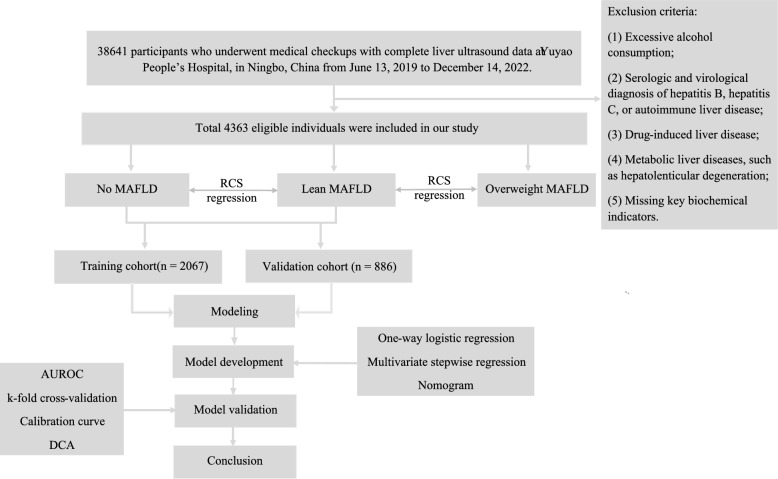
Methods: This retrospective cross-sectional study included 4363 participants who underwent annual health checkup at Yuyao from 2019 to 2022. The study population was stratified into three groups: non-MAFLD, lean MAFLD (defined as the presence of fatty liver changes as determined by ultrasound in individuals with a BMI < 25 kg/m2), and overweight MAFLD (BMI ≥ 25.0 kg/m2). Subsequent modeling analysis was conducted in a population that included healthy subjects with < 25 kg/m2 (n = 2104) and subjects with lean MAFLD (n = 849). The study population was randomly split (7:3 ratio) to a training vs. a validation cohort. Risk factors for lean MAFLD was identify by multivariate regression of the training cohort, and used to construct a nomogram to estimate the probability of lean MAFLD. Model performance was examined using the receiver operating characteristic (ROC) curve analysis and k-fold cross-validation (k = 5). Decision curve analysis (DCA) was applied to evaluate the clinical usefulness of the prediction model.
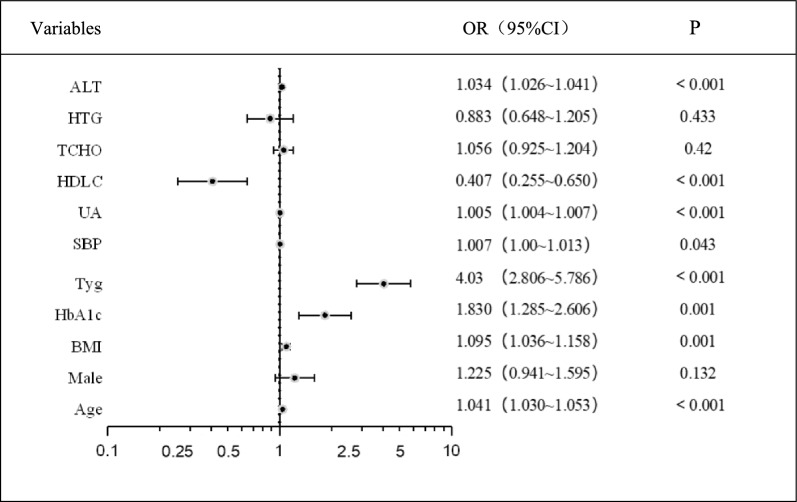
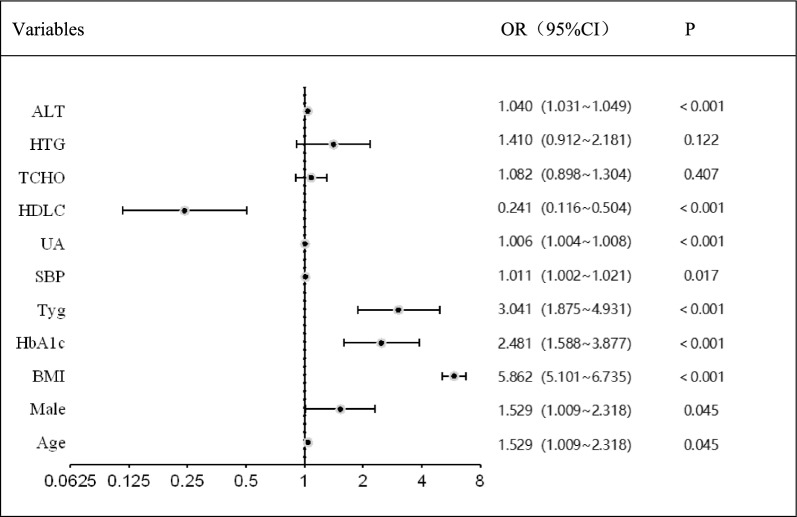
Results: The multivariate regression analysis indicated that the triglycerides and glucose index (TyG) was the most significant risk factor for lean MAFLD (OR: 4.03, 95% CI 2.806-5.786). The restricted cubic spline curves (RCS) regression model demonstrated that the relationships between systolic pressure (SBP), alanine aminotransferase (ALT), serum urate (UA), total cholesterol (TCHO), triglyceride (TG), triglyceride glucose (TyG) index, high density lipoprotein cholesterol (HDLC), and MAFLD were nonlinear and the cutoff values for lean MAFLD and overweight MAFLD were different. The nomogram was constructed based on seven predictors: glycosylated hemoglobin A1c (HbA1c), serum ferritin (SF), ALT, UA, BMI, TyG index, and age. In the validation cohort, the area under the ROC curve was 0.866 (95% CI 0.842-0.891), with 83.8% sensitivity and 76.6% specificity at the optimal cutoff. The PPV and NPV was 63.3% and 90.8%, respectively. Furthermore, we used fivefold cross-validation and the average area under the ROC curve was 0.866 (Figure S3). The calibration curves for the model's predictions and the actual outcomes were in good agreement. The DCA findings demonstrated that the nomogram model was clinically useful throughout a broad threshold probability range.
Conclusions: Lean and overweight MAFLD exhibit distinct metabolic profiles. The nomogram model developed in this study is designed to assist clinicians in the early identification of high-risk individuals with lean MAFLD, including those with a normal BMI but at metabolic risk, as well as those with abnormal blood lipid, glucose, uric acid or transaminase levels. In addition, this model enhances screening efforts in communities and medical screening centers, ultimately ensuring more timely and effective medical services for patients.
期刊介绍:
European Journal of Medical Research publishes translational and clinical research of international interest across all medical disciplines, enabling clinicians and other researchers to learn about developments and innovations within these disciplines and across the boundaries between disciplines. The journal publishes high quality research and reviews and aims to ensure that the results of all well-conducted research are published, regardless of their outcome.




 京公网安备 11010802042870号
京ICP备2023020795号-1
京公网安备 11010802042870号
京ICP备2023020795号-1

 分享
分享
 求助内容:
求助内容: 应助结果提醒方式:
 扫码关注我们
