Xin Li, Hai Xiang, Rong Liang, Xinyu Han, Rongzhen Zhong, Hongyu Liu, Yi Fang
{"title":"单宁可减轻妊娠母羊感染弯血螨后的生殖功能障碍。","authors":"Xin Li, Hai Xiang, Rong Liang, Xinyu Han, Rongzhen Zhong, Hongyu Liu, Yi Fang","doi":"10.3389/fvets.2025.1531233","DOIUrl":null,"url":null,"abstract":"<p><strong>Introduction: </strong><i>Haemonchus contortus</i> (<i>H. contortus</i>) infection has a significant impact on the health of pregnant ewes and adversely affects fetal development, highlighting the critical need for a non-toxic feed additive as an alternative and sustainable control strategy. Tannin is a kind of polyphenol compound, which has certain antiparasitic. The objective of this study was to evaluate the impact of dietary tannin supplementation on fecal egg count (FEC), packed cell volume (PCV), complete blood count (CBC), hormone levels, inflammatory markers, placental inflammation, and fetal growth and development in pregnant ewes infected with <i>H. contortus</i>.</p><p><strong>Methods: </strong>Hulunbuir ewes were randomly divided into three groups: control group (CON), gastrointestinal nematode infection group (GIN), and tannin group, which was infected by <i>H. contortus</i> with tannin feeding therapy (TAN). After artificial insemination was completed, and the ewes were confirmed for pregnancy and infection; stools were collected for FEC, and blood samples were collected for PCV and CBC, hormonal, and inflammation levels. The mRNA levels of hypothalamic-pituitary-ovarian axis-related hormone receptors and placental tissue inflammation genes were detected by quantitative reverse transcription polymerase chain reaction (RT-qPCR). Finally, fetal weights were measured, and fetal ovarian tissue samples were taken for transcriptomic analysis.</p><p><strong>Results: </strong>The results showed that tannins increased the levels of gonadotropin-releasing hormone (GnRH), follicle-stimulating hormone (FSH), luteinizing hormone (LH), estrogen (E<sub>2</sub>), progesterone (P<sub>4</sub>), human chorionic gonadotropin (hCG), red blood cell (RBC) counts, packed cell volume (PCV), and mRNA levels of gonadotropic axis receptors in pregnant ewes infected with <i>H. contortus</i> (<i>p</i> < 0.05). In addition, tannin reduced fecal egg count (FEC), leukocyte counts, and mRNA levels of inflammatory markers (<i>p</i> < 0.05). In addition, fetal ovarian sequencing further showed that tannin may alleviate the delay in fetal growth and development induced by <i>H. contortus</i> infection (<i>p</i> < 0.05).</p><p><strong>Conclusion: </strong>In summary, tannins have anthelmintic effects, restore reproductive hormone levels in pregnant ewes, reduce inflammation levels, and alleviate fetal growth retardation caused by <i>H. contortus</i> infection. Therefore, tannin is a suitable potential alternative to antibiotics as a feed additive.</p>","PeriodicalId":12772,"journal":{"name":"Frontiers in Veterinary Science","volume":"12 ","pages":"1531233"},"PeriodicalIF":3.1000,"publicationDate":"2025-02-11","publicationTypes":"Journal Article","fieldsOfStudy":null,"isOpenAccess":false,"openAccessPdf":"https://www.ncbi.nlm.nih.gov/pmc/articles/PMC11851946/pdf/","citationCount":"0","resultStr":"{\"title\":\"Tannin alleviated reproductive dysfunction in pregnant ewes infected with <i>Haemonchus contortus</i>.\",\"authors\":\"Xin Li, Hai Xiang, Rong Liang, Xinyu Han, Rongzhen Zhong, Hongyu Liu, Yi Fang\",\"doi\":\"10.3389/fvets.2025.1531233\",\"DOIUrl\":null,\"url\":null,\"abstract\":\"<p><strong>Introduction: </strong><i>Haemonchus contortus</i> (<i>H. contortus</i>) infection has a significant impact on the health of pregnant ewes and adversely affects fetal development, highlighting the critical need for a non-toxic feed additive as an alternative and sustainable control strategy. Tannin is a kind of polyphenol compound, which has certain antiparasitic. The objective of this study was to evaluate the impact of dietary tannin supplementation on fecal egg count (FEC), packed cell volume (PCV), complete blood count (CBC), hormone levels, inflammatory markers, placental inflammation, and fetal growth and development in pregnant ewes infected with <i>H. contortus</i>.</p><p><strong>Methods: </strong>Hulunbuir ewes were randomly divided into three groups: control group (CON), gastrointestinal nematode infection group (GIN), and tannin group, which was infected by <i>H. contortus</i> with tannin feeding therapy (TAN). After artificial insemination was completed, and the ewes were confirmed for pregnancy and infection; stools were collected for FEC, and blood samples were collected for PCV and CBC, hormonal, and inflammation levels. The mRNA levels of hypothalamic-pituitary-ovarian axis-related hormone receptors and placental tissue inflammation genes were detected by quantitative reverse transcription polymerase chain reaction (RT-qPCR). Finally, fetal weights were measured, and fetal ovarian tissue samples were taken for transcriptomic analysis.</p><p><strong>Results: </strong>The results showed that tannins increased the levels of gonadotropin-releasing hormone (GnRH), follicle-stimulating hormone (FSH), luteinizing hormone (LH), estrogen (E<sub>2</sub>), progesterone (P<sub>4</sub>), human chorionic gonadotropin (hCG), red blood cell (RBC) counts, packed cell volume (PCV), and mRNA levels of gonadotropic axis receptors in pregnant ewes infected with <i>H. contortus</i> (<i>p</i> < 0.05). In addition, tannin reduced fecal egg count (FEC), leukocyte counts, and mRNA levels of inflammatory markers (<i>p</i> < 0.05). In addition, fetal ovarian sequencing further showed that tannin may alleviate the delay in fetal growth and development induced by <i>H. contortus</i> infection (<i>p</i> < 0.05).</p><p><strong>Conclusion: </strong>In summary, tannins have anthelmintic effects, restore reproductive hormone levels in pregnant ewes, reduce inflammation levels, and alleviate fetal growth retardation caused by <i>H. contortus</i> infection. Therefore, tannin is a suitable potential alternative to antibiotics as a feed additive.</p>\",\"PeriodicalId\":12772,\"journal\":{\"name\":\"Frontiers in Veterinary Science\",\"volume\":\"12 \",\"pages\":\"1531233\"},\"PeriodicalIF\":3.1000,\"publicationDate\":\"2025-02-11\",\"publicationTypes\":\"Journal Article\",\"fieldsOfStudy\":null,\"isOpenAccess\":false,\"openAccessPdf\":\"https://www.ncbi.nlm.nih.gov/pmc/articles/PMC11851946/pdf/\",\"citationCount\":\"0\",\"resultStr\":null,\"platform\":\"Semanticscholar\",\"paperid\":null,\"PeriodicalName\":\"Frontiers in Veterinary Science\",\"FirstCategoryId\":\"97\",\"ListUrlMain\":\"https://doi.org/10.3389/fvets.2025.1531233\",\"RegionNum\":2,\"RegionCategory\":\"农林科学\",\"ArticlePicture\":[],\"TitleCN\":null,\"AbstractTextCN\":null,\"PMCID\":null,\"EPubDate\":\"2025/1/1 0:00:00\",\"PubModel\":\"eCollection\",\"JCR\":\"Q1\",\"JCRName\":\"VETERINARY SCIENCES\",\"Score\":null,\"Total\":0}","platform":"Semanticscholar","paperid":null,"PeriodicalName":"Frontiers in Veterinary Science","FirstCategoryId":"97","ListUrlMain":"https://doi.org/10.3389/fvets.2025.1531233","RegionNum":2,"RegionCategory":"农林科学","ArticlePicture":[],"TitleCN":null,"AbstractTextCN":null,"PMCID":null,"EPubDate":"2025/1/1 0:00:00","PubModel":"eCollection","JCR":"Q1","JCRName":"VETERINARY SCIENCES","Score":null,"Total":0}
引用次数: 0
摘要
简介:弯曲血蜱(H. contortus)感染对怀孕母羊的健康有重大影响,并对胎儿发育产生不利影响,因此迫切需要一种无毒饲料添加剂作为替代和可持续的控制策略。单宁是一种多酚类化合物,具有一定的抗寄生虫作用。本研究的目的是评估饲粮中添加单宁对感染弯腹螺旋体的妊娠母羊的粪卵计数(FEC)、堆积细胞体积(PCV)、全血细胞计数(CBC)、激素水平、炎症标志物、胎盘炎症和胎儿生长发育的影响。方法:将呼伦贝尔母羊随机分为3组:对照组(CON)、胃肠道线虫感染组(GIN)和单宁组(TAN)。单宁组是用单宁喂养疗法(TAN)感染扭曲螺旋体。人工授精完成后,确认母羊妊娠和感染;收集粪便FEC,收集血液PCV和CBC、激素和炎症水平。采用定量逆转录聚合酶链式反应(RT-qPCR)检测下丘脑-垂体-卵巢轴相关激素受体和胎盘组织炎症基因mRNA水平。最后,测量胎儿体重,并采集胎儿卵巢组织样本进行转录组学分析。结果:结果显示单宁能提高妊娠妊娠母羊感染扭曲红毛囊后促性腺激素释放激素(GnRH)、促卵泡激素(FSH)、促黄体生成素(LH)、雌激素(E2)、孕激素(P4)、绒毛膜促性腺激素(hCG)、红细胞(RBC)计数、堆积细胞体积(PCV)水平和促性腺轴受体mRNA水平(p p H。结论:综上所述,单宁具有驱虫作用,可恢复妊娠母羊生殖激素水平,降低炎症水平,减轻扭曲鼠感染引起的胎儿发育迟缓。因此,单宁是一种有潜力替代抗生素的饲料添加剂。
Tannin alleviated reproductive dysfunction in pregnant ewes infected with Haemonchus contortus.
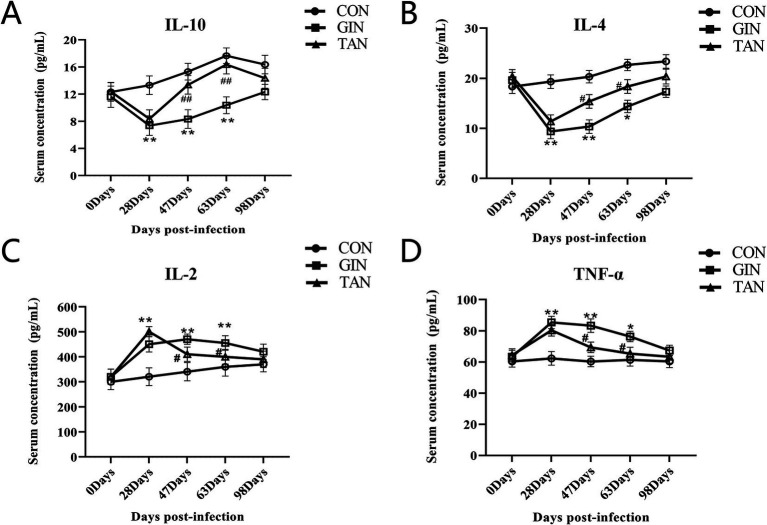
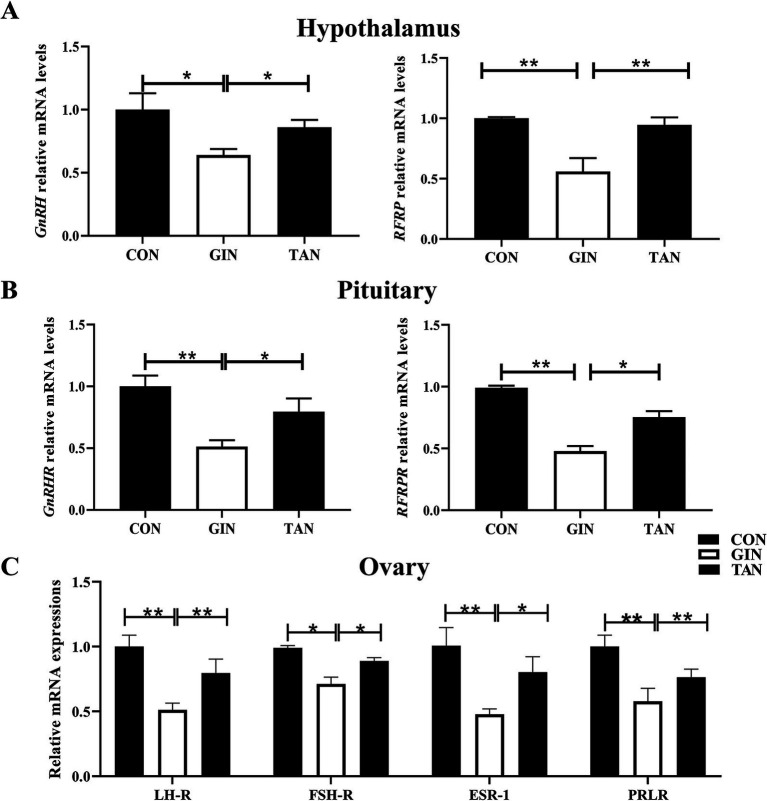
Introduction: Haemonchus contortus (H. contortus) infection has a significant impact on the health of pregnant ewes and adversely affects fetal development, highlighting the critical need for a non-toxic feed additive as an alternative and sustainable control strategy. Tannin is a kind of polyphenol compound, which has certain antiparasitic. The objective of this study was to evaluate the impact of dietary tannin supplementation on fecal egg count (FEC), packed cell volume (PCV), complete blood count (CBC), hormone levels, inflammatory markers, placental inflammation, and fetal growth and development in pregnant ewes infected with H. contortus.
Methods: Hulunbuir ewes were randomly divided into three groups: control group (CON), gastrointestinal nematode infection group (GIN), and tannin group, which was infected by H. contortus with tannin feeding therapy (TAN). After artificial insemination was completed, and the ewes were confirmed for pregnancy and infection; stools were collected for FEC, and blood samples were collected for PCV and CBC, hormonal, and inflammation levels. The mRNA levels of hypothalamic-pituitary-ovarian axis-related hormone receptors and placental tissue inflammation genes were detected by quantitative reverse transcription polymerase chain reaction (RT-qPCR). Finally, fetal weights were measured, and fetal ovarian tissue samples were taken for transcriptomic analysis.
Results: The results showed that tannins increased the levels of gonadotropin-releasing hormone (GnRH), follicle-stimulating hormone (FSH), luteinizing hormone (LH), estrogen (E2), progesterone (P4), human chorionic gonadotropin (hCG), red blood cell (RBC) counts, packed cell volume (PCV), and mRNA levels of gonadotropic axis receptors in pregnant ewes infected with H. contortus (p < 0.05). In addition, tannin reduced fecal egg count (FEC), leukocyte counts, and mRNA levels of inflammatory markers (p < 0.05). In addition, fetal ovarian sequencing further showed that tannin may alleviate the delay in fetal growth and development induced by H. contortus infection (p < 0.05).
Conclusion: In summary, tannins have anthelmintic effects, restore reproductive hormone levels in pregnant ewes, reduce inflammation levels, and alleviate fetal growth retardation caused by H. contortus infection. Therefore, tannin is a suitable potential alternative to antibiotics as a feed additive.
期刊介绍:
Frontiers in Veterinary Science is a global, peer-reviewed, Open Access journal that bridges animal and human health, brings a comparative approach to medical and surgical challenges, and advances innovative biotechnology and therapy.
Veterinary research today is interdisciplinary, collaborative, and socially relevant, transforming how we understand and investigate animal health and disease. Fundamental research in emerging infectious diseases, predictive genomics, stem cell therapy, and translational modelling is grounded within the integrative social context of public and environmental health, wildlife conservation, novel biomarkers, societal well-being, and cutting-edge clinical practice and specialization. Frontiers in Veterinary Science brings a 21st-century approach—networked, collaborative, and Open Access—to communicate this progress and innovation to both the specialist and to the wider audience of readers in the field.
Frontiers in Veterinary Science publishes articles on outstanding discoveries across a wide spectrum of translational, foundational, and clinical research. The journal''s mission is to bring all relevant veterinary sciences together on a single platform with the goal of improving animal and human health.





 京公网安备 11010802042870号
京ICP备2023020795号-1
京公网安备 11010802042870号
京ICP备2023020795号-1

 分享
分享
 求助内容:
求助内容: 应助结果提醒方式:
 扫码关注我们
