Benjamin R. Schrank, Yifan Wang, Annette Wu, Nhat Tran, DaeYong Lee, Jared Edwards, Kristin Huntoon, Shiyan Dong, JongHoon Ha, Yifan Ma, Adam J. Grippin, Seong Dong Jeong, Abin Antony, Mengyu Chang, Minjeong Kang, Thomas D. Gallup, Albert C. Koong, Jing Li, Kyuson Yun, Betty Y. S. Kim, Wen Jiang
{"title":"一种靶向CD47的抗体-毒素结合物,与细菌毒素李斯特溶素O结合,用于癌症免疫治疗。","authors":"Benjamin R. Schrank, Yifan Wang, Annette Wu, Nhat Tran, DaeYong Lee, Jared Edwards, Kristin Huntoon, Shiyan Dong, JongHoon Ha, Yifan Ma, Adam J. Grippin, Seong Dong Jeong, Abin Antony, Mengyu Chang, Minjeong Kang, Thomas D. Gallup, Albert C. Koong, Jing Li, Kyuson Yun, Betty Y. S. Kim, Wen Jiang","doi":"10.1038/s43018-025-00919-0","DOIUrl":null,"url":null,"abstract":"Antigen-presenting cells phagocytose tumor cells and subsequently cross-present tumor-derived antigens. However, these processes are impeded by phagocytosis checkpoints and inefficient cytosolic transport of antigenic peptides from phagolysosomes. Here, using a microbial-inspired strategy, we engineered an antibody–toxin conjugate (ATC) that targets the ‘don’t eat me’ signal CD47 linked to the bacterial toxin listeriolysin O from the intracellular bacterium Listeria monocytogenes via a cleavable linker (CD47–LLO). CD47–LLO promotes cancer cell phagocytosis by macrophages followed by LLO release and activation to form pores on phagolysosomal membranes that enhance antigen cross-presentation of tumor-derived peptides and activate cytosolic immune sensors. CD47–LLO treatment in vivo significantly inhibited the growth of both localized and metastatic breast and melanoma tumors and improved animal survival as a monotherapy or in combination with checkpoint blockade. Together, these results demonstrate that designing ATCs to promote immune recognition of tumor cells represents a promising therapeutic strategy for treating multiple cancers. Schrank et al. report the design and characterization of an antibody–toxin conjugate targeting CD47, promoting anti-tumor immunity in preclinical cancer models.","PeriodicalId":18885,"journal":{"name":"Nature cancer","volume":"6 3","pages":"511-527"},"PeriodicalIF":28.0000,"publicationDate":"2025-02-25","publicationTypes":"Journal Article","fieldsOfStudy":null,"isOpenAccess":false,"openAccessPdf":"","citationCount":"0","resultStr":"{\"title\":\"An antibody–toxin conjugate targeting CD47 linked to the bacterial toxin listeriolysin O for cancer immunotherapy\",\"authors\":\"Benjamin R. Schrank, Yifan Wang, Annette Wu, Nhat Tran, DaeYong Lee, Jared Edwards, Kristin Huntoon, Shiyan Dong, JongHoon Ha, Yifan Ma, Adam J. Grippin, Seong Dong Jeong, Abin Antony, Mengyu Chang, Minjeong Kang, Thomas D. Gallup, Albert C. Koong, Jing Li, Kyuson Yun, Betty Y. S. Kim, Wen Jiang\",\"doi\":\"10.1038/s43018-025-00919-0\",\"DOIUrl\":null,\"url\":null,\"abstract\":\"Antigen-presenting cells phagocytose tumor cells and subsequently cross-present tumor-derived antigens. However, these processes are impeded by phagocytosis checkpoints and inefficient cytosolic transport of antigenic peptides from phagolysosomes. Here, using a microbial-inspired strategy, we engineered an antibody–toxin conjugate (ATC) that targets the ‘don’t eat me’ signal CD47 linked to the bacterial toxin listeriolysin O from the intracellular bacterium Listeria monocytogenes via a cleavable linker (CD47–LLO). CD47–LLO promotes cancer cell phagocytosis by macrophages followed by LLO release and activation to form pores on phagolysosomal membranes that enhance antigen cross-presentation of tumor-derived peptides and activate cytosolic immune sensors. CD47–LLO treatment in vivo significantly inhibited the growth of both localized and metastatic breast and melanoma tumors and improved animal survival as a monotherapy or in combination with checkpoint blockade. Together, these results demonstrate that designing ATCs to promote immune recognition of tumor cells represents a promising therapeutic strategy for treating multiple cancers. Schrank et al. report the design and characterization of an antibody–toxin conjugate targeting CD47, promoting anti-tumor immunity in preclinical cancer models.\",\"PeriodicalId\":18885,\"journal\":{\"name\":\"Nature cancer\",\"volume\":\"6 3\",\"pages\":\"511-527\"},\"PeriodicalIF\":28.0000,\"publicationDate\":\"2025-02-25\",\"publicationTypes\":\"Journal Article\",\"fieldsOfStudy\":null,\"isOpenAccess\":false,\"openAccessPdf\":\"\",\"citationCount\":\"0\",\"resultStr\":null,\"platform\":\"Semanticscholar\",\"paperid\":null,\"PeriodicalName\":\"Nature cancer\",\"FirstCategoryId\":\"3\",\"ListUrlMain\":\"https://www.nature.com/articles/s43018-025-00919-0\",\"RegionNum\":1,\"RegionCategory\":\"医学\",\"ArticlePicture\":[],\"TitleCN\":null,\"AbstractTextCN\":null,\"PMCID\":null,\"EPubDate\":\"\",\"PubModel\":\"\",\"JCR\":\"Q1\",\"JCRName\":\"ONCOLOGY\",\"Score\":null,\"Total\":0}","platform":"Semanticscholar","paperid":null,"PeriodicalName":"Nature cancer","FirstCategoryId":"3","ListUrlMain":"https://www.nature.com/articles/s43018-025-00919-0","RegionNum":1,"RegionCategory":"医学","ArticlePicture":[],"TitleCN":null,"AbstractTextCN":null,"PMCID":null,"EPubDate":"","PubModel":"","JCR":"Q1","JCRName":"ONCOLOGY","Score":null,"Total":0}
An antibody–toxin conjugate targeting CD47 linked to the bacterial toxin listeriolysin O for cancer immunotherapy
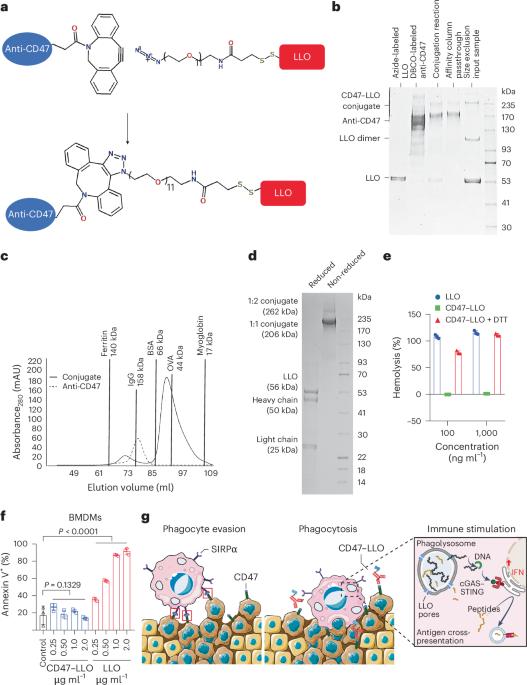
Antigen-presenting cells phagocytose tumor cells and subsequently cross-present tumor-derived antigens. However, these processes are impeded by phagocytosis checkpoints and inefficient cytosolic transport of antigenic peptides from phagolysosomes. Here, using a microbial-inspired strategy, we engineered an antibody–toxin conjugate (ATC) that targets the ‘don’t eat me’ signal CD47 linked to the bacterial toxin listeriolysin O from the intracellular bacterium Listeria monocytogenes via a cleavable linker (CD47–LLO). CD47–LLO promotes cancer cell phagocytosis by macrophages followed by LLO release and activation to form pores on phagolysosomal membranes that enhance antigen cross-presentation of tumor-derived peptides and activate cytosolic immune sensors. CD47–LLO treatment in vivo significantly inhibited the growth of both localized and metastatic breast and melanoma tumors and improved animal survival as a monotherapy or in combination with checkpoint blockade. Together, these results demonstrate that designing ATCs to promote immune recognition of tumor cells represents a promising therapeutic strategy for treating multiple cancers. Schrank et al. report the design and characterization of an antibody–toxin conjugate targeting CD47, promoting anti-tumor immunity in preclinical cancer models.
期刊介绍:
Cancer is a devastating disease responsible for millions of deaths worldwide. However, many of these deaths could be prevented with improved prevention and treatment strategies. To achieve this, it is crucial to focus on accurate diagnosis, effective treatment methods, and understanding the socioeconomic factors that influence cancer rates.
Nature Cancer aims to serve as a unique platform for sharing the latest advancements in cancer research across various scientific fields, encompassing life sciences, physical sciences, applied sciences, and social sciences. The journal is particularly interested in fundamental research that enhances our understanding of tumor development and progression, as well as research that translates this knowledge into clinical applications through innovative diagnostic and therapeutic approaches. Additionally, Nature Cancer welcomes clinical studies that inform cancer diagnosis, treatment, and prevention, along with contributions exploring the societal impact of cancer on a global scale.
In addition to publishing original research, Nature Cancer will feature Comments, Reviews, News & Views, Features, and Correspondence that hold significant value for the diverse field of cancer research.





 京公网安备 11010802042870号
京ICP备2023020795号-1
京公网安备 11010802042870号
京ICP备2023020795号-1

 分享
分享
 求助内容:
求助内容: 应助结果提醒方式:
 扫码关注我们
