{"title":"人工智能驱动的经皮给药皮肤动力学创新:克服障碍,提高精度。","authors":"Nubul Albayati, Sesha Rajeswari Talluri, Nirali Dholaria, Bozena Michniak-Kohn","doi":"10.3390/pharmaceutics17020188","DOIUrl":null,"url":null,"abstract":"<p><p>Transdermal drug delivery systems (TDDS) offer an alternative to conventional oral and injectable drug administration by bypassing the gastrointestinal tract and liver metabolism, improving bioavailability, and minimizing systemic side effects. However, widespread adoption of TDDS is limited by challenges such as the skin's permeability barrier, particularly the stratum corneum, and the need for optimized formulations. Factors like skin type, hydration levels, and age further complicate the development of universally effective solutions. Advances in artificial intelligence (AI) address these challenges through predictive modeling and personalized medicine approaches. Machine learning models trained on extensive molecular datasets predict skin permeability and accelerate the selection of suitable drug candidates. AI-driven algorithms optimize formulations, including penetration enhancers and advanced delivery technologies like microneedles and liposomes, while ensuring safety and efficacy. Personalized TDDS design tailors drug delivery to individual patient profiles, enhancing therapeutic precision. Innovative systems, such as sensor-integrated patches, dynamically adjust drug release based on real-time feedback, ensuring optimal outcomes. AI also streamlines the pharmaceutical process, from disease diagnosis to the prediction of drug distribution in skin layers, enabling efficient formulation development. This review highlights AI's transformative role in TDDS, including applications of models such as Deep Neural Networks (DNN), Artificial Neural Networks (ANN), BioSIM, COMSOL, K-Nearest Neighbors (KNN), and Set Covering Machine (SVM). These technologies revolutionize TDDS for both skin and non-skin diseases, demonstrating AI's potential to overcome existing barriers and improve patient care through innovative drug delivery solutions.</p>","PeriodicalId":19894,"journal":{"name":"Pharmaceutics","volume":"17 2","pages":""},"PeriodicalIF":5.5000,"publicationDate":"2025-02-02","publicationTypes":"Journal Article","fieldsOfStudy":null,"isOpenAccess":false,"openAccessPdf":"https://www.ncbi.nlm.nih.gov/pmc/articles/PMC11859831/pdf/","citationCount":"0","resultStr":"{\"title\":\"AI-Driven Innovation in Skin Kinetics for Transdermal Drug Delivery: Overcoming Barriers and Enhancing Precision.\",\"authors\":\"Nubul Albayati, Sesha Rajeswari Talluri, Nirali Dholaria, Bozena Michniak-Kohn\",\"doi\":\"10.3390/pharmaceutics17020188\",\"DOIUrl\":null,\"url\":null,\"abstract\":\"<p><p>Transdermal drug delivery systems (TDDS) offer an alternative to conventional oral and injectable drug administration by bypassing the gastrointestinal tract and liver metabolism, improving bioavailability, and minimizing systemic side effects. However, widespread adoption of TDDS is limited by challenges such as the skin's permeability barrier, particularly the stratum corneum, and the need for optimized formulations. Factors like skin type, hydration levels, and age further complicate the development of universally effective solutions. Advances in artificial intelligence (AI) address these challenges through predictive modeling and personalized medicine approaches. Machine learning models trained on extensive molecular datasets predict skin permeability and accelerate the selection of suitable drug candidates. AI-driven algorithms optimize formulations, including penetration enhancers and advanced delivery technologies like microneedles and liposomes, while ensuring safety and efficacy. Personalized TDDS design tailors drug delivery to individual patient profiles, enhancing therapeutic precision. Innovative systems, such as sensor-integrated patches, dynamically adjust drug release based on real-time feedback, ensuring optimal outcomes. AI also streamlines the pharmaceutical process, from disease diagnosis to the prediction of drug distribution in skin layers, enabling efficient formulation development. This review highlights AI's transformative role in TDDS, including applications of models such as Deep Neural Networks (DNN), Artificial Neural Networks (ANN), BioSIM, COMSOL, K-Nearest Neighbors (KNN), and Set Covering Machine (SVM). These technologies revolutionize TDDS for both skin and non-skin diseases, demonstrating AI's potential to overcome existing barriers and improve patient care through innovative drug delivery solutions.</p>\",\"PeriodicalId\":19894,\"journal\":{\"name\":\"Pharmaceutics\",\"volume\":\"17 2\",\"pages\":\"\"},\"PeriodicalIF\":5.5000,\"publicationDate\":\"2025-02-02\",\"publicationTypes\":\"Journal Article\",\"fieldsOfStudy\":null,\"isOpenAccess\":false,\"openAccessPdf\":\"https://www.ncbi.nlm.nih.gov/pmc/articles/PMC11859831/pdf/\",\"citationCount\":\"0\",\"resultStr\":null,\"platform\":\"Semanticscholar\",\"paperid\":null,\"PeriodicalName\":\"Pharmaceutics\",\"FirstCategoryId\":\"3\",\"ListUrlMain\":\"https://doi.org/10.3390/pharmaceutics17020188\",\"RegionNum\":3,\"RegionCategory\":\"医学\",\"ArticlePicture\":[],\"TitleCN\":null,\"AbstractTextCN\":null,\"PMCID\":null,\"EPubDate\":\"\",\"PubModel\":\"\",\"JCR\":\"Q1\",\"JCRName\":\"PHARMACOLOGY & PHARMACY\",\"Score\":null,\"Total\":0}","platform":"Semanticscholar","paperid":null,"PeriodicalName":"Pharmaceutics","FirstCategoryId":"3","ListUrlMain":"https://doi.org/10.3390/pharmaceutics17020188","RegionNum":3,"RegionCategory":"医学","ArticlePicture":[],"TitleCN":null,"AbstractTextCN":null,"PMCID":null,"EPubDate":"","PubModel":"","JCR":"Q1","JCRName":"PHARMACOLOGY & PHARMACY","Score":null,"Total":0}
AI-Driven Innovation in Skin Kinetics for Transdermal Drug Delivery: Overcoming Barriers and Enhancing Precision.
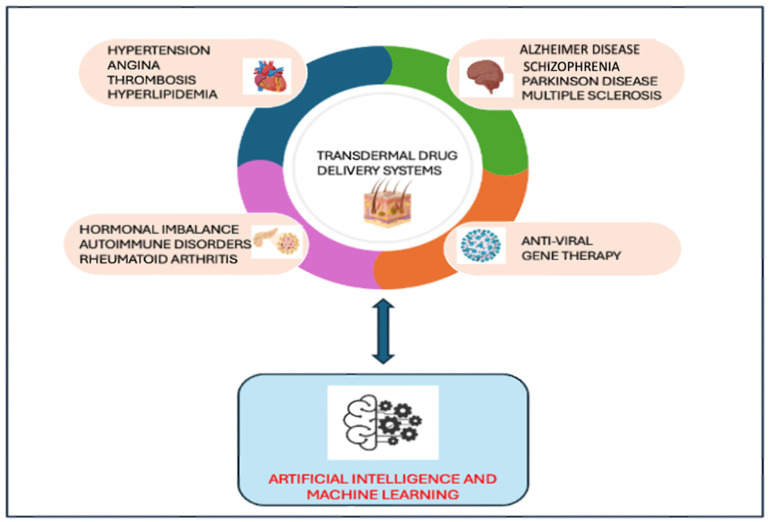
Transdermal drug delivery systems (TDDS) offer an alternative to conventional oral and injectable drug administration by bypassing the gastrointestinal tract and liver metabolism, improving bioavailability, and minimizing systemic side effects. However, widespread adoption of TDDS is limited by challenges such as the skin's permeability barrier, particularly the stratum corneum, and the need for optimized formulations. Factors like skin type, hydration levels, and age further complicate the development of universally effective solutions. Advances in artificial intelligence (AI) address these challenges through predictive modeling and personalized medicine approaches. Machine learning models trained on extensive molecular datasets predict skin permeability and accelerate the selection of suitable drug candidates. AI-driven algorithms optimize formulations, including penetration enhancers and advanced delivery technologies like microneedles and liposomes, while ensuring safety and efficacy. Personalized TDDS design tailors drug delivery to individual patient profiles, enhancing therapeutic precision. Innovative systems, such as sensor-integrated patches, dynamically adjust drug release based on real-time feedback, ensuring optimal outcomes. AI also streamlines the pharmaceutical process, from disease diagnosis to the prediction of drug distribution in skin layers, enabling efficient formulation development. This review highlights AI's transformative role in TDDS, including applications of models such as Deep Neural Networks (DNN), Artificial Neural Networks (ANN), BioSIM, COMSOL, K-Nearest Neighbors (KNN), and Set Covering Machine (SVM). These technologies revolutionize TDDS for both skin and non-skin diseases, demonstrating AI's potential to overcome existing barriers and improve patient care through innovative drug delivery solutions.
PharmaceuticsPharmacology, Toxicology and Pharmaceutics-Pharmaceutical Science
CiteScore
7.90
自引率
11.10%
发文量
2379
审稿时长
16.41 days
期刊介绍:
Pharmaceutics (ISSN 1999-4923) is an open access journal which provides an advanced forum for the science and technology of pharmaceutics and biopharmaceutics. It publishes reviews, regular research papers, communications, and short notes. Covered topics include pharmacokinetics, toxicokinetics, pharmacodynamics, pharmacogenetics and pharmacogenomics, and pharmaceutical formulation. Our aim is to encourage scientists to publish their experimental and theoretical details in as much detail as possible. There is no restriction on the length of the papers. The full experimental details must be provided so that the results can be reproduced.




 京公网安备 11010802042870号
京ICP备2023020795号-1
京公网安备 11010802042870号
京ICP备2023020795号-1

 分享
分享
 求助内容:
求助内容: 应助结果提醒方式:
 扫码关注我们
