Jiyoung Agatha Kim, Ji Eun Lee, Kunhyung Bae, Sung Soo Ahn
{"title":"痛风患者可溶性抑瘤因子2水平升高及其与心血管疾病危险指标的关系","authors":"Jiyoung Agatha Kim, Ji Eun Lee, Kunhyung Bae, Sung Soo Ahn","doi":"10.3349/ymj.2024.0001","DOIUrl":null,"url":null,"abstract":"<p><strong>Purpose: </strong>To investigate the association between soluble suppressor of tumorigenicity 2 (sST2) levels and cardiovascular disease predictors in patients with gout.</p><p><strong>Materials and methods: </strong>We retrospectively reviewed the medical records of patients with gout who were tested for sST2 but did not receive uric acid-lowering therapy. These patients were classified into elevated and normal sST2 groups using a cut-off of >49.6 ng/mL and >35.4 ng/mL in males and females, respectively. Correlations between clinical and laboratory variables, sST2 levels, and elevated sST2 level predictors were assessed using linear and logistic regression analyses.</p><p><strong>Results: </strong>Notably, 27 (11.3%) and 211 (88.7%) of the 238 identified patients had elevated and normal sST2 levels, respectively. Linear regression analysis revealed that male sex (β=-0.190, <i>p</i>=0.002), body mass index (BMI) (β=-0.184, <i>p</i>=0.002), white blood cell count (β=0.231, <i>p</i><0.001), C-reactive protein (β=0.135, <i>p</i>=0.031), and fasting blood glucose (β=0.210, <i>p</i><0.001) were independently associated with sST2 levels. In multivariate logistic regression analysis, male sex [odds ratio (OR) 0.112, <i>p</i>=0.001], BMI (OR 0.836, <i>p</i>=0.008), creatinine (OR 5.730, <i>p</i>=0.024), and fasting blood glucose (OR 1.042, <i>p</i>=0.002) predicted elevated sST2 levels. Patients with increased sST2 levels had a significantly higher atherosclerotic cardiovascular disease risk score and a greater proportion of high-risk Framingham Risk Score compared to the normal sST2 group (<i>p</i>=0.002 and <i>p</i><0.001).</p><p><strong>Conclusion: </strong>Patients with gout and elevated sST2 levels have a higher risk of future cardiovascular disorders, which may provide insights into risk stratification and the implementation of intervention strategies.</p>","PeriodicalId":23765,"journal":{"name":"Yonsei Medical Journal","volume":"66 3","pages":"151-159"},"PeriodicalIF":2.8000,"publicationDate":"2025-03-01","publicationTypes":"Journal Article","fieldsOfStudy":null,"isOpenAccess":false,"openAccessPdf":"https://www.ncbi.nlm.nih.gov/pmc/articles/PMC11865869/pdf/","citationCount":"0","resultStr":"{\"title\":\"Elevated Soluble Suppressor of Tumorigenicity 2 Levels in Gout Patients and Its Association with Cardiovascular Disease Risk Indicators.\",\"authors\":\"Jiyoung Agatha Kim, Ji Eun Lee, Kunhyung Bae, Sung Soo Ahn\",\"doi\":\"10.3349/ymj.2024.0001\",\"DOIUrl\":null,\"url\":null,\"abstract\":\"<p><strong>Purpose: </strong>To investigate the association between soluble suppressor of tumorigenicity 2 (sST2) levels and cardiovascular disease predictors in patients with gout.</p><p><strong>Materials and methods: </strong>We retrospectively reviewed the medical records of patients with gout who were tested for sST2 but did not receive uric acid-lowering therapy. These patients were classified into elevated and normal sST2 groups using a cut-off of >49.6 ng/mL and >35.4 ng/mL in males and females, respectively. Correlations between clinical and laboratory variables, sST2 levels, and elevated sST2 level predictors were assessed using linear and logistic regression analyses.</p><p><strong>Results: </strong>Notably, 27 (11.3%) and 211 (88.7%) of the 238 identified patients had elevated and normal sST2 levels, respectively. Linear regression analysis revealed that male sex (β=-0.190, <i>p</i>=0.002), body mass index (BMI) (β=-0.184, <i>p</i>=0.002), white blood cell count (β=0.231, <i>p</i><0.001), C-reactive protein (β=0.135, <i>p</i>=0.031), and fasting blood glucose (β=0.210, <i>p</i><0.001) were independently associated with sST2 levels. In multivariate logistic regression analysis, male sex [odds ratio (OR) 0.112, <i>p</i>=0.001], BMI (OR 0.836, <i>p</i>=0.008), creatinine (OR 5.730, <i>p</i>=0.024), and fasting blood glucose (OR 1.042, <i>p</i>=0.002) predicted elevated sST2 levels. Patients with increased sST2 levels had a significantly higher atherosclerotic cardiovascular disease risk score and a greater proportion of high-risk Framingham Risk Score compared to the normal sST2 group (<i>p</i>=0.002 and <i>p</i><0.001).</p><p><strong>Conclusion: </strong>Patients with gout and elevated sST2 levels have a higher risk of future cardiovascular disorders, which may provide insights into risk stratification and the implementation of intervention strategies.</p>\",\"PeriodicalId\":23765,\"journal\":{\"name\":\"Yonsei Medical Journal\",\"volume\":\"66 3\",\"pages\":\"151-159\"},\"PeriodicalIF\":2.8000,\"publicationDate\":\"2025-03-01\",\"publicationTypes\":\"Journal Article\",\"fieldsOfStudy\":null,\"isOpenAccess\":false,\"openAccessPdf\":\"https://www.ncbi.nlm.nih.gov/pmc/articles/PMC11865869/pdf/\",\"citationCount\":\"0\",\"resultStr\":null,\"platform\":\"Semanticscholar\",\"paperid\":null,\"PeriodicalName\":\"Yonsei Medical Journal\",\"FirstCategoryId\":\"3\",\"ListUrlMain\":\"https://doi.org/10.3349/ymj.2024.0001\",\"RegionNum\":4,\"RegionCategory\":\"医学\",\"ArticlePicture\":[],\"TitleCN\":null,\"AbstractTextCN\":null,\"PMCID\":null,\"EPubDate\":\"\",\"PubModel\":\"\",\"JCR\":\"Q1\",\"JCRName\":\"MEDICINE, GENERAL & INTERNAL\",\"Score\":null,\"Total\":0}","platform":"Semanticscholar","paperid":null,"PeriodicalName":"Yonsei Medical Journal","FirstCategoryId":"3","ListUrlMain":"https://doi.org/10.3349/ymj.2024.0001","RegionNum":4,"RegionCategory":"医学","ArticlePicture":[],"TitleCN":null,"AbstractTextCN":null,"PMCID":null,"EPubDate":"","PubModel":"","JCR":"Q1","JCRName":"MEDICINE, GENERAL & INTERNAL","Score":null,"Total":0}
Elevated Soluble Suppressor of Tumorigenicity 2 Levels in Gout Patients and Its Association with Cardiovascular Disease Risk Indicators.
Purpose: To investigate the association between soluble suppressor of tumorigenicity 2 (sST2) levels and cardiovascular disease predictors in patients with gout.
Materials and methods: We retrospectively reviewed the medical records of patients with gout who were tested for sST2 but did not receive uric acid-lowering therapy. These patients were classified into elevated and normal sST2 groups using a cut-off of >49.6 ng/mL and >35.4 ng/mL in males and females, respectively. Correlations between clinical and laboratory variables, sST2 levels, and elevated sST2 level predictors were assessed using linear and logistic regression analyses.
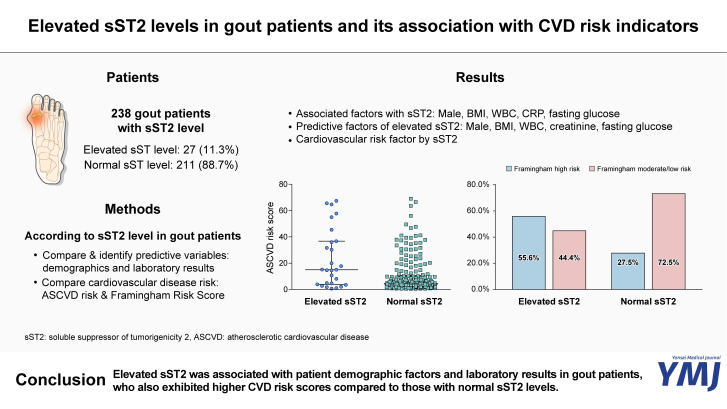
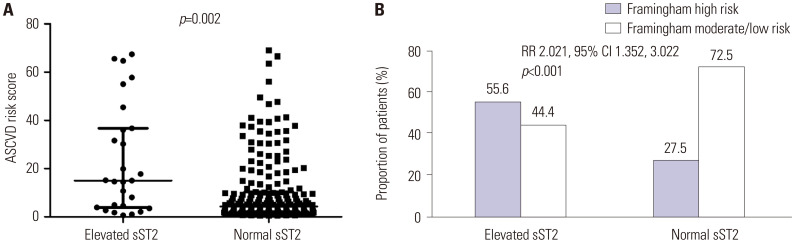
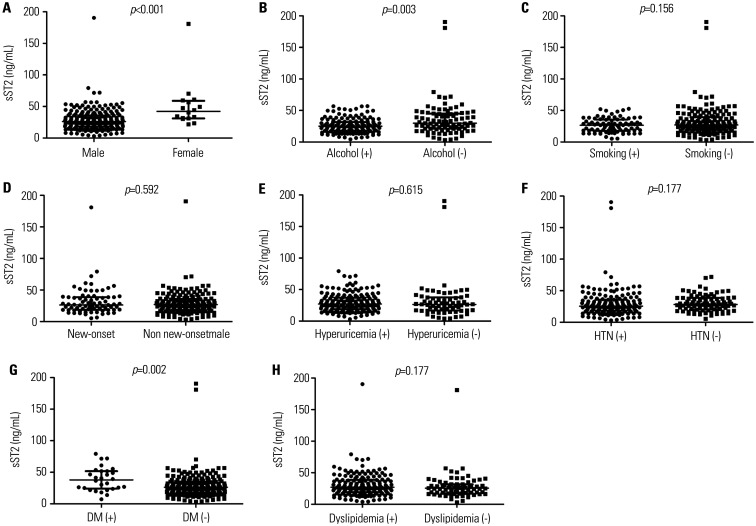
Results: Notably, 27 (11.3%) and 211 (88.7%) of the 238 identified patients had elevated and normal sST2 levels, respectively. Linear regression analysis revealed that male sex (β=-0.190, p=0.002), body mass index (BMI) (β=-0.184, p=0.002), white blood cell count (β=0.231, p<0.001), C-reactive protein (β=0.135, p=0.031), and fasting blood glucose (β=0.210, p<0.001) were independently associated with sST2 levels. In multivariate logistic regression analysis, male sex [odds ratio (OR) 0.112, p=0.001], BMI (OR 0.836, p=0.008), creatinine (OR 5.730, p=0.024), and fasting blood glucose (OR 1.042, p=0.002) predicted elevated sST2 levels. Patients with increased sST2 levels had a significantly higher atherosclerotic cardiovascular disease risk score and a greater proportion of high-risk Framingham Risk Score compared to the normal sST2 group (p=0.002 and p<0.001).
Conclusion: Patients with gout and elevated sST2 levels have a higher risk of future cardiovascular disorders, which may provide insights into risk stratification and the implementation of intervention strategies.
期刊介绍:
The goal of the Yonsei Medical Journal (YMJ) is to publish high quality manuscripts dedicated to clinical or basic research. Any authors affiliated with an accredited biomedical institution may submit manuscripts of original articles, review articles, case reports, brief communications, and letters to the Editor.




 京公网安备 11010802042870号
京ICP备2023020795号-1
京公网安备 11010802042870号
京ICP备2023020795号-1

 分享
分享
 求助内容:
求助内容: 应助结果提醒方式:
 扫码关注我们
