Faustus A Azerigyik, Shelby M Cagle, William C Wilson, Dana N Mitzel, Rebekah C Kading
{"title":"温度对蚊子感染裂谷热病毒的影响以及气候驱动的流行病:综述。","authors":"Faustus A Azerigyik, Shelby M Cagle, William C Wilson, Dana N Mitzel, Rebekah C Kading","doi":"10.3390/v17020217","DOIUrl":null,"url":null,"abstract":"<p><p>Rift Valley fever virus (RVFV) is a mosquito-borne zoonotic disease within the genus <i>Phlebovirus</i>. Symptoms of the disease in animals range from moderate to severe febrile illness, which significantly impacts the livestock industry and causes severe health complications in humans. Similar to bunyaviruses in the genus <i>Orthobunyavirus</i> transmitted by mosquitoes, RVFV progression is dependent on the susceptibility of the physical, cellular, microbial, and immune response barriers of the vectors. These barriers, shaped by the genetic makeup of the mosquito species and the surrounding environmental temperature, exert strong selective pressure on the virus, affecting its replication, evolution, and spread. The changing climate coupled with the aforementioned bottlenecks are significant drivers of RVF epidemics and expansion into previously nonendemic areas. Despite the link between microclimatic changes and RVF outbreaks, there is still a dearth of knowledge on how these temperature effects impact RVF transmission and vector competence and virus persistence during interepidemic years. This intricate interdependence between the virus, larval habitat temperatures, and vector competence necessitates increased efforts in addressing RVFV disease burden. This review highlights recent advancements made in response to shifting demographics, weather patterns, and conveyance of RVFV. Additionally, ongoing studies related to temperature-sensitive variations in RVFV-vector interactions and knowledge gaps are discussed.</p>","PeriodicalId":49328,"journal":{"name":"Viruses-Basel","volume":"17 2","pages":""},"PeriodicalIF":3.5000,"publicationDate":"2025-02-01","publicationTypes":"Journal Article","fieldsOfStudy":null,"isOpenAccess":false,"openAccessPdf":"https://www.ncbi.nlm.nih.gov/pmc/articles/PMC11860320/pdf/","citationCount":"0","resultStr":"{\"title\":\"The Temperature-Associated Effects of Rift Valley Fever Virus Infections in Mosquitoes and Climate-Driven Epidemics: A Review.\",\"authors\":\"Faustus A Azerigyik, Shelby M Cagle, William C Wilson, Dana N Mitzel, Rebekah C Kading\",\"doi\":\"10.3390/v17020217\",\"DOIUrl\":null,\"url\":null,\"abstract\":\"<p><p>Rift Valley fever virus (RVFV) is a mosquito-borne zoonotic disease within the genus <i>Phlebovirus</i>. Symptoms of the disease in animals range from moderate to severe febrile illness, which significantly impacts the livestock industry and causes severe health complications in humans. Similar to bunyaviruses in the genus <i>Orthobunyavirus</i> transmitted by mosquitoes, RVFV progression is dependent on the susceptibility of the physical, cellular, microbial, and immune response barriers of the vectors. These barriers, shaped by the genetic makeup of the mosquito species and the surrounding environmental temperature, exert strong selective pressure on the virus, affecting its replication, evolution, and spread. The changing climate coupled with the aforementioned bottlenecks are significant drivers of RVF epidemics and expansion into previously nonendemic areas. Despite the link between microclimatic changes and RVF outbreaks, there is still a dearth of knowledge on how these temperature effects impact RVF transmission and vector competence and virus persistence during interepidemic years. This intricate interdependence between the virus, larval habitat temperatures, and vector competence necessitates increased efforts in addressing RVFV disease burden. This review highlights recent advancements made in response to shifting demographics, weather patterns, and conveyance of RVFV. Additionally, ongoing studies related to temperature-sensitive variations in RVFV-vector interactions and knowledge gaps are discussed.</p>\",\"PeriodicalId\":49328,\"journal\":{\"name\":\"Viruses-Basel\",\"volume\":\"17 2\",\"pages\":\"\"},\"PeriodicalIF\":3.5000,\"publicationDate\":\"2025-02-01\",\"publicationTypes\":\"Journal Article\",\"fieldsOfStudy\":null,\"isOpenAccess\":false,\"openAccessPdf\":\"https://www.ncbi.nlm.nih.gov/pmc/articles/PMC11860320/pdf/\",\"citationCount\":\"0\",\"resultStr\":null,\"platform\":\"Semanticscholar\",\"paperid\":null,\"PeriodicalName\":\"Viruses-Basel\",\"FirstCategoryId\":\"3\",\"ListUrlMain\":\"https://doi.org/10.3390/v17020217\",\"RegionNum\":3,\"RegionCategory\":\"医学\",\"ArticlePicture\":[],\"TitleCN\":null,\"AbstractTextCN\":null,\"PMCID\":null,\"EPubDate\":\"\",\"PubModel\":\"\",\"JCR\":\"Q2\",\"JCRName\":\"VIROLOGY\",\"Score\":null,\"Total\":0}","platform":"Semanticscholar","paperid":null,"PeriodicalName":"Viruses-Basel","FirstCategoryId":"3","ListUrlMain":"https://doi.org/10.3390/v17020217","RegionNum":3,"RegionCategory":"医学","ArticlePicture":[],"TitleCN":null,"AbstractTextCN":null,"PMCID":null,"EPubDate":"","PubModel":"","JCR":"Q2","JCRName":"VIROLOGY","Score":null,"Total":0}
The Temperature-Associated Effects of Rift Valley Fever Virus Infections in Mosquitoes and Climate-Driven Epidemics: A Review.
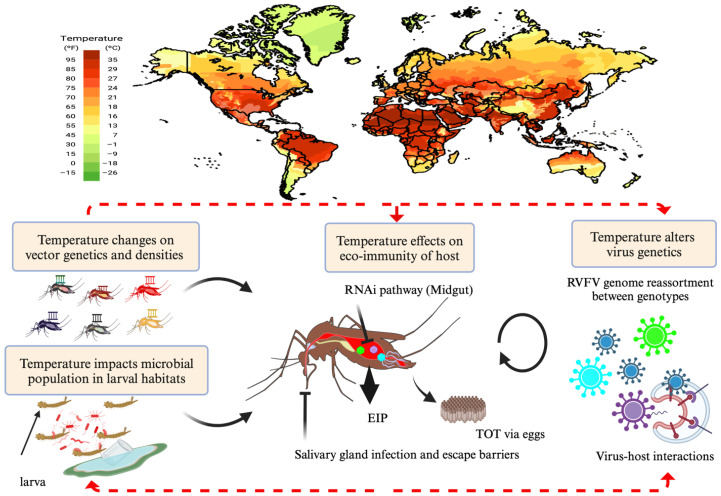
Rift Valley fever virus (RVFV) is a mosquito-borne zoonotic disease within the genus Phlebovirus. Symptoms of the disease in animals range from moderate to severe febrile illness, which significantly impacts the livestock industry and causes severe health complications in humans. Similar to bunyaviruses in the genus Orthobunyavirus transmitted by mosquitoes, RVFV progression is dependent on the susceptibility of the physical, cellular, microbial, and immune response barriers of the vectors. These barriers, shaped by the genetic makeup of the mosquito species and the surrounding environmental temperature, exert strong selective pressure on the virus, affecting its replication, evolution, and spread. The changing climate coupled with the aforementioned bottlenecks are significant drivers of RVF epidemics and expansion into previously nonendemic areas. Despite the link between microclimatic changes and RVF outbreaks, there is still a dearth of knowledge on how these temperature effects impact RVF transmission and vector competence and virus persistence during interepidemic years. This intricate interdependence between the virus, larval habitat temperatures, and vector competence necessitates increased efforts in addressing RVFV disease burden. This review highlights recent advancements made in response to shifting demographics, weather patterns, and conveyance of RVFV. Additionally, ongoing studies related to temperature-sensitive variations in RVFV-vector interactions and knowledge gaps are discussed.
期刊介绍:
Viruses (ISSN 1999-4915) is an open access journal which provides an advanced forum for studies of viruses. It publishes reviews, regular research papers, communications, conference reports and short notes. Our aim is to encourage scientists to publish their experimental and theoretical results in as much detail as possible. There is no restriction on the length of the papers. The full experimental details must be provided so that the results can be reproduced. We also encourage the publication of timely reviews and commentaries on topics of interest to the virology community and feature highlights from the virology literature in the ''News and Views'' section. Electronic files or software regarding the full details of the calculation and experimental procedure, if unable to be published in a normal way, can be deposited as supplementary material.




 京公网安备 11010802042870号
京ICP备2023020795号-1
京公网安备 11010802042870号
京ICP备2023020795号-1

 分享
分享
 求助内容:
求助内容: 应助结果提醒方式:
 扫码关注我们
