Sayan Mullick Chowdhury, Feng Hong, Christian Rolfo, Zihai Li, Kai He, Robert Wesolowski, Amir Mortazavi, Lingbin Meng
{"title":"CNPY2在实体肿瘤中的作用:机制、生物标志物潜力和治疗意义。","authors":"Sayan Mullick Chowdhury, Feng Hong, Christian Rolfo, Zihai Li, Kai He, Robert Wesolowski, Amir Mortazavi, Lingbin Meng","doi":"10.3390/biology14020214","DOIUrl":null,"url":null,"abstract":"<p><p>Canopy FGF signaling regulator 2 (CNPY2) has emerged as a crucial player in cancer development by promoting cell proliferation, tissue repair, and angiogenesis. This review synthesizes the current understanding of CNPY2's role in solid tumors, particularly renal cell carcinoma, prostate cancer, hepatocellular carcinoma, and non-small-cell lung cancer. CNPY2 modulates key pathways such as p53, MYLIP, NF-κB, and AKT/GSK3β, thereby driving tumor growth and progression. In renal cell carcinoma, CNPY2 paradoxically promotes tumor growth through p53 upregulation, while in hepatocellular carcinoma, CNPY2 drives cell cycle progression via p53 destabilization. In prostate cancer, it enhances tumor progression by stabilizing androgen receptors through MYLIP interaction, and in non-small-cell lung cancer, it contributes to chemoresistance and metastasis through NF-κB and AKT/GSK3β signaling. Additionally, CNPY2 influences the tumor microenvironment, impacting immune function and metastatic potential. As a potential biomarker, CNPY2 shows promise for cancer detection and prognosis, particularly when used in combination with other markers. Early therapeutic strategies, including siRNA and miRNA approaches, are under exploration, though challenges remain due to CNPY2's expression in normal tissues and potential off-target effects. This review underscores the need for further research to fully elucidate CNPY2's oncogenic mechanisms and develop targeted therapies. Improved understanding of CNPY2's diverse roles may lead to novel diagnostic and therapeutic approaches in solid tumors.</p>","PeriodicalId":48624,"journal":{"name":"Biology-Basel","volume":"14 2","pages":""},"PeriodicalIF":4.3000,"publicationDate":"2025-02-18","publicationTypes":"Journal Article","fieldsOfStudy":null,"isOpenAccess":false,"openAccessPdf":"https://www.ncbi.nlm.nih.gov/pmc/articles/PMC11851889/pdf/","citationCount":"0","resultStr":"{\"title\":\"CNPY2 in Solid Tumors: Mechanisms, Biomarker Potential, and Therapeutic Implications.\",\"authors\":\"Sayan Mullick Chowdhury, Feng Hong, Christian Rolfo, Zihai Li, Kai He, Robert Wesolowski, Amir Mortazavi, Lingbin Meng\",\"doi\":\"10.3390/biology14020214\",\"DOIUrl\":null,\"url\":null,\"abstract\":\"<p><p>Canopy FGF signaling regulator 2 (CNPY2) has emerged as a crucial player in cancer development by promoting cell proliferation, tissue repair, and angiogenesis. This review synthesizes the current understanding of CNPY2's role in solid tumors, particularly renal cell carcinoma, prostate cancer, hepatocellular carcinoma, and non-small-cell lung cancer. CNPY2 modulates key pathways such as p53, MYLIP, NF-κB, and AKT/GSK3β, thereby driving tumor growth and progression. In renal cell carcinoma, CNPY2 paradoxically promotes tumor growth through p53 upregulation, while in hepatocellular carcinoma, CNPY2 drives cell cycle progression via p53 destabilization. In prostate cancer, it enhances tumor progression by stabilizing androgen receptors through MYLIP interaction, and in non-small-cell lung cancer, it contributes to chemoresistance and metastasis through NF-κB and AKT/GSK3β signaling. Additionally, CNPY2 influences the tumor microenvironment, impacting immune function and metastatic potential. As a potential biomarker, CNPY2 shows promise for cancer detection and prognosis, particularly when used in combination with other markers. Early therapeutic strategies, including siRNA and miRNA approaches, are under exploration, though challenges remain due to CNPY2's expression in normal tissues and potential off-target effects. This review underscores the need for further research to fully elucidate CNPY2's oncogenic mechanisms and develop targeted therapies. Improved understanding of CNPY2's diverse roles may lead to novel diagnostic and therapeutic approaches in solid tumors.</p>\",\"PeriodicalId\":48624,\"journal\":{\"name\":\"Biology-Basel\",\"volume\":\"14 2\",\"pages\":\"\"},\"PeriodicalIF\":4.3000,\"publicationDate\":\"2025-02-18\",\"publicationTypes\":\"Journal Article\",\"fieldsOfStudy\":null,\"isOpenAccess\":false,\"openAccessPdf\":\"https://www.ncbi.nlm.nih.gov/pmc/articles/PMC11851889/pdf/\",\"citationCount\":\"0\",\"resultStr\":null,\"platform\":\"Semanticscholar\",\"paperid\":null,\"PeriodicalName\":\"Biology-Basel\",\"FirstCategoryId\":\"99\",\"ListUrlMain\":\"https://doi.org/10.3390/biology14020214\",\"RegionNum\":3,\"RegionCategory\":\"生物学\",\"ArticlePicture\":[],\"TitleCN\":null,\"AbstractTextCN\":null,\"PMCID\":null,\"EPubDate\":\"\",\"PubModel\":\"\",\"JCR\":\"Q1\",\"JCRName\":\"BIOLOGY\",\"Score\":null,\"Total\":0}","platform":"Semanticscholar","paperid":null,"PeriodicalName":"Biology-Basel","FirstCategoryId":"99","ListUrlMain":"https://doi.org/10.3390/biology14020214","RegionNum":3,"RegionCategory":"生物学","ArticlePicture":[],"TitleCN":null,"AbstractTextCN":null,"PMCID":null,"EPubDate":"","PubModel":"","JCR":"Q1","JCRName":"BIOLOGY","Score":null,"Total":0}
CNPY2 in Solid Tumors: Mechanisms, Biomarker Potential, and Therapeutic Implications.
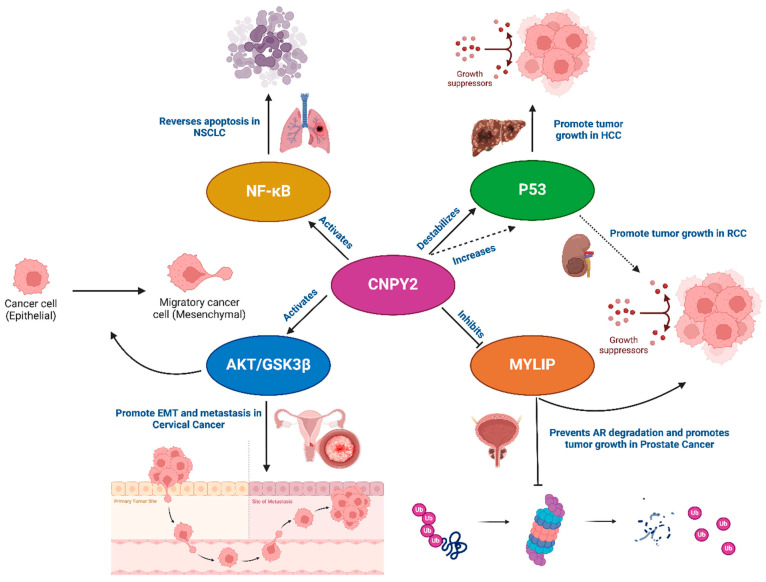
Canopy FGF signaling regulator 2 (CNPY2) has emerged as a crucial player in cancer development by promoting cell proliferation, tissue repair, and angiogenesis. This review synthesizes the current understanding of CNPY2's role in solid tumors, particularly renal cell carcinoma, prostate cancer, hepatocellular carcinoma, and non-small-cell lung cancer. CNPY2 modulates key pathways such as p53, MYLIP, NF-κB, and AKT/GSK3β, thereby driving tumor growth and progression. In renal cell carcinoma, CNPY2 paradoxically promotes tumor growth through p53 upregulation, while in hepatocellular carcinoma, CNPY2 drives cell cycle progression via p53 destabilization. In prostate cancer, it enhances tumor progression by stabilizing androgen receptors through MYLIP interaction, and in non-small-cell lung cancer, it contributes to chemoresistance and metastasis through NF-κB and AKT/GSK3β signaling. Additionally, CNPY2 influences the tumor microenvironment, impacting immune function and metastatic potential. As a potential biomarker, CNPY2 shows promise for cancer detection and prognosis, particularly when used in combination with other markers. Early therapeutic strategies, including siRNA and miRNA approaches, are under exploration, though challenges remain due to CNPY2's expression in normal tissues and potential off-target effects. This review underscores the need for further research to fully elucidate CNPY2's oncogenic mechanisms and develop targeted therapies. Improved understanding of CNPY2's diverse roles may lead to novel diagnostic and therapeutic approaches in solid tumors.
期刊介绍:
Biology (ISSN 2079-7737) is an international, peer-reviewed, quick-refereeing open access journal of Biological Science published by MDPI online. It publishes reviews, research papers and communications in all areas of biology and at the interface of related disciplines. Our aim is to encourage scientists to publish their experimental and theoretical results in as much detail as possible. There is no restriction on the length of the papers. The full experimental details must be provided so that the results can be reproduced. Electronic files regarding the full details of the experimental procedure, if unable to be published in a normal way, can be deposited as supplementary material.





 京公网安备 11010802042870号
京ICP备2023020795号-1
京公网安备 11010802042870号
京ICP备2023020795号-1

 分享
分享
 求助内容:
求助内容: 应助结果提醒方式:
 扫码关注我们
