{"title":"黄河山东地区鱼类生物量粒度谱的时空变化特征","authors":"Lufeng Sun, Jianglong Que, Jianqun Niu, Xiuqi Li, Junpeng Wang, Xuri Cong","doi":"10.3390/biology14020196","DOIUrl":null,"url":null,"abstract":"<p><p>Based on the data from a continuous fishery resource survey conducted in the Shandong province area of the Yellow River from the summer and autumn of 2022 to the winter and spring of 2023, this study constructed fish biomass particle-size spectra. It compared and analyzed the differences in the characteristics of the fish biomass particle-size spectrum parameters across four different seasons in various survey areas. The results indicated that the fish biomass particle-size spectra in the Shandong province area of the Yellow River exhibited significant seasonal and spatial variations. Overall, the shape of the Sheldon-type biomass particle-size spectra across the four seasons showed a unimodal pattern. The peak values in spring and summer ranged between 32-64 g, while in autumn, it reached 64-128 g, and in winter, it was 1024-2048 g. The dominant species shifted from small individuals in spring and summer to larger individuals in autumn and winter. The fitted curves of the standardized biomass particle-size spectra for the four seasons displayed a dome-shaped parabola, generally arranged from high to low in the biomass particle-size spectra lines from spring to winter, with winter experiencing the least external disturbance. In terms of the regional distribution, the peak particle-size classes for fish in the areas of Gaocun, Dong'a, and Gaoqing all corresponded to the particle-size class of 16-32 g, predominantly featuring small fish species such as <i>Carassius auratus</i> and <i>Pseudobrama simoni</i>. In contrast, the peak particle-size class in the estuarine waters corresponded to 512-1024 g, mainly comprising larger fish species like <i>Cyprinus carpio</i>, <i>Hypophthalmichthys molitrix</i>, and <i>Liza haematocheila</i>. The differences in the standardized biomass particle-size spectra among the four regions were not significant, but the curvature of the estuarine waters was the highest, indicating the least external disturbance. The abundance-biomass comparison (ABC) curve suggested that the fish community in the Shandong province area of the Yellow River is in a severely disturbed state.</p>","PeriodicalId":48624,"journal":{"name":"Biology-Basel","volume":"14 2","pages":""},"PeriodicalIF":4.3000,"publicationDate":"2025-02-13","publicationTypes":"Journal Article","fieldsOfStudy":null,"isOpenAccess":false,"openAccessPdf":"https://www.ncbi.nlm.nih.gov/pmc/articles/PMC11851740/pdf/","citationCount":"0","resultStr":"{\"title\":\"Temporal and Spatial Variation Characteristics of the Fish Biomass Particle-Size Spectra in the Shandong Province Area of the Yellow River.\",\"authors\":\"Lufeng Sun, Jianglong Que, Jianqun Niu, Xiuqi Li, Junpeng Wang, Xuri Cong\",\"doi\":\"10.3390/biology14020196\",\"DOIUrl\":null,\"url\":null,\"abstract\":\"<p><p>Based on the data from a continuous fishery resource survey conducted in the Shandong province area of the Yellow River from the summer and autumn of 2022 to the winter and spring of 2023, this study constructed fish biomass particle-size spectra. It compared and analyzed the differences in the characteristics of the fish biomass particle-size spectrum parameters across four different seasons in various survey areas. The results indicated that the fish biomass particle-size spectra in the Shandong province area of the Yellow River exhibited significant seasonal and spatial variations. Overall, the shape of the Sheldon-type biomass particle-size spectra across the four seasons showed a unimodal pattern. The peak values in spring and summer ranged between 32-64 g, while in autumn, it reached 64-128 g, and in winter, it was 1024-2048 g. The dominant species shifted from small individuals in spring and summer to larger individuals in autumn and winter. The fitted curves of the standardized biomass particle-size spectra for the four seasons displayed a dome-shaped parabola, generally arranged from high to low in the biomass particle-size spectra lines from spring to winter, with winter experiencing the least external disturbance. In terms of the regional distribution, the peak particle-size classes for fish in the areas of Gaocun, Dong'a, and Gaoqing all corresponded to the particle-size class of 16-32 g, predominantly featuring small fish species such as <i>Carassius auratus</i> and <i>Pseudobrama simoni</i>. In contrast, the peak particle-size class in the estuarine waters corresponded to 512-1024 g, mainly comprising larger fish species like <i>Cyprinus carpio</i>, <i>Hypophthalmichthys molitrix</i>, and <i>Liza haematocheila</i>. The differences in the standardized biomass particle-size spectra among the four regions were not significant, but the curvature of the estuarine waters was the highest, indicating the least external disturbance. The abundance-biomass comparison (ABC) curve suggested that the fish community in the Shandong province area of the Yellow River is in a severely disturbed state.</p>\",\"PeriodicalId\":48624,\"journal\":{\"name\":\"Biology-Basel\",\"volume\":\"14 2\",\"pages\":\"\"},\"PeriodicalIF\":4.3000,\"publicationDate\":\"2025-02-13\",\"publicationTypes\":\"Journal Article\",\"fieldsOfStudy\":null,\"isOpenAccess\":false,\"openAccessPdf\":\"https://www.ncbi.nlm.nih.gov/pmc/articles/PMC11851740/pdf/\",\"citationCount\":\"0\",\"resultStr\":null,\"platform\":\"Semanticscholar\",\"paperid\":null,\"PeriodicalName\":\"Biology-Basel\",\"FirstCategoryId\":\"99\",\"ListUrlMain\":\"https://doi.org/10.3390/biology14020196\",\"RegionNum\":3,\"RegionCategory\":\"生物学\",\"ArticlePicture\":[],\"TitleCN\":null,\"AbstractTextCN\":null,\"PMCID\":null,\"EPubDate\":\"\",\"PubModel\":\"\",\"JCR\":\"Q1\",\"JCRName\":\"BIOLOGY\",\"Score\":null,\"Total\":0}","platform":"Semanticscholar","paperid":null,"PeriodicalName":"Biology-Basel","FirstCategoryId":"99","ListUrlMain":"https://doi.org/10.3390/biology14020196","RegionNum":3,"RegionCategory":"生物学","ArticlePicture":[],"TitleCN":null,"AbstractTextCN":null,"PMCID":null,"EPubDate":"","PubModel":"","JCR":"Q1","JCRName":"BIOLOGY","Score":null,"Total":0}
Temporal and Spatial Variation Characteristics of the Fish Biomass Particle-Size Spectra in the Shandong Province Area of the Yellow River.
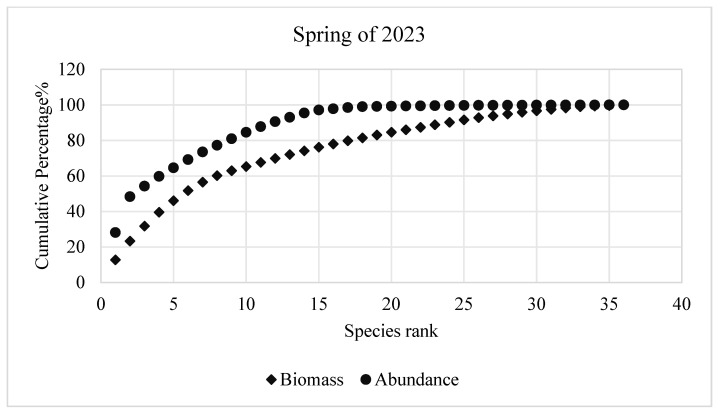
Based on the data from a continuous fishery resource survey conducted in the Shandong province area of the Yellow River from the summer and autumn of 2022 to the winter and spring of 2023, this study constructed fish biomass particle-size spectra. It compared and analyzed the differences in the characteristics of the fish biomass particle-size spectrum parameters across four different seasons in various survey areas. The results indicated that the fish biomass particle-size spectra in the Shandong province area of the Yellow River exhibited significant seasonal and spatial variations. Overall, the shape of the Sheldon-type biomass particle-size spectra across the four seasons showed a unimodal pattern. The peak values in spring and summer ranged between 32-64 g, while in autumn, it reached 64-128 g, and in winter, it was 1024-2048 g. The dominant species shifted from small individuals in spring and summer to larger individuals in autumn and winter. The fitted curves of the standardized biomass particle-size spectra for the four seasons displayed a dome-shaped parabola, generally arranged from high to low in the biomass particle-size spectra lines from spring to winter, with winter experiencing the least external disturbance. In terms of the regional distribution, the peak particle-size classes for fish in the areas of Gaocun, Dong'a, and Gaoqing all corresponded to the particle-size class of 16-32 g, predominantly featuring small fish species such as Carassius auratus and Pseudobrama simoni. In contrast, the peak particle-size class in the estuarine waters corresponded to 512-1024 g, mainly comprising larger fish species like Cyprinus carpio, Hypophthalmichthys molitrix, and Liza haematocheila. The differences in the standardized biomass particle-size spectra among the four regions were not significant, but the curvature of the estuarine waters was the highest, indicating the least external disturbance. The abundance-biomass comparison (ABC) curve suggested that the fish community in the Shandong province area of the Yellow River is in a severely disturbed state.
期刊介绍:
Biology (ISSN 2079-7737) is an international, peer-reviewed, quick-refereeing open access journal of Biological Science published by MDPI online. It publishes reviews, research papers and communications in all areas of biology and at the interface of related disciplines. Our aim is to encourage scientists to publish their experimental and theoretical results in as much detail as possible. There is no restriction on the length of the papers. The full experimental details must be provided so that the results can be reproduced. Electronic files regarding the full details of the experimental procedure, if unable to be published in a normal way, can be deposited as supplementary material.





 京公网安备 11010802042870号
京ICP备2023020795号-1
京公网安备 11010802042870号
京ICP备2023020795号-1

 分享
分享
 求助内容:
求助内容: 应助结果提醒方式:
 扫码关注我们
