Heuder G O Paião, Antônio C da Costa, Noely E Ferreira, Layla Honorato, Bianca M Dos Santos, Maria L M de Matos, Renan B Domingues, Carlos A Senne, Amanda de O Lopes, Vanessa S de Paula, Steven S Witkin, Tânia R Tozetto-Mendoza, Maria Cássia Mendes-Correa
{"title":"急性中枢神经系统感染个体脑脊液中水痘-带状疱疹病毒的系统发育分析:一项探索性研究。","authors":"Heuder G O Paião, Antônio C da Costa, Noely E Ferreira, Layla Honorato, Bianca M Dos Santos, Maria L M de Matos, Renan B Domingues, Carlos A Senne, Amanda de O Lopes, Vanessa S de Paula, Steven S Witkin, Tânia R Tozetto-Mendoza, Maria Cássia Mendes-Correa","doi":"10.3390/v17020286","DOIUrl":null,"url":null,"abstract":"<p><strong>Background: </strong>There is scarce information on Varicella-Zoster virus genetic variability in individuals with acute central nervous system infection in Brazil. The objective of this study was the molecular characterization of Varicella-Zoster virus isolates in cerebrospinal fluid from individuals with acute central nervous system infection.</p><p><strong>Methods: </strong>Cerebrospinal fluid samples were collected from individuals evaluated in emergency and community healthcare services in São Paulo, Brazil. Varicella-Zoster virus identification was performed using commercial platforms Biofire-FilmArray Meningitis/Encephalitis (BioMérieux, Craponne, France) and XGEN-UMLTI-N9<sup>®</sup> (Mobius Life, Pinhais, Brazil). Positive samples were further characterized as wild-type or vaccine-strain by a real-time polymerase chain reaction assay that targeted a single nucleotide polymorphism in open reading frame 62. We also estimated the mean genetic distance and phylogenetic reconstruction based on open reading frames 22, 38, 54, and 62 in relation to sequences of intercontinentally circulating Varicella-Zoster virus isolates.</p><p><strong>Results: </strong>Among the 600 cerebrospinal fluid samples, we identified Varicella-Zoster virus in 30 (5%) samples. None were positive for the vaccine-strain. Twelve samples were sequenced and phylogenetically classified into Clades 1 (41.7%), 2 (25%), 3 (8.3%), 5 (16.7%), or 6 (8%).</p><p><strong>Conclusion: </strong>Enhanced characterization of circulating Varicella-Zoster virus Clades in Brazil identified previously unreported Clades 2 and 6 as well as three other Clades disseminated intercontinentally. These findings reinforce the importance of Varicella-Zoster virus molecular surveillance in cerebrospinal fluid.</p>","PeriodicalId":49328,"journal":{"name":"Viruses-Basel","volume":"17 2","pages":""},"PeriodicalIF":3.8000,"publicationDate":"2025-02-19","publicationTypes":"Journal Article","fieldsOfStudy":null,"isOpenAccess":false,"openAccessPdf":"https://www.ncbi.nlm.nih.gov/pmc/articles/PMC11860453/pdf/","citationCount":"0","resultStr":"{\"title\":\"Phylogenetic Analysis of Varicella-Zoster Virus in Cerebrospinal Fluid from Individuals with Acute Central Nervous System Infection: An Exploratory Study.\",\"authors\":\"Heuder G O Paião, Antônio C da Costa, Noely E Ferreira, Layla Honorato, Bianca M Dos Santos, Maria L M de Matos, Renan B Domingues, Carlos A Senne, Amanda de O Lopes, Vanessa S de Paula, Steven S Witkin, Tânia R Tozetto-Mendoza, Maria Cássia Mendes-Correa\",\"doi\":\"10.3390/v17020286\",\"DOIUrl\":null,\"url\":null,\"abstract\":\"<p><strong>Background: </strong>There is scarce information on Varicella-Zoster virus genetic variability in individuals with acute central nervous system infection in Brazil. The objective of this study was the molecular characterization of Varicella-Zoster virus isolates in cerebrospinal fluid from individuals with acute central nervous system infection.</p><p><strong>Methods: </strong>Cerebrospinal fluid samples were collected from individuals evaluated in emergency and community healthcare services in São Paulo, Brazil. Varicella-Zoster virus identification was performed using commercial platforms Biofire-FilmArray Meningitis/Encephalitis (BioMérieux, Craponne, France) and XGEN-UMLTI-N9<sup>®</sup> (Mobius Life, Pinhais, Brazil). Positive samples were further characterized as wild-type or vaccine-strain by a real-time polymerase chain reaction assay that targeted a single nucleotide polymorphism in open reading frame 62. We also estimated the mean genetic distance and phylogenetic reconstruction based on open reading frames 22, 38, 54, and 62 in relation to sequences of intercontinentally circulating Varicella-Zoster virus isolates.</p><p><strong>Results: </strong>Among the 600 cerebrospinal fluid samples, we identified Varicella-Zoster virus in 30 (5%) samples. None were positive for the vaccine-strain. Twelve samples were sequenced and phylogenetically classified into Clades 1 (41.7%), 2 (25%), 3 (8.3%), 5 (16.7%), or 6 (8%).</p><p><strong>Conclusion: </strong>Enhanced characterization of circulating Varicella-Zoster virus Clades in Brazil identified previously unreported Clades 2 and 6 as well as three other Clades disseminated intercontinentally. These findings reinforce the importance of Varicella-Zoster virus molecular surveillance in cerebrospinal fluid.</p>\",\"PeriodicalId\":49328,\"journal\":{\"name\":\"Viruses-Basel\",\"volume\":\"17 2\",\"pages\":\"\"},\"PeriodicalIF\":3.8000,\"publicationDate\":\"2025-02-19\",\"publicationTypes\":\"Journal Article\",\"fieldsOfStudy\":null,\"isOpenAccess\":false,\"openAccessPdf\":\"https://www.ncbi.nlm.nih.gov/pmc/articles/PMC11860453/pdf/\",\"citationCount\":\"0\",\"resultStr\":null,\"platform\":\"Semanticscholar\",\"paperid\":null,\"PeriodicalName\":\"Viruses-Basel\",\"FirstCategoryId\":\"3\",\"ListUrlMain\":\"https://doi.org/10.3390/v17020286\",\"RegionNum\":3,\"RegionCategory\":\"医学\",\"ArticlePicture\":[],\"TitleCN\":null,\"AbstractTextCN\":null,\"PMCID\":null,\"EPubDate\":\"\",\"PubModel\":\"\",\"JCR\":\"Q2\",\"JCRName\":\"VIROLOGY\",\"Score\":null,\"Total\":0}","platform":"Semanticscholar","paperid":null,"PeriodicalName":"Viruses-Basel","FirstCategoryId":"3","ListUrlMain":"https://doi.org/10.3390/v17020286","RegionNum":3,"RegionCategory":"医学","ArticlePicture":[],"TitleCN":null,"AbstractTextCN":null,"PMCID":null,"EPubDate":"","PubModel":"","JCR":"Q2","JCRName":"VIROLOGY","Score":null,"Total":0}
Phylogenetic Analysis of Varicella-Zoster Virus in Cerebrospinal Fluid from Individuals with Acute Central Nervous System Infection: An Exploratory Study.
Background: There is scarce information on Varicella-Zoster virus genetic variability in individuals with acute central nervous system infection in Brazil. The objective of this study was the molecular characterization of Varicella-Zoster virus isolates in cerebrospinal fluid from individuals with acute central nervous system infection.
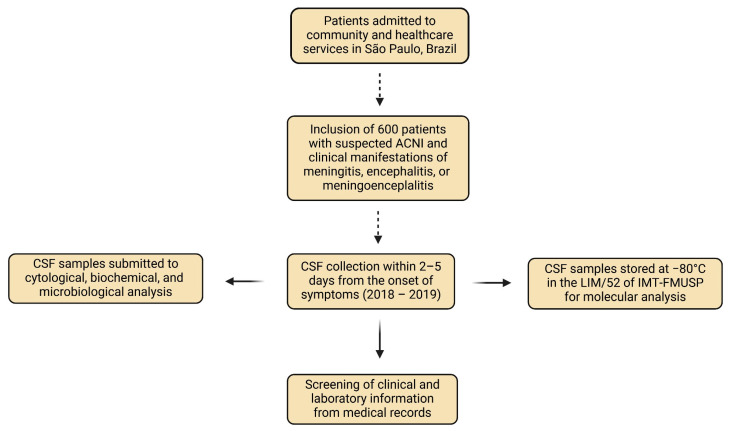
Methods: Cerebrospinal fluid samples were collected from individuals evaluated in emergency and community healthcare services in São Paulo, Brazil. Varicella-Zoster virus identification was performed using commercial platforms Biofire-FilmArray Meningitis/Encephalitis (BioMérieux, Craponne, France) and XGEN-UMLTI-N9® (Mobius Life, Pinhais, Brazil). Positive samples were further characterized as wild-type or vaccine-strain by a real-time polymerase chain reaction assay that targeted a single nucleotide polymorphism in open reading frame 62. We also estimated the mean genetic distance and phylogenetic reconstruction based on open reading frames 22, 38, 54, and 62 in relation to sequences of intercontinentally circulating Varicella-Zoster virus isolates.
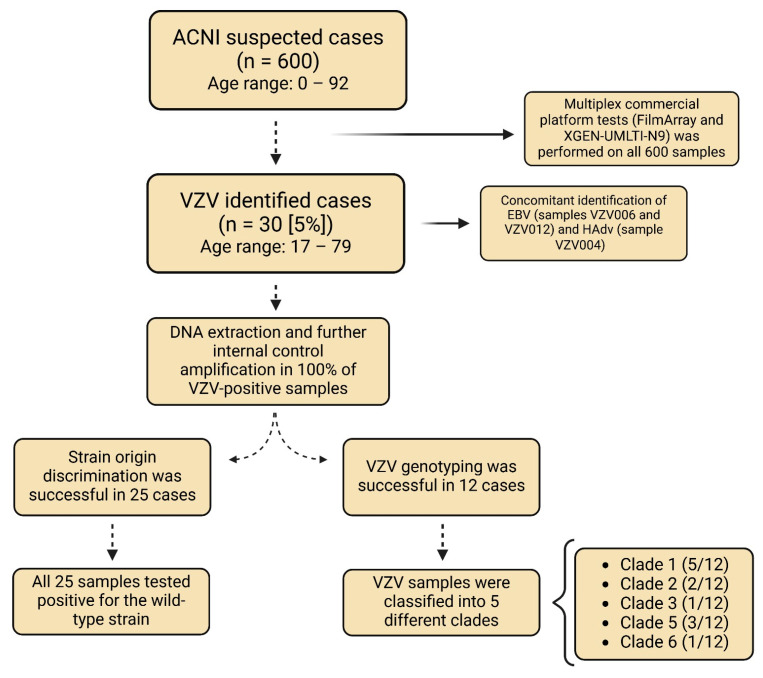
Results: Among the 600 cerebrospinal fluid samples, we identified Varicella-Zoster virus in 30 (5%) samples. None were positive for the vaccine-strain. Twelve samples were sequenced and phylogenetically classified into Clades 1 (41.7%), 2 (25%), 3 (8.3%), 5 (16.7%), or 6 (8%).
Conclusion: Enhanced characterization of circulating Varicella-Zoster virus Clades in Brazil identified previously unreported Clades 2 and 6 as well as three other Clades disseminated intercontinentally. These findings reinforce the importance of Varicella-Zoster virus molecular surveillance in cerebrospinal fluid.
期刊介绍:
Viruses (ISSN 1999-4915) is an open access journal which provides an advanced forum for studies of viruses. It publishes reviews, regular research papers, communications, conference reports and short notes. Our aim is to encourage scientists to publish their experimental and theoretical results in as much detail as possible. There is no restriction on the length of the papers. The full experimental details must be provided so that the results can be reproduced. We also encourage the publication of timely reviews and commentaries on topics of interest to the virology community and feature highlights from the virology literature in the ''News and Views'' section. Electronic files or software regarding the full details of the calculation and experimental procedure, if unable to be published in a normal way, can be deposited as supplementary material.





 京公网安备 11010802042870号
京ICP备2023020795号-1
京公网安备 11010802042870号
京ICP备2023020795号-1

 分享
分享
 求助内容:
求助内容: 应助结果提醒方式:
 扫码关注我们
