Pâmela Jóyce Previdelli da Conceição, Gabriela Miranda Ayusso, Tamara Carvalho, Maria Leticia Duarte Lima, Mikaela Dos Santos Marinho, Fábio Rogério Moraes, Paola Elaine Galán-Jurado, José González-Santamaría, Cíntia Bittar, Bo Zhang, Ana Carolina Gomes Jardim, Paula Rahal, Marilia Freitas Calmon
{"title":"多酚(-)-表没食子儿茶素-3-没食子酸酯(EGCG)抗Mayaro病毒活性的体外评价","authors":"Pâmela Jóyce Previdelli da Conceição, Gabriela Miranda Ayusso, Tamara Carvalho, Maria Leticia Duarte Lima, Mikaela Dos Santos Marinho, Fábio Rogério Moraes, Paola Elaine Galán-Jurado, José González-Santamaría, Cíntia Bittar, Bo Zhang, Ana Carolina Gomes Jardim, Paula Rahal, Marilia Freitas Calmon","doi":"10.3390/v17020258","DOIUrl":null,"url":null,"abstract":"<p><p>The Mayaro virus (MAYV), <i>Togaviridae</i> family, genus <i>Alphavirus</i>, has caused several sporadic outbreaks, affecting countries in the Americas. Currently, there are no licensed drugs against MAYV, requiring the search for effective antiviral compounds. Thus, this study aimed to evaluate the antiviral potential of polyphenol (-)-epigallocatechin-3-gallate (EGCG) against MAYV infection, in vitro. Antiviral assays against MAYV were performed in BHK-21 and Vero E6 cells. In addition, molecular docking was performed with EGCG and the MAYV non-structural and structural proteins. EGCG showed a significant protective effect against MAYV infection in both cell lines. The virucidal assay showed an effect on extracellular viral particles at the entry stage into BHK-21 cells. Finally, it also showed significant inhibition in the post-entry stages of the MAYV replication cycle, acting on the replication of the genetic material and late stages, such as assembly and release. In addition, the MAYV proteins E1 and nsP1 were significantly inhibited by the EGCG treatment in BHK-21 cells. Molecular docking analysis also showed that EGCG could interact with MAYV Capsid and Envelope proteins (E1 and E2). Therefore, this study shows the potential of EGCG as a promising antiviral against MAYV, as it acts on different stages of the MAYV replication cycle.</p>","PeriodicalId":49328,"journal":{"name":"Viruses-Basel","volume":"17 2","pages":""},"PeriodicalIF":3.8000,"publicationDate":"2025-02-14","publicationTypes":"Journal Article","fieldsOfStudy":null,"isOpenAccess":false,"openAccessPdf":"https://www.ncbi.nlm.nih.gov/pmc/articles/PMC11860591/pdf/","citationCount":"0","resultStr":"{\"title\":\"In Vitro Evaluation of the Antiviral Activity of Polyphenol (-)-Epigallocatechin-3-Gallate (EGCG) Against Mayaro Virus.\",\"authors\":\"Pâmela Jóyce Previdelli da Conceição, Gabriela Miranda Ayusso, Tamara Carvalho, Maria Leticia Duarte Lima, Mikaela Dos Santos Marinho, Fábio Rogério Moraes, Paola Elaine Galán-Jurado, José González-Santamaría, Cíntia Bittar, Bo Zhang, Ana Carolina Gomes Jardim, Paula Rahal, Marilia Freitas Calmon\",\"doi\":\"10.3390/v17020258\",\"DOIUrl\":null,\"url\":null,\"abstract\":\"<p><p>The Mayaro virus (MAYV), <i>Togaviridae</i> family, genus <i>Alphavirus</i>, has caused several sporadic outbreaks, affecting countries in the Americas. Currently, there are no licensed drugs against MAYV, requiring the search for effective antiviral compounds. Thus, this study aimed to evaluate the antiviral potential of polyphenol (-)-epigallocatechin-3-gallate (EGCG) against MAYV infection, in vitro. Antiviral assays against MAYV were performed in BHK-21 and Vero E6 cells. In addition, molecular docking was performed with EGCG and the MAYV non-structural and structural proteins. EGCG showed a significant protective effect against MAYV infection in both cell lines. The virucidal assay showed an effect on extracellular viral particles at the entry stage into BHK-21 cells. Finally, it also showed significant inhibition in the post-entry stages of the MAYV replication cycle, acting on the replication of the genetic material and late stages, such as assembly and release. In addition, the MAYV proteins E1 and nsP1 were significantly inhibited by the EGCG treatment in BHK-21 cells. Molecular docking analysis also showed that EGCG could interact with MAYV Capsid and Envelope proteins (E1 and E2). Therefore, this study shows the potential of EGCG as a promising antiviral against MAYV, as it acts on different stages of the MAYV replication cycle.</p>\",\"PeriodicalId\":49328,\"journal\":{\"name\":\"Viruses-Basel\",\"volume\":\"17 2\",\"pages\":\"\"},\"PeriodicalIF\":3.8000,\"publicationDate\":\"2025-02-14\",\"publicationTypes\":\"Journal Article\",\"fieldsOfStudy\":null,\"isOpenAccess\":false,\"openAccessPdf\":\"https://www.ncbi.nlm.nih.gov/pmc/articles/PMC11860591/pdf/\",\"citationCount\":\"0\",\"resultStr\":null,\"platform\":\"Semanticscholar\",\"paperid\":null,\"PeriodicalName\":\"Viruses-Basel\",\"FirstCategoryId\":\"3\",\"ListUrlMain\":\"https://doi.org/10.3390/v17020258\",\"RegionNum\":3,\"RegionCategory\":\"医学\",\"ArticlePicture\":[],\"TitleCN\":null,\"AbstractTextCN\":null,\"PMCID\":null,\"EPubDate\":\"\",\"PubModel\":\"\",\"JCR\":\"Q2\",\"JCRName\":\"VIROLOGY\",\"Score\":null,\"Total\":0}","platform":"Semanticscholar","paperid":null,"PeriodicalName":"Viruses-Basel","FirstCategoryId":"3","ListUrlMain":"https://doi.org/10.3390/v17020258","RegionNum":3,"RegionCategory":"医学","ArticlePicture":[],"TitleCN":null,"AbstractTextCN":null,"PMCID":null,"EPubDate":"","PubModel":"","JCR":"Q2","JCRName":"VIROLOGY","Score":null,"Total":0}
In Vitro Evaluation of the Antiviral Activity of Polyphenol (-)-Epigallocatechin-3-Gallate (EGCG) Against Mayaro Virus.
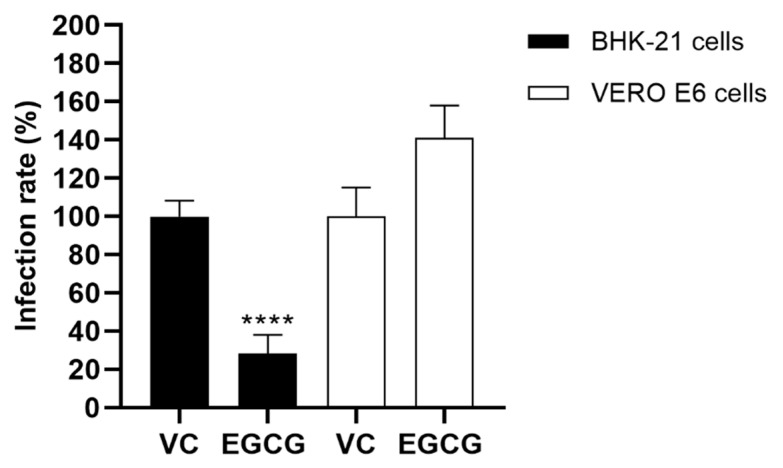
The Mayaro virus (MAYV), Togaviridae family, genus Alphavirus, has caused several sporadic outbreaks, affecting countries in the Americas. Currently, there are no licensed drugs against MAYV, requiring the search for effective antiviral compounds. Thus, this study aimed to evaluate the antiviral potential of polyphenol (-)-epigallocatechin-3-gallate (EGCG) against MAYV infection, in vitro. Antiviral assays against MAYV were performed in BHK-21 and Vero E6 cells. In addition, molecular docking was performed with EGCG and the MAYV non-structural and structural proteins. EGCG showed a significant protective effect against MAYV infection in both cell lines. The virucidal assay showed an effect on extracellular viral particles at the entry stage into BHK-21 cells. Finally, it also showed significant inhibition in the post-entry stages of the MAYV replication cycle, acting on the replication of the genetic material and late stages, such as assembly and release. In addition, the MAYV proteins E1 and nsP1 were significantly inhibited by the EGCG treatment in BHK-21 cells. Molecular docking analysis also showed that EGCG could interact with MAYV Capsid and Envelope proteins (E1 and E2). Therefore, this study shows the potential of EGCG as a promising antiviral against MAYV, as it acts on different stages of the MAYV replication cycle.
期刊介绍:
Viruses (ISSN 1999-4915) is an open access journal which provides an advanced forum for studies of viruses. It publishes reviews, regular research papers, communications, conference reports and short notes. Our aim is to encourage scientists to publish their experimental and theoretical results in as much detail as possible. There is no restriction on the length of the papers. The full experimental details must be provided so that the results can be reproduced. We also encourage the publication of timely reviews and commentaries on topics of interest to the virology community and feature highlights from the virology literature in the ''News and Views'' section. Electronic files or software regarding the full details of the calculation and experimental procedure, if unable to be published in a normal way, can be deposited as supplementary material.






 京公网安备 11010802042870号
京ICP备2023020795号-1
京公网安备 11010802042870号
京ICP备2023020795号-1

 分享
分享
 求助内容:
求助内容: 应助结果提醒方式:
 扫码关注我们
