{"title":"病毒再感染对神经坏死病毒耐药和易感的欧洲黑鲈头肾转录组的影响","authors":"Dimitra K Toubanaki, Odysseas-Panagiotis Tzortzatos, Antonia Efstathiou, Vasileios Bakopoulos, Evdokia Karagouni","doi":"10.3390/v17020230","DOIUrl":null,"url":null,"abstract":"<p><p>Fish viral infections have great environmental and economic implications in aquaculture. Nervous necrosis virus (NNV) is a pathogen affecting more than 120 different species, causing high mortality and morbidity. Herein, we study how NNV re-infection affects the European sea bass (<i>Dicentrarchus labrax</i>, L.) head kidney transcriptome in disease-resistant and -susceptible sea bass families. To determine how each family responds to re-infection, we performed the RNA-sequencing analysis of experimentally NNV-infected <i>D. labrax</i>. Fish were experimentally infected in a long-term study, and one month after the last recorded death, all surviving fish were re-infected by the same NNV strain. Fish tissues were sampled 7 days upon re-infection. The transcriptome profiles of infected vs. non-infected fish revealed 103 differentially expressed genes (DEGs) for the resistant family and 336 DEGs for the susceptible family. Only a few pathways were commonly enriched in the two families, further indicating that the resistant and susceptible families utilize completely different mechanisms to fight the NNV re-infection. Protein-protein interaction analysis identified a variety of hub genes for the resistant and the susceptible families, quite distinct in their function on NNV resistance. In conclusion, NNV-resistant and -sensitive sea bass transcriptomes were analyzed following NNV survivors' viral re-infection, offering a glimpse into how host attempts to control the infection depending on its genetic background in relation with virus resistance.</p>","PeriodicalId":49328,"journal":{"name":"Viruses-Basel","volume":"17 2","pages":""},"PeriodicalIF":3.8000,"publicationDate":"2025-02-07","publicationTypes":"Journal Article","fieldsOfStudy":null,"isOpenAccess":false,"openAccessPdf":"https://www.ncbi.nlm.nih.gov/pmc/articles/PMC11860166/pdf/","citationCount":"0","resultStr":"{\"title\":\"Influence of Viral Re-Infection on Head Kidney Transcriptome of Nervous Necrosis Virus-Resistant and -Susceptible European Sea Bass (<i>Dicentrarchus labrax,</i> L.).\",\"authors\":\"Dimitra K Toubanaki, Odysseas-Panagiotis Tzortzatos, Antonia Efstathiou, Vasileios Bakopoulos, Evdokia Karagouni\",\"doi\":\"10.3390/v17020230\",\"DOIUrl\":null,\"url\":null,\"abstract\":\"<p><p>Fish viral infections have great environmental and economic implications in aquaculture. Nervous necrosis virus (NNV) is a pathogen affecting more than 120 different species, causing high mortality and morbidity. Herein, we study how NNV re-infection affects the European sea bass (<i>Dicentrarchus labrax</i>, L.) head kidney transcriptome in disease-resistant and -susceptible sea bass families. To determine how each family responds to re-infection, we performed the RNA-sequencing analysis of experimentally NNV-infected <i>D. labrax</i>. Fish were experimentally infected in a long-term study, and one month after the last recorded death, all surviving fish were re-infected by the same NNV strain. Fish tissues were sampled 7 days upon re-infection. The transcriptome profiles of infected vs. non-infected fish revealed 103 differentially expressed genes (DEGs) for the resistant family and 336 DEGs for the susceptible family. Only a few pathways were commonly enriched in the two families, further indicating that the resistant and susceptible families utilize completely different mechanisms to fight the NNV re-infection. Protein-protein interaction analysis identified a variety of hub genes for the resistant and the susceptible families, quite distinct in their function on NNV resistance. In conclusion, NNV-resistant and -sensitive sea bass transcriptomes were analyzed following NNV survivors' viral re-infection, offering a glimpse into how host attempts to control the infection depending on its genetic background in relation with virus resistance.</p>\",\"PeriodicalId\":49328,\"journal\":{\"name\":\"Viruses-Basel\",\"volume\":\"17 2\",\"pages\":\"\"},\"PeriodicalIF\":3.8000,\"publicationDate\":\"2025-02-07\",\"publicationTypes\":\"Journal Article\",\"fieldsOfStudy\":null,\"isOpenAccess\":false,\"openAccessPdf\":\"https://www.ncbi.nlm.nih.gov/pmc/articles/PMC11860166/pdf/\",\"citationCount\":\"0\",\"resultStr\":null,\"platform\":\"Semanticscholar\",\"paperid\":null,\"PeriodicalName\":\"Viruses-Basel\",\"FirstCategoryId\":\"3\",\"ListUrlMain\":\"https://doi.org/10.3390/v17020230\",\"RegionNum\":3,\"RegionCategory\":\"医学\",\"ArticlePicture\":[],\"TitleCN\":null,\"AbstractTextCN\":null,\"PMCID\":null,\"EPubDate\":\"\",\"PubModel\":\"\",\"JCR\":\"Q2\",\"JCRName\":\"VIROLOGY\",\"Score\":null,\"Total\":0}","platform":"Semanticscholar","paperid":null,"PeriodicalName":"Viruses-Basel","FirstCategoryId":"3","ListUrlMain":"https://doi.org/10.3390/v17020230","RegionNum":3,"RegionCategory":"医学","ArticlePicture":[],"TitleCN":null,"AbstractTextCN":null,"PMCID":null,"EPubDate":"","PubModel":"","JCR":"Q2","JCRName":"VIROLOGY","Score":null,"Total":0}
Influence of Viral Re-Infection on Head Kidney Transcriptome of Nervous Necrosis Virus-Resistant and -Susceptible European Sea Bass (Dicentrarchus labrax, L.).
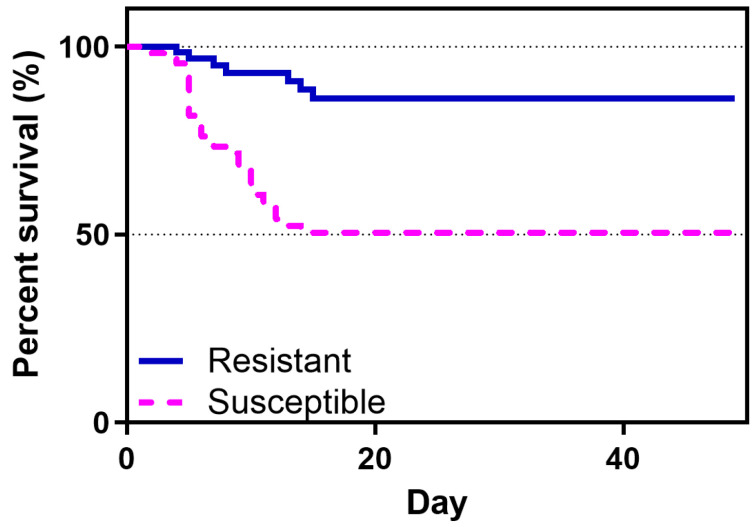
Fish viral infections have great environmental and economic implications in aquaculture. Nervous necrosis virus (NNV) is a pathogen affecting more than 120 different species, causing high mortality and morbidity. Herein, we study how NNV re-infection affects the European sea bass (Dicentrarchus labrax, L.) head kidney transcriptome in disease-resistant and -susceptible sea bass families. To determine how each family responds to re-infection, we performed the RNA-sequencing analysis of experimentally NNV-infected D. labrax. Fish were experimentally infected in a long-term study, and one month after the last recorded death, all surviving fish were re-infected by the same NNV strain. Fish tissues were sampled 7 days upon re-infection. The transcriptome profiles of infected vs. non-infected fish revealed 103 differentially expressed genes (DEGs) for the resistant family and 336 DEGs for the susceptible family. Only a few pathways were commonly enriched in the two families, further indicating that the resistant and susceptible families utilize completely different mechanisms to fight the NNV re-infection. Protein-protein interaction analysis identified a variety of hub genes for the resistant and the susceptible families, quite distinct in their function on NNV resistance. In conclusion, NNV-resistant and -sensitive sea bass transcriptomes were analyzed following NNV survivors' viral re-infection, offering a glimpse into how host attempts to control the infection depending on its genetic background in relation with virus resistance.
期刊介绍:
Viruses (ISSN 1999-4915) is an open access journal which provides an advanced forum for studies of viruses. It publishes reviews, regular research papers, communications, conference reports and short notes. Our aim is to encourage scientists to publish their experimental and theoretical results in as much detail as possible. There is no restriction on the length of the papers. The full experimental details must be provided so that the results can be reproduced. We also encourage the publication of timely reviews and commentaries on topics of interest to the virology community and feature highlights from the virology literature in the ''News and Views'' section. Electronic files or software regarding the full details of the calculation and experimental procedure, if unable to be published in a normal way, can be deposited as supplementary material.






 京公网安备 11010802042870号
京ICP备2023020795号-1
京公网安备 11010802042870号
京ICP备2023020795号-1

 分享
分享
 求助内容:
求助内容: 应助结果提醒方式:
 扫码关注我们
