{"title":"迈向通用翻译器:解码调节正黄病毒感染的ptm。","authors":"Hannah M Schmidt, Stacy M Horner","doi":"10.3390/v17020287","DOIUrl":null,"url":null,"abstract":"<p><p>Post-translational modifications (PTMs) serve as critical regulators of protein function across biological systems, including during viral infection. For orthoflaviviruses, including human pathogens like dengue, Zika, and West Nile viruses, PTMs on viral proteins regulate multiple aspects of the viral lifecycle and pathogenesis. Here, we review the mechanisms by which PTMs regulate orthoflavivirus infection in both vertebrate and arthropod hosts. We examine how ubiquitination and glycosylation on the viral envelope proteins facilitate viral entry and how phosphorylation, SUMOylation, and acetylation on non-structural proteins modulate viral RNA replication. Additionally, we describe how PTMs on viral structural proteins dynamically regulate viral assembly and egress. We also describe how PTMs can influence tissue tropism and host-specific pathogenesis, with some modifications showing divergent functions between arthropod vectors and vertebrate hosts, and how the host antiviral response can trigger specific PTMs on viral proteins to restrict infection, highlighting PTMs as key mediators of host-pathogen interactions. While significant progress has been made in identifying PTMs on viral proteins, many questions remain about their temporal dynamics, mechanisms of action, and conservation across the orthoflavivirus genus. Understanding how PTMs regulate orthoflavivirus infection may reveal new therapeutic strategies, particularly given recent advances in targeting specific protein modifications for disease treatment.</p>","PeriodicalId":49328,"journal":{"name":"Viruses-Basel","volume":"17 2","pages":""},"PeriodicalIF":3.5000,"publicationDate":"2025-02-19","publicationTypes":"Journal Article","fieldsOfStudy":null,"isOpenAccess":false,"openAccessPdf":"https://www.ncbi.nlm.nih.gov/pmc/articles/PMC11861903/pdf/","citationCount":"0","resultStr":"{\"title\":\"Towards a Universal Translator: Decoding the PTMs That Regulate Orthoflavivirus Infection.\",\"authors\":\"Hannah M Schmidt, Stacy M Horner\",\"doi\":\"10.3390/v17020287\",\"DOIUrl\":null,\"url\":null,\"abstract\":\"<p><p>Post-translational modifications (PTMs) serve as critical regulators of protein function across biological systems, including during viral infection. For orthoflaviviruses, including human pathogens like dengue, Zika, and West Nile viruses, PTMs on viral proteins regulate multiple aspects of the viral lifecycle and pathogenesis. Here, we review the mechanisms by which PTMs regulate orthoflavivirus infection in both vertebrate and arthropod hosts. We examine how ubiquitination and glycosylation on the viral envelope proteins facilitate viral entry and how phosphorylation, SUMOylation, and acetylation on non-structural proteins modulate viral RNA replication. Additionally, we describe how PTMs on viral structural proteins dynamically regulate viral assembly and egress. We also describe how PTMs can influence tissue tropism and host-specific pathogenesis, with some modifications showing divergent functions between arthropod vectors and vertebrate hosts, and how the host antiviral response can trigger specific PTMs on viral proteins to restrict infection, highlighting PTMs as key mediators of host-pathogen interactions. While significant progress has been made in identifying PTMs on viral proteins, many questions remain about their temporal dynamics, mechanisms of action, and conservation across the orthoflavivirus genus. Understanding how PTMs regulate orthoflavivirus infection may reveal new therapeutic strategies, particularly given recent advances in targeting specific protein modifications for disease treatment.</p>\",\"PeriodicalId\":49328,\"journal\":{\"name\":\"Viruses-Basel\",\"volume\":\"17 2\",\"pages\":\"\"},\"PeriodicalIF\":3.5000,\"publicationDate\":\"2025-02-19\",\"publicationTypes\":\"Journal Article\",\"fieldsOfStudy\":null,\"isOpenAccess\":false,\"openAccessPdf\":\"https://www.ncbi.nlm.nih.gov/pmc/articles/PMC11861903/pdf/\",\"citationCount\":\"0\",\"resultStr\":null,\"platform\":\"Semanticscholar\",\"paperid\":null,\"PeriodicalName\":\"Viruses-Basel\",\"FirstCategoryId\":\"3\",\"ListUrlMain\":\"https://doi.org/10.3390/v17020287\",\"RegionNum\":3,\"RegionCategory\":\"医学\",\"ArticlePicture\":[],\"TitleCN\":null,\"AbstractTextCN\":null,\"PMCID\":null,\"EPubDate\":\"\",\"PubModel\":\"\",\"JCR\":\"Q2\",\"JCRName\":\"VIROLOGY\",\"Score\":null,\"Total\":0}","platform":"Semanticscholar","paperid":null,"PeriodicalName":"Viruses-Basel","FirstCategoryId":"3","ListUrlMain":"https://doi.org/10.3390/v17020287","RegionNum":3,"RegionCategory":"医学","ArticlePicture":[],"TitleCN":null,"AbstractTextCN":null,"PMCID":null,"EPubDate":"","PubModel":"","JCR":"Q2","JCRName":"VIROLOGY","Score":null,"Total":0}
Towards a Universal Translator: Decoding the PTMs That Regulate Orthoflavivirus Infection.
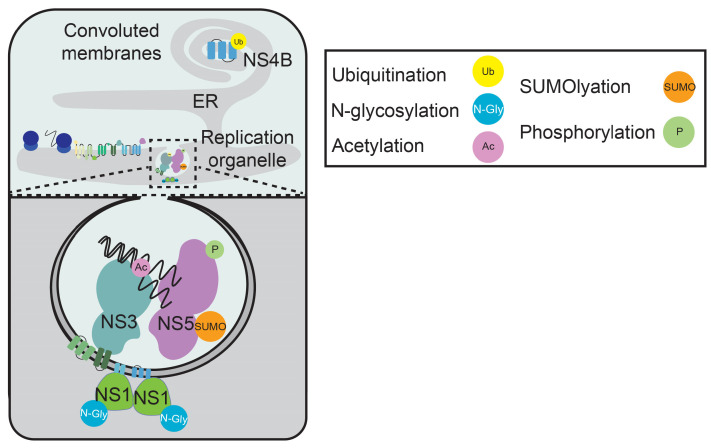
Post-translational modifications (PTMs) serve as critical regulators of protein function across biological systems, including during viral infection. For orthoflaviviruses, including human pathogens like dengue, Zika, and West Nile viruses, PTMs on viral proteins regulate multiple aspects of the viral lifecycle and pathogenesis. Here, we review the mechanisms by which PTMs regulate orthoflavivirus infection in both vertebrate and arthropod hosts. We examine how ubiquitination and glycosylation on the viral envelope proteins facilitate viral entry and how phosphorylation, SUMOylation, and acetylation on non-structural proteins modulate viral RNA replication. Additionally, we describe how PTMs on viral structural proteins dynamically regulate viral assembly and egress. We also describe how PTMs can influence tissue tropism and host-specific pathogenesis, with some modifications showing divergent functions between arthropod vectors and vertebrate hosts, and how the host antiviral response can trigger specific PTMs on viral proteins to restrict infection, highlighting PTMs as key mediators of host-pathogen interactions. While significant progress has been made in identifying PTMs on viral proteins, many questions remain about their temporal dynamics, mechanisms of action, and conservation across the orthoflavivirus genus. Understanding how PTMs regulate orthoflavivirus infection may reveal new therapeutic strategies, particularly given recent advances in targeting specific protein modifications for disease treatment.
期刊介绍:
Viruses (ISSN 1999-4915) is an open access journal which provides an advanced forum for studies of viruses. It publishes reviews, regular research papers, communications, conference reports and short notes. Our aim is to encourage scientists to publish their experimental and theoretical results in as much detail as possible. There is no restriction on the length of the papers. The full experimental details must be provided so that the results can be reproduced. We also encourage the publication of timely reviews and commentaries on topics of interest to the virology community and feature highlights from the virology literature in the ''News and Views'' section. Electronic files or software regarding the full details of the calculation and experimental procedure, if unable to be published in a normal way, can be deposited as supplementary material.






 京公网安备 11010802042870号
京ICP备2023020795号-1
京公网安备 11010802042870号
京ICP备2023020795号-1

 分享
分享
 求助内容:
求助内容: 应助结果提醒方式:
 扫码关注我们
