Wei Chen, Yan Wang, Mengyu Zhao, Hong Zhang, Ye Zong, Xinyan Zhao
{"title":"抗pd -1/PD-L1相关性腹泻和结肠炎的发生率及危险因素:中国人群的回顾性队列研究","authors":"Wei Chen, Yan Wang, Mengyu Zhao, Hong Zhang, Ye Zong, Xinyan Zhao","doi":"10.3390/medicina61020353","DOIUrl":null,"url":null,"abstract":"<p><p><i>Background and Objectives</i>: The prevalence of and risk factors for immune checkpoint inhibitor-associated diarrhea and colitis (IMDC) in the Chinese population are unclear. This study aimed to estimate IMDC incidence and identify potential risk factors. <i>Materials and Methods</i>: We reviewed the electronic medical records from Beijing Friendship Hospital (2015-2022) to identify the patients treated with immune checkpoint inhibitors. The primary outcome was IMDC occurrence. The demographics, cancer type, baseline labs, and concurrent medications were analyzed. The univariable and multivariable analyses validated the associated factors. <i>Results</i>: Among 1186 patients (median follow-up: 217 days), the IMDC incidence was 4.6%, with colitis at 0.67%. Digestive system tumors increased the IMDC risk (OR 2.79, 95% CI 1.42-5.75, <i>p</i> = 0.004), while platinum agents decreased it (OR 0.41, 95% CI 0.21-0.78, <i>p</i> = 0.008). PPIs, antibiotics, NSAIDs, and glucocorticoids showed no significant association. Colitis was the third most common irAE, leading to ICI discontinuation (15.6%). <i>Conclusions</i>: IMDC prevalence is 4.6% in the Chinese population, the third most frequent irAE causing ICI discontinuation. Digestive tumors and platinum agents are risk and protective factors, respectively, while other medications show no significant impact.</p>","PeriodicalId":49830,"journal":{"name":"Medicina-Lithuania","volume":"61 2","pages":""},"PeriodicalIF":2.4000,"publicationDate":"2025-02-18","publicationTypes":"Journal Article","fieldsOfStudy":null,"isOpenAccess":false,"openAccessPdf":"https://www.ncbi.nlm.nih.gov/pmc/articles/PMC11857649/pdf/","citationCount":"0","resultStr":"{\"title\":\"Incidence of and Risk Factors for Anti-PD-1/PD-L1- Associated Diarrhea and Colitis: A Retrospective Cohort Study of the Chinese Population.\",\"authors\":\"Wei Chen, Yan Wang, Mengyu Zhao, Hong Zhang, Ye Zong, Xinyan Zhao\",\"doi\":\"10.3390/medicina61020353\",\"DOIUrl\":null,\"url\":null,\"abstract\":\"<p><p><i>Background and Objectives</i>: The prevalence of and risk factors for immune checkpoint inhibitor-associated diarrhea and colitis (IMDC) in the Chinese population are unclear. This study aimed to estimate IMDC incidence and identify potential risk factors. <i>Materials and Methods</i>: We reviewed the electronic medical records from Beijing Friendship Hospital (2015-2022) to identify the patients treated with immune checkpoint inhibitors. The primary outcome was IMDC occurrence. The demographics, cancer type, baseline labs, and concurrent medications were analyzed. The univariable and multivariable analyses validated the associated factors. <i>Results</i>: Among 1186 patients (median follow-up: 217 days), the IMDC incidence was 4.6%, with colitis at 0.67%. Digestive system tumors increased the IMDC risk (OR 2.79, 95% CI 1.42-5.75, <i>p</i> = 0.004), while platinum agents decreased it (OR 0.41, 95% CI 0.21-0.78, <i>p</i> = 0.008). PPIs, antibiotics, NSAIDs, and glucocorticoids showed no significant association. Colitis was the third most common irAE, leading to ICI discontinuation (15.6%). <i>Conclusions</i>: IMDC prevalence is 4.6% in the Chinese population, the third most frequent irAE causing ICI discontinuation. Digestive tumors and platinum agents are risk and protective factors, respectively, while other medications show no significant impact.</p>\",\"PeriodicalId\":49830,\"journal\":{\"name\":\"Medicina-Lithuania\",\"volume\":\"61 2\",\"pages\":\"\"},\"PeriodicalIF\":2.4000,\"publicationDate\":\"2025-02-18\",\"publicationTypes\":\"Journal Article\",\"fieldsOfStudy\":null,\"isOpenAccess\":false,\"openAccessPdf\":\"https://www.ncbi.nlm.nih.gov/pmc/articles/PMC11857649/pdf/\",\"citationCount\":\"0\",\"resultStr\":null,\"platform\":\"Semanticscholar\",\"paperid\":null,\"PeriodicalName\":\"Medicina-Lithuania\",\"FirstCategoryId\":\"3\",\"ListUrlMain\":\"https://doi.org/10.3390/medicina61020353\",\"RegionNum\":4,\"RegionCategory\":\"医学\",\"ArticlePicture\":[],\"TitleCN\":null,\"AbstractTextCN\":null,\"PMCID\":null,\"EPubDate\":\"\",\"PubModel\":\"\",\"JCR\":\"Q1\",\"JCRName\":\"MEDICINE, GENERAL & INTERNAL\",\"Score\":null,\"Total\":0}","platform":"Semanticscholar","paperid":null,"PeriodicalName":"Medicina-Lithuania","FirstCategoryId":"3","ListUrlMain":"https://doi.org/10.3390/medicina61020353","RegionNum":4,"RegionCategory":"医学","ArticlePicture":[],"TitleCN":null,"AbstractTextCN":null,"PMCID":null,"EPubDate":"","PubModel":"","JCR":"Q1","JCRName":"MEDICINE, GENERAL & INTERNAL","Score":null,"Total":0}
引用次数: 0
摘要
背景和目的:免疫检查点抑制剂相关性腹泻和结肠炎(IMDC)在中国人群中的患病率和危险因素尚不清楚。本研究旨在估计IMDC的发病率并确定潜在的危险因素。材料与方法:我们查阅北京友谊医院2015-2022年的电子病历,确定使用免疫检查点抑制剂治疗的患者。主要结局为IMDC的发生。分析人口统计学、癌症类型、基线实验室和同时使用的药物。单变量和多变量分析验证了相关因素。结果:1186例患者(中位随访217天)中,IMDC发生率为4.6%,结肠炎发生率为0.67%。消化系统肿瘤增加IMDC风险(OR 2.79, 95% CI 1.42-5.75, p = 0.004),而铂类药物降低IMDC风险(OR 0.41, 95% CI 0.21-0.78, p = 0.008)。PPIs、抗生素、非甾体抗炎药和糖皮质激素无显著相关性。结肠炎是第三常见的irAE,导致ICI终止(15.6%)。结论:IMDC在中国人群中的患病率为4.6%,是导致ICI停止的第三大最常见的irAE。消化系统肿瘤和铂类药物分别是危险因素和保护因素,而其他药物无显著影响。
Incidence of and Risk Factors for Anti-PD-1/PD-L1- Associated Diarrhea and Colitis: A Retrospective Cohort Study of the Chinese Population.
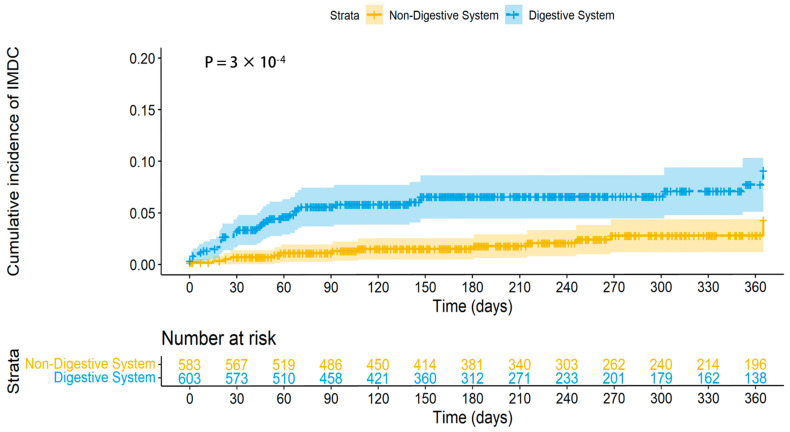
Background and Objectives: The prevalence of and risk factors for immune checkpoint inhibitor-associated diarrhea and colitis (IMDC) in the Chinese population are unclear. This study aimed to estimate IMDC incidence and identify potential risk factors. Materials and Methods: We reviewed the electronic medical records from Beijing Friendship Hospital (2015-2022) to identify the patients treated with immune checkpoint inhibitors. The primary outcome was IMDC occurrence. The demographics, cancer type, baseline labs, and concurrent medications were analyzed. The univariable and multivariable analyses validated the associated factors. Results: Among 1186 patients (median follow-up: 217 days), the IMDC incidence was 4.6%, with colitis at 0.67%. Digestive system tumors increased the IMDC risk (OR 2.79, 95% CI 1.42-5.75, p = 0.004), while platinum agents decreased it (OR 0.41, 95% CI 0.21-0.78, p = 0.008). PPIs, antibiotics, NSAIDs, and glucocorticoids showed no significant association. Colitis was the third most common irAE, leading to ICI discontinuation (15.6%). Conclusions: IMDC prevalence is 4.6% in the Chinese population, the third most frequent irAE causing ICI discontinuation. Digestive tumors and platinum agents are risk and protective factors, respectively, while other medications show no significant impact.
期刊介绍:
The journal’s main focus is on reviews as well as clinical and experimental investigations. The journal aims to advance knowledge related to problems in medicine in developing countries as well as developed economies, to disseminate research on global health, and to promote and foster prevention and treatment of diseases worldwide. MEDICINA publications cater to clinicians, diagnosticians and researchers, and serve as a forum to discuss the current status of health-related matters and their impact on a global and local scale.





 京公网安备 11010802042870号
京ICP备2023020795号-1
京公网安备 11010802042870号
京ICP备2023020795号-1

 分享
分享
 求助内容:
求助内容: 应助结果提醒方式:
 扫码关注我们
