Jorge Garrido-Mantilla, Juan Sanhueza, Julio Alvarez, Jeremy S Pittman, Peter Davies, Montserrat Torremorell, Marie R Culhane
{"title":"在综合养猪场系统种猪群中使用定制流感疫苗后,断奶仔猪甲型流感病毒流行率降低。","authors":"Jorge Garrido-Mantilla, Juan Sanhueza, Julio Alvarez, Jeremy S Pittman, Peter Davies, Montserrat Torremorell, Marie R Culhane","doi":"10.3390/v17020240","DOIUrl":null,"url":null,"abstract":"<p><p>Vaccination is a common influenza A virus (IAV) control strategy for pigs. Vaccine efficacy depends on strain cross-protection and effective vaccination program implementation. We evaluated a multi-faceted IAV vaccination strategy which included (a) monthly surveillance of pigs at weaning, (b) selection of epidemiologically relevant strains from farms under surveillance, (c) updating IAV strains in custom-made vaccines, and (d) seasonal mass vaccination with custom-made vaccines given to sows in 35 farrow-to-wean farms within an integrated swine farm system. Reduction of IAV in pigs from vaccinated sows was determined by monthly monitoring of farms for 30 months by IAV rRT-PCR (PCR) testing of nasal wipes collected from litters of piglets at weaning. Hemagglutinin (HA) nucleotide and amino acid (AA) sequence homology of the circulating and vaccine strains was determined by pairwise alignment and AA comparison at antigenic sites. Of the 35 farms monitored, 28 (80%) tested positive at least once, and 481 (5.75%) of 8352 PCR tests were IAV positive. Complete HA sequences were obtained from 54 H1 (22 H1-δ_1B.2.1, 28 H1-γ_1A.3.3.3, and 4 H1-pdm_1A.3.3.2 clades) and 14 H3 (12 IV-A 3.1990.4.1 and 2 IV-B 3.1990.4.2 clades) circulating IAV strains. During the study, custom-made vaccines were updated three times (eight strains total) and administered to sows at five distinct time periods. The HA AA similarity between vaccine and circulating strains ranged from 95% to 99%; however, the 0 to 71% similarity at HA antigenic sites prompted the vaccine updates. Herd IAV prevalence decreased from 40% (14/35) to 2.9% (1/35), accompanied by a numerical reduction in IAV-positive samples post-vaccination. Our results support having a comprehensive approach to controlling influenza in swine herds that includes surveillance, vaccination, and careful program implementation to reduce IAV in pigs.</p>","PeriodicalId":49328,"journal":{"name":"Viruses-Basel","volume":"17 2","pages":""},"PeriodicalIF":3.8000,"publicationDate":"2025-02-10","publicationTypes":"Journal Article","fieldsOfStudy":null,"isOpenAccess":false,"openAccessPdf":"https://www.ncbi.nlm.nih.gov/pmc/articles/PMC11860655/pdf/","citationCount":"0","resultStr":"{\"title\":\"Reduction of Influenza A Virus Prevalence in Pigs at Weaning After Using Custom-Made Influenza Vaccines in the Breeding Herds of an Integrated Swine Farm System.\",\"authors\":\"Jorge Garrido-Mantilla, Juan Sanhueza, Julio Alvarez, Jeremy S Pittman, Peter Davies, Montserrat Torremorell, Marie R Culhane\",\"doi\":\"10.3390/v17020240\",\"DOIUrl\":null,\"url\":null,\"abstract\":\"<p><p>Vaccination is a common influenza A virus (IAV) control strategy for pigs. Vaccine efficacy depends on strain cross-protection and effective vaccination program implementation. We evaluated a multi-faceted IAV vaccination strategy which included (a) monthly surveillance of pigs at weaning, (b) selection of epidemiologically relevant strains from farms under surveillance, (c) updating IAV strains in custom-made vaccines, and (d) seasonal mass vaccination with custom-made vaccines given to sows in 35 farrow-to-wean farms within an integrated swine farm system. Reduction of IAV in pigs from vaccinated sows was determined by monthly monitoring of farms for 30 months by IAV rRT-PCR (PCR) testing of nasal wipes collected from litters of piglets at weaning. Hemagglutinin (HA) nucleotide and amino acid (AA) sequence homology of the circulating and vaccine strains was determined by pairwise alignment and AA comparison at antigenic sites. Of the 35 farms monitored, 28 (80%) tested positive at least once, and 481 (5.75%) of 8352 PCR tests were IAV positive. Complete HA sequences were obtained from 54 H1 (22 H1-δ_1B.2.1, 28 H1-γ_1A.3.3.3, and 4 H1-pdm_1A.3.3.2 clades) and 14 H3 (12 IV-A 3.1990.4.1 and 2 IV-B 3.1990.4.2 clades) circulating IAV strains. During the study, custom-made vaccines were updated three times (eight strains total) and administered to sows at five distinct time periods. The HA AA similarity between vaccine and circulating strains ranged from 95% to 99%; however, the 0 to 71% similarity at HA antigenic sites prompted the vaccine updates. Herd IAV prevalence decreased from 40% (14/35) to 2.9% (1/35), accompanied by a numerical reduction in IAV-positive samples post-vaccination. Our results support having a comprehensive approach to controlling influenza in swine herds that includes surveillance, vaccination, and careful program implementation to reduce IAV in pigs.</p>\",\"PeriodicalId\":49328,\"journal\":{\"name\":\"Viruses-Basel\",\"volume\":\"17 2\",\"pages\":\"\"},\"PeriodicalIF\":3.8000,\"publicationDate\":\"2025-02-10\",\"publicationTypes\":\"Journal Article\",\"fieldsOfStudy\":null,\"isOpenAccess\":false,\"openAccessPdf\":\"https://www.ncbi.nlm.nih.gov/pmc/articles/PMC11860655/pdf/\",\"citationCount\":\"0\",\"resultStr\":null,\"platform\":\"Semanticscholar\",\"paperid\":null,\"PeriodicalName\":\"Viruses-Basel\",\"FirstCategoryId\":\"3\",\"ListUrlMain\":\"https://doi.org/10.3390/v17020240\",\"RegionNum\":3,\"RegionCategory\":\"医学\",\"ArticlePicture\":[],\"TitleCN\":null,\"AbstractTextCN\":null,\"PMCID\":null,\"EPubDate\":\"\",\"PubModel\":\"\",\"JCR\":\"Q2\",\"JCRName\":\"VIROLOGY\",\"Score\":null,\"Total\":0}","platform":"Semanticscholar","paperid":null,"PeriodicalName":"Viruses-Basel","FirstCategoryId":"3","ListUrlMain":"https://doi.org/10.3390/v17020240","RegionNum":3,"RegionCategory":"医学","ArticlePicture":[],"TitleCN":null,"AbstractTextCN":null,"PMCID":null,"EPubDate":"","PubModel":"","JCR":"Q2","JCRName":"VIROLOGY","Score":null,"Total":0}
Reduction of Influenza A Virus Prevalence in Pigs at Weaning After Using Custom-Made Influenza Vaccines in the Breeding Herds of an Integrated Swine Farm System.
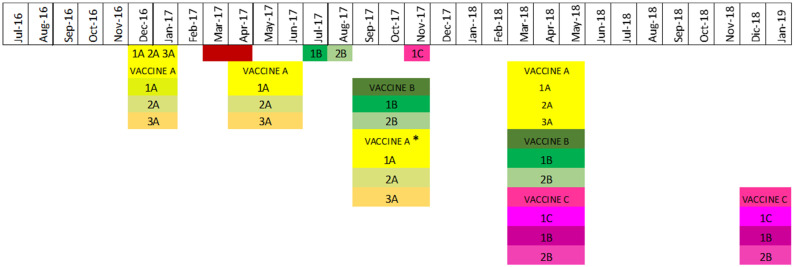
Vaccination is a common influenza A virus (IAV) control strategy for pigs. Vaccine efficacy depends on strain cross-protection and effective vaccination program implementation. We evaluated a multi-faceted IAV vaccination strategy which included (a) monthly surveillance of pigs at weaning, (b) selection of epidemiologically relevant strains from farms under surveillance, (c) updating IAV strains in custom-made vaccines, and (d) seasonal mass vaccination with custom-made vaccines given to sows in 35 farrow-to-wean farms within an integrated swine farm system. Reduction of IAV in pigs from vaccinated sows was determined by monthly monitoring of farms for 30 months by IAV rRT-PCR (PCR) testing of nasal wipes collected from litters of piglets at weaning. Hemagglutinin (HA) nucleotide and amino acid (AA) sequence homology of the circulating and vaccine strains was determined by pairwise alignment and AA comparison at antigenic sites. Of the 35 farms monitored, 28 (80%) tested positive at least once, and 481 (5.75%) of 8352 PCR tests were IAV positive. Complete HA sequences were obtained from 54 H1 (22 H1-δ_1B.2.1, 28 H1-γ_1A.3.3.3, and 4 H1-pdm_1A.3.3.2 clades) and 14 H3 (12 IV-A 3.1990.4.1 and 2 IV-B 3.1990.4.2 clades) circulating IAV strains. During the study, custom-made vaccines were updated three times (eight strains total) and administered to sows at five distinct time periods. The HA AA similarity between vaccine and circulating strains ranged from 95% to 99%; however, the 0 to 71% similarity at HA antigenic sites prompted the vaccine updates. Herd IAV prevalence decreased from 40% (14/35) to 2.9% (1/35), accompanied by a numerical reduction in IAV-positive samples post-vaccination. Our results support having a comprehensive approach to controlling influenza in swine herds that includes surveillance, vaccination, and careful program implementation to reduce IAV in pigs.
期刊介绍:
Viruses (ISSN 1999-4915) is an open access journal which provides an advanced forum for studies of viruses. It publishes reviews, regular research papers, communications, conference reports and short notes. Our aim is to encourage scientists to publish their experimental and theoretical results in as much detail as possible. There is no restriction on the length of the papers. The full experimental details must be provided so that the results can be reproduced. We also encourage the publication of timely reviews and commentaries on topics of interest to the virology community and feature highlights from the virology literature in the ''News and Views'' section. Electronic files or software regarding the full details of the calculation and experimental procedure, if unable to be published in a normal way, can be deposited as supplementary material.





 京公网安备 11010802042870号
京ICP备2023020795号-1
京公网安备 11010802042870号
京ICP备2023020795号-1

 分享
分享
 求助内容:
求助内容: 应助结果提醒方式:
 扫码关注我们
