Young Jun Uhm, Woojin Bang, Jae Hoon Chung, Cheol Young Oh, Hwanik Kim, Jin Seon Cho
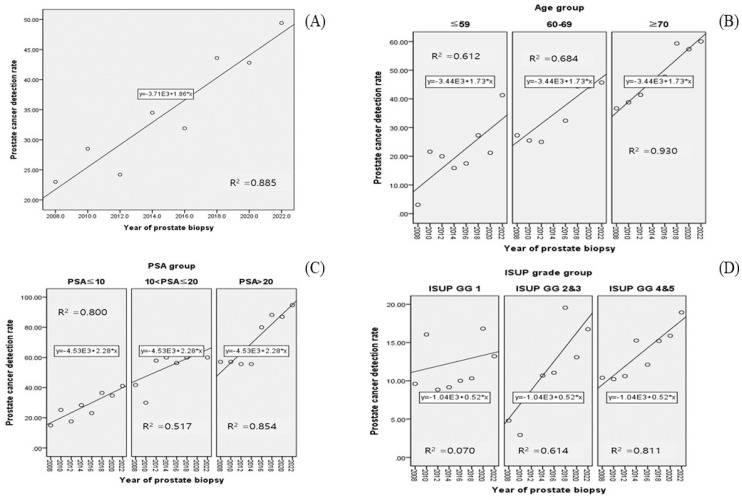
{"title":"前列腺癌检出率与前列腺活检年份的关系。","authors":"Young Jun Uhm, Woojin Bang, Jae Hoon Chung, Cheol Young Oh, Hwanik Kim, Jin Seon Cho","doi":"10.3390/life15020260","DOIUrl":null,"url":null,"abstract":"<p><p>As the prostate cancer (PCa) detection rate in South Korea is increasing year by year, authors investigated whether there was a plausible relationship between the year the prostate biopsy (PBx) was performed and the PCa detection rate. The medical records of 1628 patients who underwent PBx between 2008 and 2022, for each even-numbered year, were retrospectively reviewed. The primary outcome was the PCa detection rate, and the secondary outcome was to determine whether the PCa detection rate was significantly associated with the year of PBx and other clinical factors. When comparing baseline clinical factors among PBx patients by year, there were significant differences in age at the time of PBx (<i>p</i> = 0.017) and the number of PBx cores (<i>p</i> < 0.001). PCa detection rates ranged from 24.8% to 48.9% and were significantly positively correlated with the year of PBx (R<sup>2</sup> = 0.885, <i>p</i> < 0.001). Subgroup analysis according to the prostate-specific antigen (PSA) level (≤10, over 10 to 20, >20 ng/mL) showed detection rates of 13.5-40.9%, 29.2-62.2%, and 73.3-92.6%, respectively (<i>p</i> < 0.001-0.021). Subgroup analysis according to the International Society of Urological Pathology grade group (ISUP GG) (1, 2-3, 4-5) showed that the PCa detection rate increased significantly over time in two subgroups (2-3: 4.8→16.7%, 4-5: 10.4→18.9%, all <i>p</i> = 0.002) except in the ISUP GG 1 subgroup. The PCa detection rate tends to increase with each successive biennial year of PBx. This increasing trend seems to be particularly pronounced in patients with relatively older age, higher PSA, and higher ISUP GG.</p>","PeriodicalId":56144,"journal":{"name":"Life-Basel","volume":"15 2","pages":""},"PeriodicalIF":3.9000,"publicationDate":"2025-02-08","publicationTypes":"Journal Article","fieldsOfStudy":null,"isOpenAccess":false,"openAccessPdf":"https://www.ncbi.nlm.nih.gov/pmc/articles/PMC11856573/pdf/","citationCount":"0","resultStr":"{\"title\":\"Association Between Prostate Cancer Detection Rate and Year of Prostate Biopsy.\",\"authors\":\"Young Jun Uhm, Woojin Bang, Jae Hoon Chung, Cheol Young Oh, Hwanik Kim, Jin Seon Cho\",\"doi\":\"10.3390/life15020260\",\"DOIUrl\":null,\"url\":null,\"abstract\":\"<p><p>As the prostate cancer (PCa) detection rate in South Korea is increasing year by year, authors investigated whether there was a plausible relationship between the year the prostate biopsy (PBx) was performed and the PCa detection rate. The medical records of 1628 patients who underwent PBx between 2008 and 2022, for each even-numbered year, were retrospectively reviewed. The primary outcome was the PCa detection rate, and the secondary outcome was to determine whether the PCa detection rate was significantly associated with the year of PBx and other clinical factors. When comparing baseline clinical factors among PBx patients by year, there were significant differences in age at the time of PBx (<i>p</i> = 0.017) and the number of PBx cores (<i>p</i> < 0.001). PCa detection rates ranged from 24.8% to 48.9% and were significantly positively correlated with the year of PBx (R<sup>2</sup> = 0.885, <i>p</i> < 0.001). Subgroup analysis according to the prostate-specific antigen (PSA) level (≤10, over 10 to 20, >20 ng/mL) showed detection rates of 13.5-40.9%, 29.2-62.2%, and 73.3-92.6%, respectively (<i>p</i> < 0.001-0.021). Subgroup analysis according to the International Society of Urological Pathology grade group (ISUP GG) (1, 2-3, 4-5) showed that the PCa detection rate increased significantly over time in two subgroups (2-3: 4.8→16.7%, 4-5: 10.4→18.9%, all <i>p</i> = 0.002) except in the ISUP GG 1 subgroup. The PCa detection rate tends to increase with each successive biennial year of PBx. This increasing trend seems to be particularly pronounced in patients with relatively older age, higher PSA, and higher ISUP GG.</p>\",\"PeriodicalId\":56144,\"journal\":{\"name\":\"Life-Basel\",\"volume\":\"15 2\",\"pages\":\"\"},\"PeriodicalIF\":3.9000,\"publicationDate\":\"2025-02-08\",\"publicationTypes\":\"Journal Article\",\"fieldsOfStudy\":null,\"isOpenAccess\":false,\"openAccessPdf\":\"https://www.ncbi.nlm.nih.gov/pmc/articles/PMC11856573/pdf/\",\"citationCount\":\"0\",\"resultStr\":null,\"platform\":\"Semanticscholar\",\"paperid\":null,\"PeriodicalName\":\"Life-Basel\",\"FirstCategoryId\":\"99\",\"ListUrlMain\":\"https://doi.org/10.3390/life15020260\",\"RegionNum\":3,\"RegionCategory\":\"生物学\",\"ArticlePicture\":[],\"TitleCN\":null,\"AbstractTextCN\":null,\"PMCID\":null,\"EPubDate\":\"\",\"PubModel\":\"\",\"JCR\":\"Q1\",\"JCRName\":\"BIOLOGY\",\"Score\":null,\"Total\":0}","platform":"Semanticscholar","paperid":null,"PeriodicalName":"Life-Basel","FirstCategoryId":"99","ListUrlMain":"https://doi.org/10.3390/life15020260","RegionNum":3,"RegionCategory":"生物学","ArticlePicture":[],"TitleCN":null,"AbstractTextCN":null,"PMCID":null,"EPubDate":"","PubModel":"","JCR":"Q1","JCRName":"BIOLOGY","Score":null,"Total":0}
Association Between Prostate Cancer Detection Rate and Year of Prostate Biopsy.
As the prostate cancer (PCa) detection rate in South Korea is increasing year by year, authors investigated whether there was a plausible relationship between the year the prostate biopsy (PBx) was performed and the PCa detection rate. The medical records of 1628 patients who underwent PBx between 2008 and 2022, for each even-numbered year, were retrospectively reviewed. The primary outcome was the PCa detection rate, and the secondary outcome was to determine whether the PCa detection rate was significantly associated with the year of PBx and other clinical factors. When comparing baseline clinical factors among PBx patients by year, there were significant differences in age at the time of PBx (p = 0.017) and the number of PBx cores (p < 0.001). PCa detection rates ranged from 24.8% to 48.9% and were significantly positively correlated with the year of PBx (R2 = 0.885, p < 0.001). Subgroup analysis according to the prostate-specific antigen (PSA) level (≤10, over 10 to 20, >20 ng/mL) showed detection rates of 13.5-40.9%, 29.2-62.2%, and 73.3-92.6%, respectively (p < 0.001-0.021). Subgroup analysis according to the International Society of Urological Pathology grade group (ISUP GG) (1, 2-3, 4-5) showed that the PCa detection rate increased significantly over time in two subgroups (2-3: 4.8→16.7%, 4-5: 10.4→18.9%, all p = 0.002) except in the ISUP GG 1 subgroup. The PCa detection rate tends to increase with each successive biennial year of PBx. This increasing trend seems to be particularly pronounced in patients with relatively older age, higher PSA, and higher ISUP GG.
Life-BaselBiochemistry, Genetics and Molecular Biology-General Biochemistry,Genetics and Molecular Biology
CiteScore
4.30
自引率
6.20%
发文量
1798
审稿时长
11 weeks
期刊介绍:
Life (ISSN 2075-1729) is an international, peer-reviewed open access journal of scientific studies related to fundamental themes in Life Sciences, especially those concerned with the origins of life and evolution of biosystems. Our aim is to encourage scientists to publish their experimental and theoretical results in as much detail as possible. There is no restriction on the length of the papers.





 京公网安备 11010802042870号
京ICP备2023020795号-1
京公网安备 11010802042870号
京ICP备2023020795号-1

 分享
分享
 求助内容:
求助内容: 应助结果提醒方式:
 扫码关注我们
