Ștefan Nicolaie Lujinschi, Bogdan Marian Sorohan, Bogdan Obrișcă, Alexandra Vrabie, Elena Rusu, Diana Zilișteanu, Camelia Achim, Andreea Gabriella Andronesi, Gener Ismail
{"title":"阿尔波特综合征的候选基因修饰因子:一个病例系列。","authors":"Ștefan Nicolaie Lujinschi, Bogdan Marian Sorohan, Bogdan Obrișcă, Alexandra Vrabie, Elena Rusu, Diana Zilișteanu, Camelia Achim, Andreea Gabriella Andronesi, Gener Ismail","doi":"10.3390/life15020298","DOIUrl":null,"url":null,"abstract":"<p><strong>Background: </strong>Alport syndrome (AS) is one of the most common monogenic kidney disorders. Recent studies have highlighted the modifier effect of variants involving podocyte and non-collagenous extracellular matrix (ECM) proteins in AS.</p><p><strong>Methods: </strong>We report a case series of eight patients with genetically proven AS and simultaneous variants involving podocyte and non-collagenous ECM proteins. Our aim is to describe the influence of such variants on the phenotype of patients with AS.</p><p><strong>Results: </strong>We identified 10 different type IV collagen variants. Patients were diagnosed with autosomal dominant (3/8), autosomal recessive (2/8), digenic (2/8) and X-linked AS (1/8). There were eight different variants involving podocyte and non-collagenous ECM proteins. The genes involved were CRB2, LAMA5, LAMB2, NUP107, MYO1E and PLCE1. Four patients (LAMB2, LAMA5 and PLCE1 variants) presented with nephrotic syndrome or nephrotic range proteinuria. Two patients had hearing loss. Most patients (7/8) had a family history of kidney disease. Two patients (LAMB2 and LAMA5 variants) were diagnosed with focal segmental glomerulosclerosis. Two patients developed end-stage kidney disease (LAMA5, MYO1E and NUP107 variants).</p><p><strong>Conclusions: </strong>Although mutations of podocyte and ECM proteins do not have phenotypic expression in monoallelic form, the presence of such variants could explain the phenotypic variability of AS.</p>","PeriodicalId":56144,"journal":{"name":"Life-Basel","volume":"15 2","pages":""},"PeriodicalIF":3.9000,"publicationDate":"2025-02-14","publicationTypes":"Journal Article","fieldsOfStudy":null,"isOpenAccess":false,"openAccessPdf":"https://www.ncbi.nlm.nih.gov/pmc/articles/PMC11857524/pdf/","citationCount":"0","resultStr":"{\"title\":\"Candidate Genetic Modifiers in Alport Syndrome: A Case Series.\",\"authors\":\"Ștefan Nicolaie Lujinschi, Bogdan Marian Sorohan, Bogdan Obrișcă, Alexandra Vrabie, Elena Rusu, Diana Zilișteanu, Camelia Achim, Andreea Gabriella Andronesi, Gener Ismail\",\"doi\":\"10.3390/life15020298\",\"DOIUrl\":null,\"url\":null,\"abstract\":\"<p><strong>Background: </strong>Alport syndrome (AS) is one of the most common monogenic kidney disorders. Recent studies have highlighted the modifier effect of variants involving podocyte and non-collagenous extracellular matrix (ECM) proteins in AS.</p><p><strong>Methods: </strong>We report a case series of eight patients with genetically proven AS and simultaneous variants involving podocyte and non-collagenous ECM proteins. Our aim is to describe the influence of such variants on the phenotype of patients with AS.</p><p><strong>Results: </strong>We identified 10 different type IV collagen variants. Patients were diagnosed with autosomal dominant (3/8), autosomal recessive (2/8), digenic (2/8) and X-linked AS (1/8). There were eight different variants involving podocyte and non-collagenous ECM proteins. The genes involved were CRB2, LAMA5, LAMB2, NUP107, MYO1E and PLCE1. Four patients (LAMB2, LAMA5 and PLCE1 variants) presented with nephrotic syndrome or nephrotic range proteinuria. Two patients had hearing loss. Most patients (7/8) had a family history of kidney disease. Two patients (LAMB2 and LAMA5 variants) were diagnosed with focal segmental glomerulosclerosis. Two patients developed end-stage kidney disease (LAMA5, MYO1E and NUP107 variants).</p><p><strong>Conclusions: </strong>Although mutations of podocyte and ECM proteins do not have phenotypic expression in monoallelic form, the presence of such variants could explain the phenotypic variability of AS.</p>\",\"PeriodicalId\":56144,\"journal\":{\"name\":\"Life-Basel\",\"volume\":\"15 2\",\"pages\":\"\"},\"PeriodicalIF\":3.9000,\"publicationDate\":\"2025-02-14\",\"publicationTypes\":\"Journal Article\",\"fieldsOfStudy\":null,\"isOpenAccess\":false,\"openAccessPdf\":\"https://www.ncbi.nlm.nih.gov/pmc/articles/PMC11857524/pdf/\",\"citationCount\":\"0\",\"resultStr\":null,\"platform\":\"Semanticscholar\",\"paperid\":null,\"PeriodicalName\":\"Life-Basel\",\"FirstCategoryId\":\"99\",\"ListUrlMain\":\"https://doi.org/10.3390/life15020298\",\"RegionNum\":3,\"RegionCategory\":\"生物学\",\"ArticlePicture\":[],\"TitleCN\":null,\"AbstractTextCN\":null,\"PMCID\":null,\"EPubDate\":\"\",\"PubModel\":\"\",\"JCR\":\"Q1\",\"JCRName\":\"BIOLOGY\",\"Score\":null,\"Total\":0}","platform":"Semanticscholar","paperid":null,"PeriodicalName":"Life-Basel","FirstCategoryId":"99","ListUrlMain":"https://doi.org/10.3390/life15020298","RegionNum":3,"RegionCategory":"生物学","ArticlePicture":[],"TitleCN":null,"AbstractTextCN":null,"PMCID":null,"EPubDate":"","PubModel":"","JCR":"Q1","JCRName":"BIOLOGY","Score":null,"Total":0}
Candidate Genetic Modifiers in Alport Syndrome: A Case Series.
Background: Alport syndrome (AS) is one of the most common monogenic kidney disorders. Recent studies have highlighted the modifier effect of variants involving podocyte and non-collagenous extracellular matrix (ECM) proteins in AS.
Methods: We report a case series of eight patients with genetically proven AS and simultaneous variants involving podocyte and non-collagenous ECM proteins. Our aim is to describe the influence of such variants on the phenotype of patients with AS.
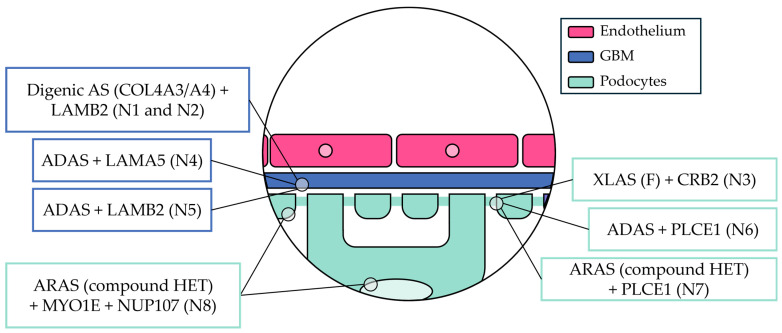
Results: We identified 10 different type IV collagen variants. Patients were diagnosed with autosomal dominant (3/8), autosomal recessive (2/8), digenic (2/8) and X-linked AS (1/8). There were eight different variants involving podocyte and non-collagenous ECM proteins. The genes involved were CRB2, LAMA5, LAMB2, NUP107, MYO1E and PLCE1. Four patients (LAMB2, LAMA5 and PLCE1 variants) presented with nephrotic syndrome or nephrotic range proteinuria. Two patients had hearing loss. Most patients (7/8) had a family history of kidney disease. Two patients (LAMB2 and LAMA5 variants) were diagnosed with focal segmental glomerulosclerosis. Two patients developed end-stage kidney disease (LAMA5, MYO1E and NUP107 variants).
Conclusions: Although mutations of podocyte and ECM proteins do not have phenotypic expression in monoallelic form, the presence of such variants could explain the phenotypic variability of AS.
Life-BaselBiochemistry, Genetics and Molecular Biology-General Biochemistry,Genetics and Molecular Biology
CiteScore
4.30
自引率
6.20%
发文量
1798
审稿时长
11 weeks
期刊介绍:
Life (ISSN 2075-1729) is an international, peer-reviewed open access journal of scientific studies related to fundamental themes in Life Sciences, especially those concerned with the origins of life and evolution of biosystems. Our aim is to encourage scientists to publish their experimental and theoretical results in as much detail as possible. There is no restriction on the length of the papers.





 京公网安备 11010802042870号
京ICP备2023020795号-1
京公网安备 11010802042870号
京ICP备2023020795号-1

 分享
分享
 求助内容:
求助内容: 应助结果提醒方式:
 扫码关注我们
