Fatih Tarlak, Jean Carlos Correia Peres Costa, Ozgun Yucel
{"title":"用于预测乳酸菌与单核增生李斯特菌相互作用行为的机器学习辅助软件的开发。","authors":"Fatih Tarlak, Jean Carlos Correia Peres Costa, Ozgun Yucel","doi":"10.3390/life15020244","DOIUrl":null,"url":null,"abstract":"<p><p>Biopreservation technology has emerged as a promising approach to enhance food safety and extend shelf life by leveraging the antimicrobial properties of beneficial microorganisms. This study aims to develop precise predictive models to characterize the growth and interaction dynamics of lactic acid bacteria (LAB) and <i>Listeria monocytogenes</i>, which serve as bioprotective agents in food systems. Using both traditional and machine learning modelling approaches, we analyzed data from previously published growth curves in broth (BHI) and milk under isothermal conditions (4, 10, and 30 °C). The models evaluated mono-culture conditions for <i>L. monocytogenes</i> and LAB, as well as their competitive interactions in co-culture scenarios. The modified Gompertz model demonstrated the best performance for mono-culture simulations, while a combination of the modified Gompertz and Lotka-Volterra models effectively described co-culture interactions, achieving high adjusted R-squared values (<i>adjusted R</i><sup>2</sup> = 0.978 and 0.962) and low root mean square errors (<i>RMSE</i> = 0.324 and 0.507) for BHI and milk, respectively. Machine learning approaches further validated these findings, with improved statistical indices (adjusted <i>R</i><sup>2</sup> = 0.988 and 0.966, <i>RMSE</i> = 0.242 and 0.475 for BHI and milk, respectively), suggesting their potential as robust alternatives to traditional methods. The integration of machine learning-assisted software developed in this work into predictive microbiology demonstrates significant advancements by bypassing the conventional primary and secondary modelling steps, enabling a streamlined, precise characterization of microbial interactions in food products.</p>","PeriodicalId":56144,"journal":{"name":"Life-Basel","volume":"15 2","pages":""},"PeriodicalIF":3.9000,"publicationDate":"2025-02-06","publicationTypes":"Journal Article","fieldsOfStudy":null,"isOpenAccess":false,"openAccessPdf":"https://www.ncbi.nlm.nih.gov/pmc/articles/PMC11856248/pdf/","citationCount":"0","resultStr":"{\"title\":\"The Development of Machine Learning-Assisted Software for Predicting the Interaction Behaviours of Lactic Acid Bacteria and <i>Listeria monocytogenes</i>.\",\"authors\":\"Fatih Tarlak, Jean Carlos Correia Peres Costa, Ozgun Yucel\",\"doi\":\"10.3390/life15020244\",\"DOIUrl\":null,\"url\":null,\"abstract\":\"<p><p>Biopreservation technology has emerged as a promising approach to enhance food safety and extend shelf life by leveraging the antimicrobial properties of beneficial microorganisms. This study aims to develop precise predictive models to characterize the growth and interaction dynamics of lactic acid bacteria (LAB) and <i>Listeria monocytogenes</i>, which serve as bioprotective agents in food systems. Using both traditional and machine learning modelling approaches, we analyzed data from previously published growth curves in broth (BHI) and milk under isothermal conditions (4, 10, and 30 °C). The models evaluated mono-culture conditions for <i>L. monocytogenes</i> and LAB, as well as their competitive interactions in co-culture scenarios. The modified Gompertz model demonstrated the best performance for mono-culture simulations, while a combination of the modified Gompertz and Lotka-Volterra models effectively described co-culture interactions, achieving high adjusted R-squared values (<i>adjusted R</i><sup>2</sup> = 0.978 and 0.962) and low root mean square errors (<i>RMSE</i> = 0.324 and 0.507) for BHI and milk, respectively. Machine learning approaches further validated these findings, with improved statistical indices (adjusted <i>R</i><sup>2</sup> = 0.988 and 0.966, <i>RMSE</i> = 0.242 and 0.475 for BHI and milk, respectively), suggesting their potential as robust alternatives to traditional methods. The integration of machine learning-assisted software developed in this work into predictive microbiology demonstrates significant advancements by bypassing the conventional primary and secondary modelling steps, enabling a streamlined, precise characterization of microbial interactions in food products.</p>\",\"PeriodicalId\":56144,\"journal\":{\"name\":\"Life-Basel\",\"volume\":\"15 2\",\"pages\":\"\"},\"PeriodicalIF\":3.9000,\"publicationDate\":\"2025-02-06\",\"publicationTypes\":\"Journal Article\",\"fieldsOfStudy\":null,\"isOpenAccess\":false,\"openAccessPdf\":\"https://www.ncbi.nlm.nih.gov/pmc/articles/PMC11856248/pdf/\",\"citationCount\":\"0\",\"resultStr\":null,\"platform\":\"Semanticscholar\",\"paperid\":null,\"PeriodicalName\":\"Life-Basel\",\"FirstCategoryId\":\"99\",\"ListUrlMain\":\"https://doi.org/10.3390/life15020244\",\"RegionNum\":3,\"RegionCategory\":\"生物学\",\"ArticlePicture\":[],\"TitleCN\":null,\"AbstractTextCN\":null,\"PMCID\":null,\"EPubDate\":\"\",\"PubModel\":\"\",\"JCR\":\"Q1\",\"JCRName\":\"BIOLOGY\",\"Score\":null,\"Total\":0}","platform":"Semanticscholar","paperid":null,"PeriodicalName":"Life-Basel","FirstCategoryId":"99","ListUrlMain":"https://doi.org/10.3390/life15020244","RegionNum":3,"RegionCategory":"生物学","ArticlePicture":[],"TitleCN":null,"AbstractTextCN":null,"PMCID":null,"EPubDate":"","PubModel":"","JCR":"Q1","JCRName":"BIOLOGY","Score":null,"Total":0}
The Development of Machine Learning-Assisted Software for Predicting the Interaction Behaviours of Lactic Acid Bacteria and Listeria monocytogenes.
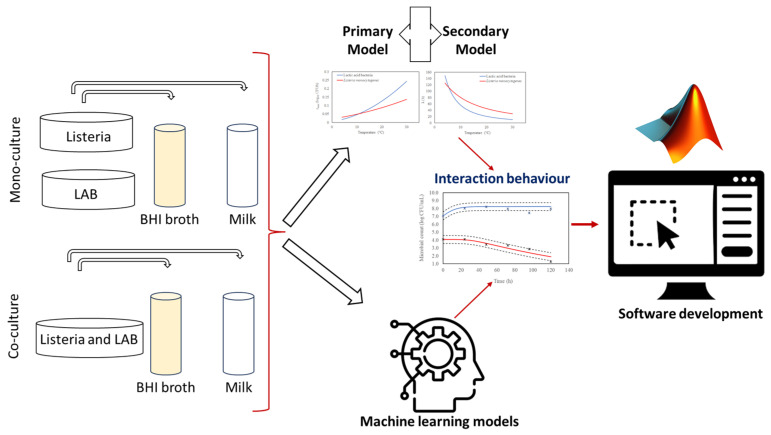
Biopreservation technology has emerged as a promising approach to enhance food safety and extend shelf life by leveraging the antimicrobial properties of beneficial microorganisms. This study aims to develop precise predictive models to characterize the growth and interaction dynamics of lactic acid bacteria (LAB) and Listeria monocytogenes, which serve as bioprotective agents in food systems. Using both traditional and machine learning modelling approaches, we analyzed data from previously published growth curves in broth (BHI) and milk under isothermal conditions (4, 10, and 30 °C). The models evaluated mono-culture conditions for L. monocytogenes and LAB, as well as their competitive interactions in co-culture scenarios. The modified Gompertz model demonstrated the best performance for mono-culture simulations, while a combination of the modified Gompertz and Lotka-Volterra models effectively described co-culture interactions, achieving high adjusted R-squared values (adjusted R2 = 0.978 and 0.962) and low root mean square errors (RMSE = 0.324 and 0.507) for BHI and milk, respectively. Machine learning approaches further validated these findings, with improved statistical indices (adjusted R2 = 0.988 and 0.966, RMSE = 0.242 and 0.475 for BHI and milk, respectively), suggesting their potential as robust alternatives to traditional methods. The integration of machine learning-assisted software developed in this work into predictive microbiology demonstrates significant advancements by bypassing the conventional primary and secondary modelling steps, enabling a streamlined, precise characterization of microbial interactions in food products.
Life-BaselBiochemistry, Genetics and Molecular Biology-General Biochemistry,Genetics and Molecular Biology
CiteScore
4.30
自引率
6.20%
发文量
1798
审稿时长
11 weeks
期刊介绍:
Life (ISSN 2075-1729) is an international, peer-reviewed open access journal of scientific studies related to fundamental themes in Life Sciences, especially those concerned with the origins of life and evolution of biosystems. Our aim is to encourage scientists to publish their experimental and theoretical results in as much detail as possible. There is no restriction on the length of the papers.





 京公网安备 11010802042870号
京ICP备2023020795号-1
京公网安备 11010802042870号
京ICP备2023020795号-1

 分享
分享
 求助内容:
求助内容: 应助结果提醒方式:
 扫码关注我们
