Shaohua Wu, Ping Chen, Xiaoyang Xia, Wenya Wang, Qifei Xie, Yanyu Qi, Huabo Han, Liang Zhou and Guangzhao Lu
{"title":"圆极化窄带磷光有机发光二极管","authors":"Shaohua Wu, Ping Chen, Xiaoyang Xia, Wenya Wang, Qifei Xie, Yanyu Qi, Huabo Han, Liang Zhou and Guangzhao Lu","doi":"10.1039/D5DT00337G","DOIUrl":null,"url":null,"abstract":"<p >Design strategies for chiral iridium(<small>III</small>) complexes with stable circularly polarized luminescent properties have emerged as important research topics in the field of organic photonics. Given the high rigidity, low chemical activity and multi-closed-loop structure of <em>R</em>-camphor, its chirality cannot be easily affected. Furthermore, the introduction of indolo[3,2,1-<em>jk</em>]carbazole is beneficial for the narrow emission spectrum. Thus, two yellow-emission chiral iridium(<small>III</small>) isomers, Δ-(mpincz)<small><sub>2</sub></small>Ir(<em>R</em>-camphor) and Λ-(mpincz)<small><sub>2</sub></small>Ir(<em>R</em>-camphor), were designed and systematically investigated to elucidate their photophysical properties, chiroptical properties, electrochemical behaviors, theoretical calculations and electroluminescence. The maximum emission peak of racemic Δ/Λ-(mpincz)<small><sub>2</sub></small>Ir(<em>R</em>-camphor) in a degassed toluene solution is located at 560 nm with a full width at half maximum (FWHM) of 48 nm, which demonstrated strong circularly polarized photoluminescence (CPPL) in toluene solution with a luminescent dissymmetry factor (<em>g</em><small><sub>PL</sub></small>) of 1.15 × 10<small><sup>−3</sup></small> and −1.0 × 10<small><sup>−3</sup></small>, respectively. Based on Δ-(mpincz)<small><sub>2</sub></small>Ir(<em>R</em>-camphor) and Λ-(mpincz)<small><sub>2</sub></small>Ir(<em>R</em>-camphor), efficient organic light-emitting diodes (OLEDs) were fabricated <em>via</em> vacuum evaporation deposition, with maximum external quantum efficiency (EQE<small><sub>max</sub></small>) values of 14.65% and 15.58% and asymmetry coefficients (<em>g</em><small><sub>EL</sub></small>) of 1.86 × 10<small><sup>−4</sup></small> and −2.29 × 10<small><sup>−4</sup></small>, respectively. This work may provide an effective strategy for the preparation of circularly polarized narrowband Ir(<small>III</small>) complexes.</p>","PeriodicalId":71,"journal":{"name":"Dalton Transactions","volume":" 14","pages":" 5805-5811"},"PeriodicalIF":3.3000,"publicationDate":"2025-02-27","publicationTypes":"Journal Article","fieldsOfStudy":null,"isOpenAccess":false,"openAccessPdf":"","citationCount":"0","resultStr":"{\"title\":\"Circularly polarized narrowband phosphorescent organic light-emitting diodes†\",\"authors\":\"Shaohua Wu, Ping Chen, Xiaoyang Xia, Wenya Wang, Qifei Xie, Yanyu Qi, Huabo Han, Liang Zhou and Guangzhao Lu\",\"doi\":\"10.1039/D5DT00337G\",\"DOIUrl\":null,\"url\":null,\"abstract\":\"<p >Design strategies for chiral iridium(<small>III</small>) complexes with stable circularly polarized luminescent properties have emerged as important research topics in the field of organic photonics. Given the high rigidity, low chemical activity and multi-closed-loop structure of <em>R</em>-camphor, its chirality cannot be easily affected. Furthermore, the introduction of indolo[3,2,1-<em>jk</em>]carbazole is beneficial for the narrow emission spectrum. Thus, two yellow-emission chiral iridium(<small>III</small>) isomers, Δ-(mpincz)<small><sub>2</sub></small>Ir(<em>R</em>-camphor) and Λ-(mpincz)<small><sub>2</sub></small>Ir(<em>R</em>-camphor), were designed and systematically investigated to elucidate their photophysical properties, chiroptical properties, electrochemical behaviors, theoretical calculations and electroluminescence. The maximum emission peak of racemic Δ/Λ-(mpincz)<small><sub>2</sub></small>Ir(<em>R</em>-camphor) in a degassed toluene solution is located at 560 nm with a full width at half maximum (FWHM) of 48 nm, which demonstrated strong circularly polarized photoluminescence (CPPL) in toluene solution with a luminescent dissymmetry factor (<em>g</em><small><sub>PL</sub></small>) of 1.15 × 10<small><sup>−3</sup></small> and −1.0 × 10<small><sup>−3</sup></small>, respectively. Based on Δ-(mpincz)<small><sub>2</sub></small>Ir(<em>R</em>-camphor) and Λ-(mpincz)<small><sub>2</sub></small>Ir(<em>R</em>-camphor), efficient organic light-emitting diodes (OLEDs) were fabricated <em>via</em> vacuum evaporation deposition, with maximum external quantum efficiency (EQE<small><sub>max</sub></small>) values of 14.65% and 15.58% and asymmetry coefficients (<em>g</em><small><sub>EL</sub></small>) of 1.86 × 10<small><sup>−4</sup></small> and −2.29 × 10<small><sup>−4</sup></small>, respectively. This work may provide an effective strategy for the preparation of circularly polarized narrowband Ir(<small>III</small>) complexes.</p>\",\"PeriodicalId\":71,\"journal\":{\"name\":\"Dalton Transactions\",\"volume\":\" 14\",\"pages\":\" 5805-5811\"},\"PeriodicalIF\":3.3000,\"publicationDate\":\"2025-02-27\",\"publicationTypes\":\"Journal Article\",\"fieldsOfStudy\":null,\"isOpenAccess\":false,\"openAccessPdf\":\"\",\"citationCount\":\"0\",\"resultStr\":null,\"platform\":\"Semanticscholar\",\"paperid\":null,\"PeriodicalName\":\"Dalton Transactions\",\"FirstCategoryId\":\"92\",\"ListUrlMain\":\"https://pubs.rsc.org/en/content/articlelanding/2025/dt/d5dt00337g\",\"RegionNum\":3,\"RegionCategory\":\"化学\",\"ArticlePicture\":[],\"TitleCN\":null,\"AbstractTextCN\":null,\"PMCID\":null,\"EPubDate\":\"\",\"PubModel\":\"\",\"JCR\":\"Q2\",\"JCRName\":\"CHEMISTRY, INORGANIC & NUCLEAR\",\"Score\":null,\"Total\":0}","platform":"Semanticscholar","paperid":null,"PeriodicalName":"Dalton Transactions","FirstCategoryId":"92","ListUrlMain":"https://pubs.rsc.org/en/content/articlelanding/2025/dt/d5dt00337g","RegionNum":3,"RegionCategory":"化学","ArticlePicture":[],"TitleCN":null,"AbstractTextCN":null,"PMCID":null,"EPubDate":"","PubModel":"","JCR":"Q2","JCRName":"CHEMISTRY, INORGANIC & NUCLEAR","Score":null,"Total":0}
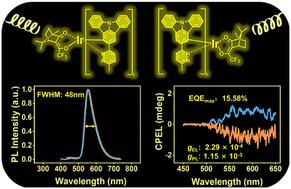
Design strategies for chiral iridium(III) complexes with stable circularly polarized luminescent properties have emerged as important research topics in the field of organic photonics. Given the high rigidity, low chemical activity and multi-closed-loop structure of R-camphor, its chirality cannot be easily affected. Furthermore, the introduction of indolo[3,2,1-jk]carbazole is beneficial for the narrow emission spectrum. Thus, two yellow-emission chiral iridium(III) isomers, Δ-(mpincz)2Ir(R-camphor) and Λ-(mpincz)2Ir(R-camphor), were designed and systematically investigated to elucidate their photophysical properties, chiroptical properties, electrochemical behaviors, theoretical calculations and electroluminescence. The maximum emission peak of racemic Δ/Λ-(mpincz)2Ir(R-camphor) in a degassed toluene solution is located at 560 nm with a full width at half maximum (FWHM) of 48 nm, which demonstrated strong circularly polarized photoluminescence (CPPL) in toluene solution with a luminescent dissymmetry factor (gPL) of 1.15 × 10⁻³ and −1.0 × 10⁻³, respectively. Based on Δ-(mpincz)2Ir(R-camphor) and Λ-(mpincz)2Ir(R-camphor), efficient organic light-emitting diodes (OLEDs) were fabricated via vacuum evaporation deposition, with maximum external quantum efficiency (EQEmax) values of 14.65% and 15.58% and asymmetry coefficients (gEL) of 1.86 × 10⁻⁴ and −2.29 × 10⁻⁴, respectively. This work may provide an effective strategy for the preparation of circularly polarized narrowband Ir(III) complexes.
期刊介绍:
Dalton Transactions is a journal for all areas of inorganic chemistry, which encompasses the organometallic, bioinorganic and materials chemistry of the elements, with applications including synthesis, catalysis, energy conversion/storage, electrical devices and medicine. Dalton Transactions welcomes high-quality, original submissions in all of these areas and more, where the advancement of knowledge in inorganic chemistry is significant.




 京公网安备 11010802042870号
京ICP备2023020795号-1
京公网安备 11010802042870号
京ICP备2023020795号-1

 分享
分享
 求助内容:
求助内容: 应助结果提醒方式:
 扫码关注我们
