Jonathan Perr, Andreas Langen, Karim Almahayni, Gianluca Nestola, Peiyuan Chai, Charlotta G. Lebedenko, Regan F. Volk, Diego Detrés, Reese M. Caldwell, Malte Spiekermann, Helena Hemberger, Namita Bisaria, Toshihiko Aiba, Francisco J. Sánchez-Rivera, Konstantinos Tzelepis, Eliezer Calo, Leonhard Möckl, Balyn W. Zaro, Ryan A. Flynn
{"title":"rna结合蛋白和糖rna在细胞表面形成结构域,用于细胞穿透肽的进入","authors":"Jonathan Perr, Andreas Langen, Karim Almahayni, Gianluca Nestola, Peiyuan Chai, Charlotta G. Lebedenko, Regan F. Volk, Diego Detrés, Reese M. Caldwell, Malte Spiekermann, Helena Hemberger, Namita Bisaria, Toshihiko Aiba, Francisco J. Sánchez-Rivera, Konstantinos Tzelepis, Eliezer Calo, Leonhard Möckl, Balyn W. Zaro, Ryan A. Flynn","doi":"10.1016/j.cell.2025.01.040","DOIUrl":null,"url":null,"abstract":"The composition and organization of the cell surface determine how cells interact with their environment. Traditionally, glycosylated transmembrane proteins were thought to be the major constituents of the external surface of the plasma membrane. Here, we provide evidence that a group of RNA-binding proteins (RBPs) is present on the surface of living cells. These cell-surface RBPs (csRBPs) precisely organize into well-defined nanoclusters enriched for multiple RBPs and glycoRNAs, and their clustering can be disrupted by extracellular RNase addition. These glycoRNA-csRBP clusters further serve as sites of cell-surface interaction for the cell-penetrating peptide <em>trans</em>-activator of transcription (TAT). Removal of RNA from the cell surface, or loss of RNA-binding activity by TAT, causes defects in TAT cell internalization. Together, we provide evidence of an expanded view of the cell surface by positioning glycoRNA-csRBP clusters as a regulator of communication between cells and the extracellular environment.","PeriodicalId":9656,"journal":{"name":"Cell","volume":"28 1","pages":""},"PeriodicalIF":42.5000,"publicationDate":"2025-02-27","publicationTypes":"Journal Article","fieldsOfStudy":null,"isOpenAccess":false,"openAccessPdf":"","citationCount":"0","resultStr":"{\"title\":\"RNA-binding proteins and glycoRNAs form domains on the cell surface for cell-penetrating peptide entry\",\"authors\":\"Jonathan Perr, Andreas Langen, Karim Almahayni, Gianluca Nestola, Peiyuan Chai, Charlotta G. Lebedenko, Regan F. Volk, Diego Detrés, Reese M. Caldwell, Malte Spiekermann, Helena Hemberger, Namita Bisaria, Toshihiko Aiba, Francisco J. Sánchez-Rivera, Konstantinos Tzelepis, Eliezer Calo, Leonhard Möckl, Balyn W. Zaro, Ryan A. Flynn\",\"doi\":\"10.1016/j.cell.2025.01.040\",\"DOIUrl\":null,\"url\":null,\"abstract\":\"The composition and organization of the cell surface determine how cells interact with their environment. Traditionally, glycosylated transmembrane proteins were thought to be the major constituents of the external surface of the plasma membrane. Here, we provide evidence that a group of RNA-binding proteins (RBPs) is present on the surface of living cells. These cell-surface RBPs (csRBPs) precisely organize into well-defined nanoclusters enriched for multiple RBPs and glycoRNAs, and their clustering can be disrupted by extracellular RNase addition. These glycoRNA-csRBP clusters further serve as sites of cell-surface interaction for the cell-penetrating peptide <em>trans</em>-activator of transcription (TAT). Removal of RNA from the cell surface, or loss of RNA-binding activity by TAT, causes defects in TAT cell internalization. Together, we provide evidence of an expanded view of the cell surface by positioning glycoRNA-csRBP clusters as a regulator of communication between cells and the extracellular environment.\",\"PeriodicalId\":9656,\"journal\":{\"name\":\"Cell\",\"volume\":\"28 1\",\"pages\":\"\"},\"PeriodicalIF\":42.5000,\"publicationDate\":\"2025-02-27\",\"publicationTypes\":\"Journal Article\",\"fieldsOfStudy\":null,\"isOpenAccess\":false,\"openAccessPdf\":\"\",\"citationCount\":\"0\",\"resultStr\":null,\"platform\":\"Semanticscholar\",\"paperid\":null,\"PeriodicalName\":\"Cell\",\"FirstCategoryId\":\"99\",\"ListUrlMain\":\"https://doi.org/10.1016/j.cell.2025.01.040\",\"RegionNum\":1,\"RegionCategory\":\"生物学\",\"ArticlePicture\":[],\"TitleCN\":null,\"AbstractTextCN\":null,\"PMCID\":null,\"EPubDate\":\"\",\"PubModel\":\"\",\"JCR\":\"Q1\",\"JCRName\":\"BIOCHEMISTRY & MOLECULAR BIOLOGY\",\"Score\":null,\"Total\":0}","platform":"Semanticscholar","paperid":null,"PeriodicalName":"Cell","FirstCategoryId":"99","ListUrlMain":"https://doi.org/10.1016/j.cell.2025.01.040","RegionNum":1,"RegionCategory":"生物学","ArticlePicture":[],"TitleCN":null,"AbstractTextCN":null,"PMCID":null,"EPubDate":"","PubModel":"","JCR":"Q1","JCRName":"BIOCHEMISTRY & MOLECULAR BIOLOGY","Score":null,"Total":0}
RNA-binding proteins and glycoRNAs form domains on the cell surface for cell-penetrating peptide entry
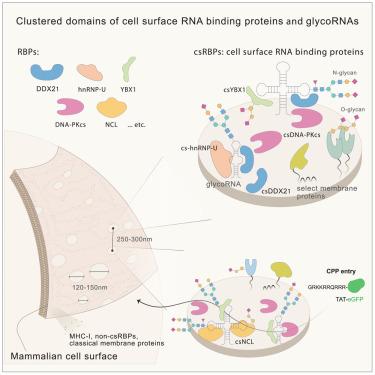
The composition and organization of the cell surface determine how cells interact with their environment. Traditionally, glycosylated transmembrane proteins were thought to be the major constituents of the external surface of the plasma membrane. Here, we provide evidence that a group of RNA-binding proteins (RBPs) is present on the surface of living cells. These cell-surface RBPs (csRBPs) precisely organize into well-defined nanoclusters enriched for multiple RBPs and glycoRNAs, and their clustering can be disrupted by extracellular RNase addition. These glycoRNA-csRBP clusters further serve as sites of cell-surface interaction for the cell-penetrating peptide trans-activator of transcription (TAT). Removal of RNA from the cell surface, or loss of RNA-binding activity by TAT, causes defects in TAT cell internalization. Together, we provide evidence of an expanded view of the cell surface by positioning glycoRNA-csRBP clusters as a regulator of communication between cells and the extracellular environment.
期刊介绍:
Cells is an international, peer-reviewed, open access journal that focuses on cell biology, molecular biology, and biophysics. It is affiliated with several societies, including the Spanish Society for Biochemistry and Molecular Biology (SEBBM), Nordic Autophagy Society (NAS), Spanish Society of Hematology and Hemotherapy (SEHH), and Society for Regenerative Medicine (Russian Federation) (RPO).
The journal publishes research findings of significant importance in various areas of experimental biology, such as cell biology, molecular biology, neuroscience, immunology, virology, microbiology, cancer, human genetics, systems biology, signaling, and disease mechanisms and therapeutics. The primary criterion for considering papers is whether the results contribute to significant conceptual advances or raise thought-provoking questions and hypotheses related to interesting and important biological inquiries.
In addition to primary research articles presented in four formats, Cells also features review and opinion articles in its "leading edge" section, discussing recent research advancements and topics of interest to its wide readership.




 京公网安备 11010802042870号
京ICP备2023020795号-1
京公网安备 11010802042870号
京ICP备2023020795号-1

 分享
分享
 求助内容:
求助内容: 应助结果提醒方式:
 扫码关注我们
