{"title":"非精确局部求解的分布式自适应空间滤波","authors":"Charles Hovine;Alexander Bertrand","doi":"10.1109/TSP.2025.3546484","DOIUrl":null,"url":null,"abstract":"The Distributed Adaptive Signal Fusion (DASF) framework is a meta-algorithm for computing data-driven spatial filters in a distributed sensing platform with limited bandwidth and computational resources, such as a wireless sensor network. The convergence and optimality of the DASF algorithm has been extensively studied under the assumption that an exact, but possibly impractical solver for the local optimization problem at each updating node is available. In this work, we provide convergence and optimality results for the DASF framework when used with an inexact, finite-time solver such as (proximal) gradient descent or Newton's method. We provide sufficient conditions that the solver should satisfy in order to guarantee convergence of the resulting algorithm as well as numerical simulations to validate these theoretical results.","PeriodicalId":13330,"journal":{"name":"IEEE Transactions on Signal Processing","volume":"73 ","pages":"1262-1277"},"PeriodicalIF":5.5000,"publicationDate":"2025-02-26","publicationTypes":"Journal Article","fieldsOfStudy":null,"isOpenAccess":false,"openAccessPdf":"","citationCount":"0","resultStr":"{\"title\":\"Distributed Adaptive Spatial Filtering With Inexact Local Solvers\",\"authors\":\"Charles Hovine;Alexander Bertrand\",\"doi\":\"10.1109/TSP.2025.3546484\",\"DOIUrl\":null,\"url\":null,\"abstract\":\"The Distributed Adaptive Signal Fusion (DASF) framework is a meta-algorithm for computing data-driven spatial filters in a distributed sensing platform with limited bandwidth and computational resources, such as a wireless sensor network. The convergence and optimality of the DASF algorithm has been extensively studied under the assumption that an exact, but possibly impractical solver for the local optimization problem at each updating node is available. In this work, we provide convergence and optimality results for the DASF framework when used with an inexact, finite-time solver such as (proximal) gradient descent or Newton's method. We provide sufficient conditions that the solver should satisfy in order to guarantee convergence of the resulting algorithm as well as numerical simulations to validate these theoretical results.\",\"PeriodicalId\":13330,\"journal\":{\"name\":\"IEEE Transactions on Signal Processing\",\"volume\":\"73 \",\"pages\":\"1262-1277\"},\"PeriodicalIF\":5.5000,\"publicationDate\":\"2025-02-26\",\"publicationTypes\":\"Journal Article\",\"fieldsOfStudy\":null,\"isOpenAccess\":false,\"openAccessPdf\":\"\",\"citationCount\":\"0\",\"resultStr\":null,\"platform\":\"Semanticscholar\",\"paperid\":null,\"PeriodicalName\":\"IEEE Transactions on Signal Processing\",\"FirstCategoryId\":\"5\",\"ListUrlMain\":\"https://ieeexplore.ieee.org/document/10906463/\",\"RegionNum\":2,\"RegionCategory\":\"工程技术\",\"ArticlePicture\":[],\"TitleCN\":null,\"AbstractTextCN\":null,\"PMCID\":null,\"EPubDate\":\"\",\"PubModel\":\"\",\"JCR\":\"Q1\",\"JCRName\":\"ENGINEERING, ELECTRICAL & ELECTRONIC\",\"Score\":null,\"Total\":0}","platform":"Semanticscholar","paperid":null,"PeriodicalName":"IEEE Transactions on Signal Processing","FirstCategoryId":"5","ListUrlMain":"https://ieeexplore.ieee.org/document/10906463/","RegionNum":2,"RegionCategory":"工程技术","ArticlePicture":[],"TitleCN":null,"AbstractTextCN":null,"PMCID":null,"EPubDate":"","PubModel":"","JCR":"Q1","JCRName":"ENGINEERING, ELECTRICAL & ELECTRONIC","Score":null,"Total":0}
Distributed Adaptive Spatial Filtering With Inexact Local Solvers
The Distributed Adaptive Signal Fusion (DASF) framework is a meta-algorithm for computing data-driven spatial filters in a distributed sensing platform with limited bandwidth and computational resources, such as a wireless sensor network. The convergence and optimality of the DASF algorithm has been extensively studied under the assumption that an exact, but possibly impractical solver for the local optimization problem at each updating node is available. In this work, we provide convergence and optimality results for the DASF framework when used with an inexact, finite-time solver such as (proximal) gradient descent or Newton's method. We provide sufficient conditions that the solver should satisfy in order to guarantee convergence of the resulting algorithm as well as numerical simulations to validate these theoretical results.
期刊介绍:
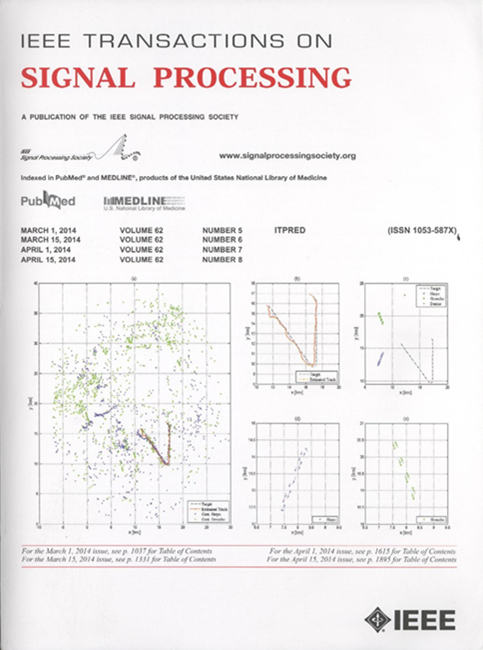
The IEEE Transactions on Signal Processing covers novel theory, algorithms, performance analyses and applications of techniques for the processing, understanding, learning, retrieval, mining, and extraction of information from signals. The term “signal” includes, among others, audio, video, speech, image, communication, geophysical, sonar, radar, medical and musical signals. Examples of topics of interest include, but are not limited to, information processing and the theory and application of filtering, coding, transmitting, estimating, detecting, analyzing, recognizing, synthesizing, recording, and reproducing signals.




 京公网安备 11010802042870号
京ICP备2023020795号-1
京公网安备 11010802042870号
京ICP备2023020795号-1

 分享
分享
 求助内容:
求助内容: 应助结果提醒方式:
 扫码关注我们
