Ammara Ghafoor, Mina Lotfi, Abouelhassan A. Gomaa, Andreas Goldbach* and Wenjie Shen,
{"title":"纳米结构Pt/ZnO催化剂上的CO氧化","authors":"Ammara Ghafoor, Mina Lotfi, Abouelhassan A. Gomaa, Andreas Goldbach* and Wenjie Shen, ","doi":"10.1021/acsanm.4c06270","DOIUrl":null,"url":null,"abstract":"<p >Low-temperature CO poisoning of Pt-based catalysts remains a persistent issue during the start-up of automotive three-way catalysts and at the operation temperatures of polymer electrolyte membrane fuel cells. Hence, we have investigated the low-temperature CO oxidation behavior of Pt/ZnO catalysts composed of size-controlled, 2–4 nm large Pt particles and 8–20 nm wide hexagonal ZnO nanorods. Carbon monoxide conversion abruptly escalated as soon as it reached ∼10%, approaching 100% at temperatures as low as 110 °C in a 1/20/79 CO/O<sub>2</sub>/He feed. The onset of CO conversion shifted by ca. 70 °C in a 5/5/90 CO/O<sub>2</sub>/He feed, indicating that it is very sensitive to the CO/O<sub>2</sub> reactant ratio. At lower temperatures, the activation of O<sub>2</sub> on the Pt particles was strongly inhibited by CO, pointing to a Langmuir–Hinshelwood-type reaction mechanism. Kinetic analyses of the temperature dependence suggest that the generation of vacant Pt sites for O<sub>2</sub> activation is the oxidation rate-limiting process at the lowest temperatures, while O<sub>2</sub> activation at Pt sites and/or its subsequent reaction with CO becomes rate-determining at higher temperatures. CO turnover frequencies amounted to τ ≈ 0.05 s<sup>–1</sup> at 100 °C in the 1/20/79 feed and τ ≈ 0.29 s<sup>–1</sup> at 190 °C in the 5/5/90 CO/O<sub>2</sub>/He feed. Reductive pretreatment of the catalysts increased the metallic character of the Pt particles with a concomitant enhancement of the CO turnover frequencies. Infrared spectroscopic analyses revealed that CO is more strongly activated at metallic than at positively charged Pt sites. Still, the effect of reductive treatment on CO activation is minor in comparison to the impact of CO inhibition on O<sub>2</sub> activation. Therefore, the generation of accessible Pt sites for O<sub>2</sub> activation via reactive removal of CO is a key to low-temperature efficiency improvement of Pt catalysts for CO oxidation.</p>","PeriodicalId":6,"journal":{"name":"ACS Applied Nano Materials","volume":"8 8","pages":"3887–3898 3887–3898"},"PeriodicalIF":5.5000,"publicationDate":"2025-02-13","publicationTypes":"Journal Article","fieldsOfStudy":null,"isOpenAccess":false,"openAccessPdf":"","citationCount":"0","resultStr":"{\"title\":\"CO Oxidation over Nanostructured Pt/ZnO Catalysts\",\"authors\":\"Ammara Ghafoor, Mina Lotfi, Abouelhassan A. Gomaa, Andreas Goldbach* and Wenjie Shen, \",\"doi\":\"10.1021/acsanm.4c06270\",\"DOIUrl\":null,\"url\":null,\"abstract\":\"<p >Low-temperature CO poisoning of Pt-based catalysts remains a persistent issue during the start-up of automotive three-way catalysts and at the operation temperatures of polymer electrolyte membrane fuel cells. Hence, we have investigated the low-temperature CO oxidation behavior of Pt/ZnO catalysts composed of size-controlled, 2–4 nm large Pt particles and 8–20 nm wide hexagonal ZnO nanorods. Carbon monoxide conversion abruptly escalated as soon as it reached ∼10%, approaching 100% at temperatures as low as 110 °C in a 1/20/79 CO/O<sub>2</sub>/He feed. The onset of CO conversion shifted by ca. 70 °C in a 5/5/90 CO/O<sub>2</sub>/He feed, indicating that it is very sensitive to the CO/O<sub>2</sub> reactant ratio. At lower temperatures, the activation of O<sub>2</sub> on the Pt particles was strongly inhibited by CO, pointing to a Langmuir–Hinshelwood-type reaction mechanism. Kinetic analyses of the temperature dependence suggest that the generation of vacant Pt sites for O<sub>2</sub> activation is the oxidation rate-limiting process at the lowest temperatures, while O<sub>2</sub> activation at Pt sites and/or its subsequent reaction with CO becomes rate-determining at higher temperatures. CO turnover frequencies amounted to τ ≈ 0.05 s<sup>–1</sup> at 100 °C in the 1/20/79 feed and τ ≈ 0.29 s<sup>–1</sup> at 190 °C in the 5/5/90 CO/O<sub>2</sub>/He feed. Reductive pretreatment of the catalysts increased the metallic character of the Pt particles with a concomitant enhancement of the CO turnover frequencies. Infrared spectroscopic analyses revealed that CO is more strongly activated at metallic than at positively charged Pt sites. Still, the effect of reductive treatment on CO activation is minor in comparison to the impact of CO inhibition on O<sub>2</sub> activation. Therefore, the generation of accessible Pt sites for O<sub>2</sub> activation via reactive removal of CO is a key to low-temperature efficiency improvement of Pt catalysts for CO oxidation.</p>\",\"PeriodicalId\":6,\"journal\":{\"name\":\"ACS Applied Nano Materials\",\"volume\":\"8 8\",\"pages\":\"3887–3898 3887–3898\"},\"PeriodicalIF\":5.5000,\"publicationDate\":\"2025-02-13\",\"publicationTypes\":\"Journal Article\",\"fieldsOfStudy\":null,\"isOpenAccess\":false,\"openAccessPdf\":\"\",\"citationCount\":\"0\",\"resultStr\":null,\"platform\":\"Semanticscholar\",\"paperid\":null,\"PeriodicalName\":\"ACS Applied Nano Materials\",\"FirstCategoryId\":\"88\",\"ListUrlMain\":\"https://pubs.acs.org/doi/10.1021/acsanm.4c06270\",\"RegionNum\":2,\"RegionCategory\":\"材料科学\",\"ArticlePicture\":[],\"TitleCN\":null,\"AbstractTextCN\":null,\"PMCID\":null,\"EPubDate\":\"\",\"PubModel\":\"\",\"JCR\":\"Q2\",\"JCRName\":\"MATERIALS SCIENCE, MULTIDISCIPLINARY\",\"Score\":null,\"Total\":0}","platform":"Semanticscholar","paperid":null,"PeriodicalName":"ACS Applied Nano Materials","FirstCategoryId":"88","ListUrlMain":"https://pubs.acs.org/doi/10.1021/acsanm.4c06270","RegionNum":2,"RegionCategory":"材料科学","ArticlePicture":[],"TitleCN":null,"AbstractTextCN":null,"PMCID":null,"EPubDate":"","PubModel":"","JCR":"Q2","JCRName":"MATERIALS SCIENCE, MULTIDISCIPLINARY","Score":null,"Total":0}
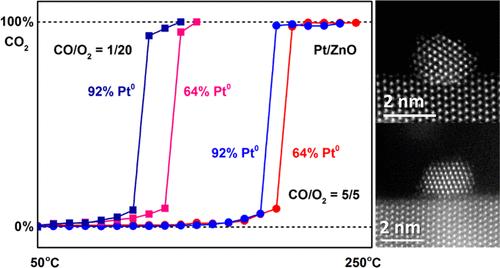
Low-temperature CO poisoning of Pt-based catalysts remains a persistent issue during the start-up of automotive three-way catalysts and at the operation temperatures of polymer electrolyte membrane fuel cells. Hence, we have investigated the low-temperature CO oxidation behavior of Pt/ZnO catalysts composed of size-controlled, 2–4 nm large Pt particles and 8–20 nm wide hexagonal ZnO nanorods. Carbon monoxide conversion abruptly escalated as soon as it reached ∼10%, approaching 100% at temperatures as low as 110 °C in a 1/20/79 CO/O2/He feed. The onset of CO conversion shifted by ca. 70 °C in a 5/5/90 CO/O2/He feed, indicating that it is very sensitive to the CO/O2 reactant ratio. At lower temperatures, the activation of O2 on the Pt particles was strongly inhibited by CO, pointing to a Langmuir–Hinshelwood-type reaction mechanism. Kinetic analyses of the temperature dependence suggest that the generation of vacant Pt sites for O2 activation is the oxidation rate-limiting process at the lowest temperatures, while O2 activation at Pt sites and/or its subsequent reaction with CO becomes rate-determining at higher temperatures. CO turnover frequencies amounted to τ ≈ 0.05 s–1 at 100 °C in the 1/20/79 feed and τ ≈ 0.29 s–1 at 190 °C in the 5/5/90 CO/O2/He feed. Reductive pretreatment of the catalysts increased the metallic character of the Pt particles with a concomitant enhancement of the CO turnover frequencies. Infrared spectroscopic analyses revealed that CO is more strongly activated at metallic than at positively charged Pt sites. Still, the effect of reductive treatment on CO activation is minor in comparison to the impact of CO inhibition on O2 activation. Therefore, the generation of accessible Pt sites for O2 activation via reactive removal of CO is a key to low-temperature efficiency improvement of Pt catalysts for CO oxidation.
期刊介绍:
ACS Applied Nano Materials is an interdisciplinary journal publishing original research covering all aspects of engineering, chemistry, physics and biology relevant to applications of nanomaterials. The journal is devoted to reports of new and original experimental and theoretical research of an applied nature that integrate knowledge in the areas of materials, engineering, physics, bioscience, and chemistry into important applications of nanomaterials.




 京公网安备 11010802042870号
京ICP备2023020795号-1
京公网安备 11010802042870号
京ICP备2023020795号-1

 分享
分享
 求助内容:
求助内容: 应助结果提醒方式:
 扫码关注我们
