{"title":"基于多孔β-Ga2O3纳米棒的深紫外通信太阳盲紫外光电探测器","authors":"Xiaoxuan Wang, Lingfeng Mao, Feifei Qin, Xueyao Lu, Chaoyang Huang, Xun Yang, Gangyi Zhu, Zengliang Shi, Qiannan Cui and Chunxiang Xu*, ","doi":"10.1021/acsanm.4c07249","DOIUrl":null,"url":null,"abstract":"<p >Ultraviolet communication is a promising candidate for applications in short-range military communications, internal safety communication in aerospace, etc. Nevertheless, traditional detectors for deep ultraviolet light frequently necessitate high driving voltages and rely heavily on filters. Nanomaterials are efficient means to develop high-performance photodetectors based on their high surface-to-volume ratio, quantum effect, and high light field confinement ability. Herein, the one-dimensional (1D) porous Ga<sub>2</sub>O<sub>3</sub> nanorods are fabricated through a straightforward hydrothermal method. Subsequent to optimizing the crystallinity characteristics of these nanorods, the solar blind ultraviolet photodetector (SBPD) performances are studied in detail, including rising edge, falling edge, responsiveness, and switching ratio. Notably, the device with the highest oxygen defect concentration shows a high photo-to-dark current ratio of 10<sup>6</sup>, a fast response time of 28 ms, a responsivity of ∼0.9 mA/W, and a detectivity of 1.4 × 10<sup>9</sup> Jones, respectively. Furthermore, by using this detector as the signal receiver and a commercial light-emitting diode (LED) with a peak wavelength of 254 nm as the emitter, a deep ultraviolet optical wireless communication (OWC) system is established, employing on–off-keying (OOK) modulation to transmit ASCII codes at a data rate of 50 bps. The received signal increased with the application of bias voltage, successfully transmitting the message “SEU-2024-2025”. This work highlights the potential of 1D porous ultrawide bandgap semiconductor nanorods in deep-ultraviolet photodetection and optical communications.</p>","PeriodicalId":6,"journal":{"name":"ACS Applied Nano Materials","volume":"8 8","pages":"4199–4205 4199–4205"},"PeriodicalIF":5.8000,"publicationDate":"2025-02-17","publicationTypes":"Journal Article","fieldsOfStudy":null,"isOpenAccess":false,"openAccessPdf":"","citationCount":"0","resultStr":"{\"title\":\"Solar-Blind Ultraviolet Photodetectors Based on Porous β-Ga2O3 Nanorods for Deep-Ultraviolet Communications\",\"authors\":\"Xiaoxuan Wang, Lingfeng Mao, Feifei Qin, Xueyao Lu, Chaoyang Huang, Xun Yang, Gangyi Zhu, Zengliang Shi, Qiannan Cui and Chunxiang Xu*, \",\"doi\":\"10.1021/acsanm.4c07249\",\"DOIUrl\":null,\"url\":null,\"abstract\":\"<p >Ultraviolet communication is a promising candidate for applications in short-range military communications, internal safety communication in aerospace, etc. Nevertheless, traditional detectors for deep ultraviolet light frequently necessitate high driving voltages and rely heavily on filters. Nanomaterials are efficient means to develop high-performance photodetectors based on their high surface-to-volume ratio, quantum effect, and high light field confinement ability. Herein, the one-dimensional (1D) porous Ga<sub>2</sub>O<sub>3</sub> nanorods are fabricated through a straightforward hydrothermal method. Subsequent to optimizing the crystallinity characteristics of these nanorods, the solar blind ultraviolet photodetector (SBPD) performances are studied in detail, including rising edge, falling edge, responsiveness, and switching ratio. Notably, the device with the highest oxygen defect concentration shows a high photo-to-dark current ratio of 10<sup>6</sup>, a fast response time of 28 ms, a responsivity of ∼0.9 mA/W, and a detectivity of 1.4 × 10<sup>9</sup> Jones, respectively. Furthermore, by using this detector as the signal receiver and a commercial light-emitting diode (LED) with a peak wavelength of 254 nm as the emitter, a deep ultraviolet optical wireless communication (OWC) system is established, employing on–off-keying (OOK) modulation to transmit ASCII codes at a data rate of 50 bps. The received signal increased with the application of bias voltage, successfully transmitting the message “SEU-2024-2025”. This work highlights the potential of 1D porous ultrawide bandgap semiconductor nanorods in deep-ultraviolet photodetection and optical communications.</p>\",\"PeriodicalId\":6,\"journal\":{\"name\":\"ACS Applied Nano Materials\",\"volume\":\"8 8\",\"pages\":\"4199–4205 4199–4205\"},\"PeriodicalIF\":5.8000,\"publicationDate\":\"2025-02-17\",\"publicationTypes\":\"Journal Article\",\"fieldsOfStudy\":null,\"isOpenAccess\":false,\"openAccessPdf\":\"\",\"citationCount\":\"0\",\"resultStr\":null,\"platform\":\"Semanticscholar\",\"paperid\":null,\"PeriodicalName\":\"ACS Applied Nano Materials\",\"FirstCategoryId\":\"88\",\"ListUrlMain\":\"https://pubs.acs.org/doi/10.1021/acsanm.4c07249\",\"RegionNum\":2,\"RegionCategory\":\"材料科学\",\"ArticlePicture\":[],\"TitleCN\":null,\"AbstractTextCN\":null,\"PMCID\":null,\"EPubDate\":\"\",\"PubModel\":\"\",\"JCR\":\"Q2\",\"JCRName\":\"MATERIALS SCIENCE, MULTIDISCIPLINARY\",\"Score\":null,\"Total\":0}","platform":"Semanticscholar","paperid":null,"PeriodicalName":"ACS Applied Nano Materials","FirstCategoryId":"88","ListUrlMain":"https://pubs.acs.org/doi/10.1021/acsanm.4c07249","RegionNum":2,"RegionCategory":"材料科学","ArticlePicture":[],"TitleCN":null,"AbstractTextCN":null,"PMCID":null,"EPubDate":"","PubModel":"","JCR":"Q2","JCRName":"MATERIALS SCIENCE, MULTIDISCIPLINARY","Score":null,"Total":0}
Solar-Blind Ultraviolet Photodetectors Based on Porous β-Ga2O3 Nanorods for Deep-Ultraviolet Communications
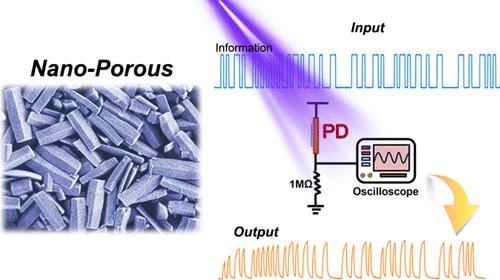
Ultraviolet communication is a promising candidate for applications in short-range military communications, internal safety communication in aerospace, etc. Nevertheless, traditional detectors for deep ultraviolet light frequently necessitate high driving voltages and rely heavily on filters. Nanomaterials are efficient means to develop high-performance photodetectors based on their high surface-to-volume ratio, quantum effect, and high light field confinement ability. Herein, the one-dimensional (1D) porous Ga2O3 nanorods are fabricated through a straightforward hydrothermal method. Subsequent to optimizing the crystallinity characteristics of these nanorods, the solar blind ultraviolet photodetector (SBPD) performances are studied in detail, including rising edge, falling edge, responsiveness, and switching ratio. Notably, the device with the highest oxygen defect concentration shows a high photo-to-dark current ratio of 106, a fast response time of 28 ms, a responsivity of ∼0.9 mA/W, and a detectivity of 1.4 × 10⁹ Jones, respectively. Furthermore, by using this detector as the signal receiver and a commercial light-emitting diode (LED) with a peak wavelength of 254 nm as the emitter, a deep ultraviolet optical wireless communication (OWC) system is established, employing on–off-keying (OOK) modulation to transmit ASCII codes at a data rate of 50 bps. The received signal increased with the application of bias voltage, successfully transmitting the message “SEU-2024-2025”. This work highlights the potential of 1D porous ultrawide bandgap semiconductor nanorods in deep-ultraviolet photodetection and optical communications.
期刊介绍:
ACS Applied Nano Materials is an interdisciplinary journal publishing original research covering all aspects of engineering, chemistry, physics and biology relevant to applications of nanomaterials. The journal is devoted to reports of new and original experimental and theoretical research of an applied nature that integrate knowledge in the areas of materials, engineering, physics, bioscience, and chemistry into important applications of nanomaterials.




 京公网安备 11010802042870号
京ICP备2023020795号-1
京公网安备 11010802042870号
京ICP备2023020795号-1

 分享
分享
 求助内容:
求助内容: 应助结果提醒方式:
 扫码关注我们
