Yee Vern Ng , Majid Khan Majahar Ali , Wan Rosli Wan Ishak
{"title":"响应面法优化过熟香蕉中生物活性成分的提取条件及抗氧化性能","authors":"Yee Vern Ng , Majid Khan Majahar Ali , Wan Rosli Wan Ishak","doi":"10.1016/j.jafr.2025.101775","DOIUrl":null,"url":null,"abstract":"<div><div>Overripe bananas, often considered waste, represent a rich source of bioactive compounds with significant antioxidant properties. This study focused on optimizing the extraction process of these compounds using Response Surface Methodology (RSM). Key extraction parameters, including water ratio, temperature, and incubation time, were systematically varied based on a central composite design. Responses evaluated included total phenolic content (TPC), total flavonoid content (TFC), DPPH radical scavenging activity, and ferric reducing antioxidant power (FRAP). The resulting quadratic models exhibited excellent fit (R<sup>2</sup> > 0.98), validating their predictive reliability. Optimal extraction conditions were determined as a banana:water ratio of 1:3.2 (w/w), temperature of 51.5 °C, and incubation time of 33.5 min. Predicted values under these conditions were 84.7 mg GAE/100 g for TPC, 69.5 mg CEQ/100 g for TFC, 75.1 % for DPPH, and 25.8 mM TE/g for FRAP. Experimental validation closely matched these predictions, yielding 85.3 mg GAE/100 g for TPC, 68.9 mg CEQ/100 g for TFC, 76.5 % for DPPH, and 26.8 mM TE/g for FRAP. The results highlighted the significant influence of extraction temperature and time on bioactive compound recovery, with moderate conditions ensuring maximal yield while minimizing thermal degradation of sensitive compounds. This study underscores the value of integrating RSM in process optimization for efficient extraction of bioactive compounds. Consequently, the optimum extraction conditions provided the highest phenolic concentration and antioxidant yield. By leveraging overripe bananas, this work supports sustainability and promotes the development of high-value functional ingredients.</div></div>","PeriodicalId":34393,"journal":{"name":"Journal of Agriculture and Food Research","volume":"20 ","pages":"Article 101775"},"PeriodicalIF":7.2000,"publicationDate":"2025-04-01","publicationTypes":"Journal Article","fieldsOfStudy":null,"isOpenAccess":false,"openAccessPdf":"","citationCount":"0","resultStr":"{\"title\":\"Optimization of aqueous extraction conditions for bioactive compounds and antioxidant properties of overripe banana (musa acuminata) using response surface methodology\",\"authors\":\"Yee Vern Ng , Majid Khan Majahar Ali , Wan Rosli Wan Ishak\",\"doi\":\"10.1016/j.jafr.2025.101775\",\"DOIUrl\":null,\"url\":null,\"abstract\":\"<div><div>Overripe bananas, often considered waste, represent a rich source of bioactive compounds with significant antioxidant properties. This study focused on optimizing the extraction process of these compounds using Response Surface Methodology (RSM). Key extraction parameters, including water ratio, temperature, and incubation time, were systematically varied based on a central composite design. Responses evaluated included total phenolic content (TPC), total flavonoid content (TFC), DPPH radical scavenging activity, and ferric reducing antioxidant power (FRAP). The resulting quadratic models exhibited excellent fit (R<sup>2</sup> > 0.98), validating their predictive reliability. Optimal extraction conditions were determined as a banana:water ratio of 1:3.2 (w/w), temperature of 51.5 °C, and incubation time of 33.5 min. Predicted values under these conditions were 84.7 mg GAE/100 g for TPC, 69.5 mg CEQ/100 g for TFC, 75.1 % for DPPH, and 25.8 mM TE/g for FRAP. Experimental validation closely matched these predictions, yielding 85.3 mg GAE/100 g for TPC, 68.9 mg CEQ/100 g for TFC, 76.5 % for DPPH, and 26.8 mM TE/g for FRAP. The results highlighted the significant influence of extraction temperature and time on bioactive compound recovery, with moderate conditions ensuring maximal yield while minimizing thermal degradation of sensitive compounds. This study underscores the value of integrating RSM in process optimization for efficient extraction of bioactive compounds. Consequently, the optimum extraction conditions provided the highest phenolic concentration and antioxidant yield. By leveraging overripe bananas, this work supports sustainability and promotes the development of high-value functional ingredients.</div></div>\",\"PeriodicalId\":34393,\"journal\":{\"name\":\"Journal of Agriculture and Food Research\",\"volume\":\"20 \",\"pages\":\"Article 101775\"},\"PeriodicalIF\":7.2000,\"publicationDate\":\"2025-04-01\",\"publicationTypes\":\"Journal Article\",\"fieldsOfStudy\":null,\"isOpenAccess\":false,\"openAccessPdf\":\"\",\"citationCount\":\"0\",\"resultStr\":null,\"platform\":\"Semanticscholar\",\"paperid\":null,\"PeriodicalName\":\"Journal of Agriculture and Food Research\",\"FirstCategoryId\":\"1085\",\"ListUrlMain\":\"https://www.sciencedirect.com/science/article/pii/S2666154325001462\",\"RegionNum\":0,\"RegionCategory\":null,\"ArticlePicture\":[],\"TitleCN\":null,\"AbstractTextCN\":null,\"PMCID\":null,\"EPubDate\":\"2025/2/24 0:00:00\",\"PubModel\":\"Epub\",\"JCR\":\"Q1\",\"JCRName\":\"AGRICULTURE, MULTIDISCIPLINARY\",\"Score\":null,\"Total\":0}","platform":"Semanticscholar","paperid":null,"PeriodicalName":"Journal of Agriculture and Food Research","FirstCategoryId":"1085","ListUrlMain":"https://www.sciencedirect.com/science/article/pii/S2666154325001462","RegionNum":0,"RegionCategory":null,"ArticlePicture":[],"TitleCN":null,"AbstractTextCN":null,"PMCID":null,"EPubDate":"2025/2/24 0:00:00","PubModel":"Epub","JCR":"Q1","JCRName":"AGRICULTURE, MULTIDISCIPLINARY","Score":null,"Total":0}
Optimization of aqueous extraction conditions for bioactive compounds and antioxidant properties of overripe banana (musa acuminata) using response surface methodology
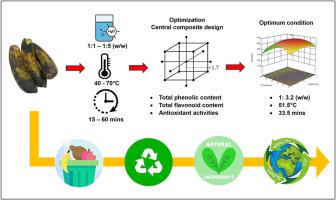
Overripe bananas, often considered waste, represent a rich source of bioactive compounds with significant antioxidant properties. This study focused on optimizing the extraction process of these compounds using Response Surface Methodology (RSM). Key extraction parameters, including water ratio, temperature, and incubation time, were systematically varied based on a central composite design. Responses evaluated included total phenolic content (TPC), total flavonoid content (TFC), DPPH radical scavenging activity, and ferric reducing antioxidant power (FRAP). The resulting quadratic models exhibited excellent fit (R2 > 0.98), validating their predictive reliability. Optimal extraction conditions were determined as a banana:water ratio of 1:3.2 (w/w), temperature of 51.5 °C, and incubation time of 33.5 min. Predicted values under these conditions were 84.7 mg GAE/100 g for TPC, 69.5 mg CEQ/100 g for TFC, 75.1 % for DPPH, and 25.8 mM TE/g for FRAP. Experimental validation closely matched these predictions, yielding 85.3 mg GAE/100 g for TPC, 68.9 mg CEQ/100 g for TFC, 76.5 % for DPPH, and 26.8 mM TE/g for FRAP. The results highlighted the significant influence of extraction temperature and time on bioactive compound recovery, with moderate conditions ensuring maximal yield while minimizing thermal degradation of sensitive compounds. This study underscores the value of integrating RSM in process optimization for efficient extraction of bioactive compounds. Consequently, the optimum extraction conditions provided the highest phenolic concentration and antioxidant yield. By leveraging overripe bananas, this work supports sustainability and promotes the development of high-value functional ingredients.





 京公网安备 11010802042870号
京ICP备2023020795号-1
京公网安备 11010802042870号
京ICP备2023020795号-1

 分享
分享
 求助内容:
求助内容: 应助结果提醒方式:
 扫码关注我们
