Fang Wang , Lin Fang , Jin-Juan Zhang , Qian Wang , Ya Wang , Qiong Fu , Yan Hong , Yan-Yan Gao , Xiao-Li Guo , Jing Li , Xue-Long Yan , Guo-Bo Xu , Xing-Jiang Liao , Xiang Fang , Shang-Gao Liao
{"title":"丁香能有效改善小鼠高尿酸血症和高尿酸血症引起的肾损伤","authors":"Fang Wang , Lin Fang , Jin-Juan Zhang , Qian Wang , Ya Wang , Qiong Fu , Yan Hong , Yan-Yan Gao , Xiao-Li Guo , Jing Li , Xue-Long Yan , Guo-Bo Xu , Xing-Jiang Liao , Xiang Fang , Shang-Gao Liao","doi":"10.1016/j.jafr.2025.101760","DOIUrl":null,"url":null,"abstract":"<div><div>Clove, the dried flower bud of <em>Syzygium aromaticum</em>, is a global spice used in various culinary traditions. In the present study, the antihyperuricemic (anti-HUA) effect of a clove water extract (CWE) and its mechanism were investigated using a hyperuricemic (HUA) mouse model, with organ coefficients and histological assessments employed to determine its safety profile. Western blot, RT-qPCR and transcriptomic analysis were conducted to uncover the proteins, RNAs and signalling pathways involved. The results showed that a very low dose of clove water extract could significantly lower serum uric acid (UA) levels in HUA mice with no overt toxicity to the organs and markedly attenuated HUA-induced renal damage. Western blotting analysis revealed that the expression levels of xanthine oxidase (XOD), urate transporter 1 (URAT1), glucose transporter 9 (GLUT9), and monocarboxylate transporter 9 (MCT9) were substantially decreased, whereas those of renal organic anion transporters 1 (OAT1) and 3 (OAT3) and ATP transporter G2 (ABCG2) were notably increased. Transcriptomic analysis revealed that CWE reversed 38 differentially expressed key genes within the kidney induced by HUA. A reduction in the expression of inflammatory cytokines and their transcription factors in the cytokine‒cytokine receptor interaction signalling pathway was also observed. The UA-lowering mechanism of CWE involved suppressing XOD to curtail UA synthesis; lowering the expression of URAT1, GLUT9, and MCT9 to diminish UA reabsorption; and enhancing the expression of ABCG2, OAT1, and OAT3 to increase UA elimination. Additionally, CWE is capable of mitigating HUA-induced kidney injury through modulating the cytokine‒cytokine receptor interaction signalling pathway.</div></div>","PeriodicalId":34393,"journal":{"name":"Journal of Agriculture and Food Research","volume":"20 ","pages":"Article 101760"},"PeriodicalIF":6.2000,"publicationDate":"2025-04-01","publicationTypes":"Journal Article","fieldsOfStudy":null,"isOpenAccess":false,"openAccessPdf":"","citationCount":"0","resultStr":"{\"title\":\"The spice clove effectively ameliorated hyperuricemia and hyperuricemia-induced kidney injury in mice\",\"authors\":\"Fang Wang , Lin Fang , Jin-Juan Zhang , Qian Wang , Ya Wang , Qiong Fu , Yan Hong , Yan-Yan Gao , Xiao-Li Guo , Jing Li , Xue-Long Yan , Guo-Bo Xu , Xing-Jiang Liao , Xiang Fang , Shang-Gao Liao\",\"doi\":\"10.1016/j.jafr.2025.101760\",\"DOIUrl\":null,\"url\":null,\"abstract\":\"<div><div>Clove, the dried flower bud of <em>Syzygium aromaticum</em>, is a global spice used in various culinary traditions. In the present study, the antihyperuricemic (anti-HUA) effect of a clove water extract (CWE) and its mechanism were investigated using a hyperuricemic (HUA) mouse model, with organ coefficients and histological assessments employed to determine its safety profile. Western blot, RT-qPCR and transcriptomic analysis were conducted to uncover the proteins, RNAs and signalling pathways involved. The results showed that a very low dose of clove water extract could significantly lower serum uric acid (UA) levels in HUA mice with no overt toxicity to the organs and markedly attenuated HUA-induced renal damage. Western blotting analysis revealed that the expression levels of xanthine oxidase (XOD), urate transporter 1 (URAT1), glucose transporter 9 (GLUT9), and monocarboxylate transporter 9 (MCT9) were substantially decreased, whereas those of renal organic anion transporters 1 (OAT1) and 3 (OAT3) and ATP transporter G2 (ABCG2) were notably increased. Transcriptomic analysis revealed that CWE reversed 38 differentially expressed key genes within the kidney induced by HUA. A reduction in the expression of inflammatory cytokines and their transcription factors in the cytokine‒cytokine receptor interaction signalling pathway was also observed. The UA-lowering mechanism of CWE involved suppressing XOD to curtail UA synthesis; lowering the expression of URAT1, GLUT9, and MCT9 to diminish UA reabsorption; and enhancing the expression of ABCG2, OAT1, and OAT3 to increase UA elimination. Additionally, CWE is capable of mitigating HUA-induced kidney injury through modulating the cytokine‒cytokine receptor interaction signalling pathway.</div></div>\",\"PeriodicalId\":34393,\"journal\":{\"name\":\"Journal of Agriculture and Food Research\",\"volume\":\"20 \",\"pages\":\"Article 101760\"},\"PeriodicalIF\":6.2000,\"publicationDate\":\"2025-04-01\",\"publicationTypes\":\"Journal Article\",\"fieldsOfStudy\":null,\"isOpenAccess\":false,\"openAccessPdf\":\"\",\"citationCount\":\"0\",\"resultStr\":null,\"platform\":\"Semanticscholar\",\"paperid\":null,\"PeriodicalName\":\"Journal of Agriculture and Food Research\",\"FirstCategoryId\":\"1085\",\"ListUrlMain\":\"https://www.sciencedirect.com/science/article/pii/S2666154325001310\",\"RegionNum\":0,\"RegionCategory\":null,\"ArticlePicture\":[],\"TitleCN\":null,\"AbstractTextCN\":null,\"PMCID\":null,\"EPubDate\":\"2025/2/25 0:00:00\",\"PubModel\":\"Epub\",\"JCR\":\"Q1\",\"JCRName\":\"AGRICULTURE, MULTIDISCIPLINARY\",\"Score\":null,\"Total\":0}","platform":"Semanticscholar","paperid":null,"PeriodicalName":"Journal of Agriculture and Food Research","FirstCategoryId":"1085","ListUrlMain":"https://www.sciencedirect.com/science/article/pii/S2666154325001310","RegionNum":0,"RegionCategory":null,"ArticlePicture":[],"TitleCN":null,"AbstractTextCN":null,"PMCID":null,"EPubDate":"2025/2/25 0:00:00","PubModel":"Epub","JCR":"Q1","JCRName":"AGRICULTURE, MULTIDISCIPLINARY","Score":null,"Total":0}
The spice clove effectively ameliorated hyperuricemia and hyperuricemia-induced kidney injury in mice
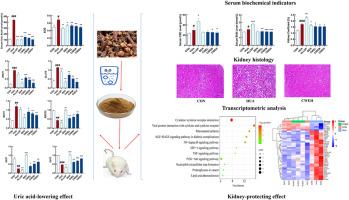
Clove, the dried flower bud of Syzygium aromaticum, is a global spice used in various culinary traditions. In the present study, the antihyperuricemic (anti-HUA) effect of a clove water extract (CWE) and its mechanism were investigated using a hyperuricemic (HUA) mouse model, with organ coefficients and histological assessments employed to determine its safety profile. Western blot, RT-qPCR and transcriptomic analysis were conducted to uncover the proteins, RNAs and signalling pathways involved. The results showed that a very low dose of clove water extract could significantly lower serum uric acid (UA) levels in HUA mice with no overt toxicity to the organs and markedly attenuated HUA-induced renal damage. Western blotting analysis revealed that the expression levels of xanthine oxidase (XOD), urate transporter 1 (URAT1), glucose transporter 9 (GLUT9), and monocarboxylate transporter 9 (MCT9) were substantially decreased, whereas those of renal organic anion transporters 1 (OAT1) and 3 (OAT3) and ATP transporter G2 (ABCG2) were notably increased. Transcriptomic analysis revealed that CWE reversed 38 differentially expressed key genes within the kidney induced by HUA. A reduction in the expression of inflammatory cytokines and their transcription factors in the cytokine‒cytokine receptor interaction signalling pathway was also observed. The UA-lowering mechanism of CWE involved suppressing XOD to curtail UA synthesis; lowering the expression of URAT1, GLUT9, and MCT9 to diminish UA reabsorption; and enhancing the expression of ABCG2, OAT1, and OAT3 to increase UA elimination. Additionally, CWE is capable of mitigating HUA-induced kidney injury through modulating the cytokine‒cytokine receptor interaction signalling pathway.





 京公网安备 11010802042870号
京ICP备2023020795号-1
京公网安备 11010802042870号
京ICP备2023020795号-1

 分享
分享
 求助内容:
求助内容: 应助结果提醒方式:
 扫码关注我们
