Claudio Cannata , Chiara Alessandra Carmen Rutigliano , Cristina Restuccia , Giuseppe Muratore , Leo Sabatino , Emmanuel Geoffriau , Cherubino Leonardi , Rosario Paolo Mauro
{"title":"多糖基食用涂层对不同色素鲜切胡萝卜保质期的影响","authors":"Claudio Cannata , Chiara Alessandra Carmen Rutigliano , Cristina Restuccia , Giuseppe Muratore , Leo Sabatino , Emmanuel Geoffriau , Cherubino Leonardi , Rosario Paolo Mauro","doi":"10.1016/j.jafr.2025.101765","DOIUrl":null,"url":null,"abstract":"<div><div>Promoting the consumption of purple carrots, particularly in ready-to-eat products, is justified due to their peculiar composition and health benefits for consumers. However, there is limited literature on the shelf life of ready-to-eat purple carrots and the potential role of edible coatings in mitigating their quality decay. This study examined the postharvest behavior of sliced carrots ‘Dordogne’ (orange) and ‘Purple Sun’ (purple), both uncoated and coated with chitosan (CH) or locust bean gum (LBG), stored for 0 (S<sub>0</sub>), 4 (S<sub>4</sub>), and 8 (S<sub>8</sub>) days at 4.0 °C. ‘Purple Sun’ proved a high fresh weight loss (up to 7.57 g 100 g<sup>−1</sup> FW) and respiration metabolism. Compared to controls, CH reduced total color difference in ‘Dordogne’ (−70 %) but increased it in ‘Purple Sun’ (+68 %) due to the occurrence of tissue browning. Compared to uncoated controls, at the end of storage, total phenolic and ascorbic acid contents were lower in CH-coated ‘Purple Sun’ (−14 % and −20 %, respectively), while CH preserved total carotenoid content in ‘Dordogne’ (up to 1000 mg kg<sup>−1</sup> DW). Moreover, compared to controls, LBG promoted <em>Pseudomonas</em> spp. (+23 % and +22 % in ‘Dordogne’ and ‘Purple Sun’, respectively) and yeasts and molds (+26 % and +24 %, respectively). Overall, these results indicate that issues of ready-to-eat carrots are significantly affected by carrot type, with the gas-barrier effect (in the case of CH for ‘Purple Sun’) and the antimicrobial properties of LBG (for both cultivars) seeming the most critical aspects to enhance the shelf life of the tested carrots.</div></div>","PeriodicalId":34393,"journal":{"name":"Journal of Agriculture and Food Research","volume":"20 ","pages":"Article 101765"},"PeriodicalIF":6.2000,"publicationDate":"2025-04-01","publicationTypes":"Journal Article","fieldsOfStudy":null,"isOpenAccess":false,"openAccessPdf":"","citationCount":"0","resultStr":"{\"title\":\"Effects of polysaccharide-based edible coatings on the shelf life of fresh-cut carrots with different pigmentations\",\"authors\":\"Claudio Cannata , Chiara Alessandra Carmen Rutigliano , Cristina Restuccia , Giuseppe Muratore , Leo Sabatino , Emmanuel Geoffriau , Cherubino Leonardi , Rosario Paolo Mauro\",\"doi\":\"10.1016/j.jafr.2025.101765\",\"DOIUrl\":null,\"url\":null,\"abstract\":\"<div><div>Promoting the consumption of purple carrots, particularly in ready-to-eat products, is justified due to their peculiar composition and health benefits for consumers. However, there is limited literature on the shelf life of ready-to-eat purple carrots and the potential role of edible coatings in mitigating their quality decay. This study examined the postharvest behavior of sliced carrots ‘Dordogne’ (orange) and ‘Purple Sun’ (purple), both uncoated and coated with chitosan (CH) or locust bean gum (LBG), stored for 0 (S<sub>0</sub>), 4 (S<sub>4</sub>), and 8 (S<sub>8</sub>) days at 4.0 °C. ‘Purple Sun’ proved a high fresh weight loss (up to 7.57 g 100 g<sup>−1</sup> FW) and respiration metabolism. Compared to controls, CH reduced total color difference in ‘Dordogne’ (−70 %) but increased it in ‘Purple Sun’ (+68 %) due to the occurrence of tissue browning. Compared to uncoated controls, at the end of storage, total phenolic and ascorbic acid contents were lower in CH-coated ‘Purple Sun’ (−14 % and −20 %, respectively), while CH preserved total carotenoid content in ‘Dordogne’ (up to 1000 mg kg<sup>−1</sup> DW). Moreover, compared to controls, LBG promoted <em>Pseudomonas</em> spp. (+23 % and +22 % in ‘Dordogne’ and ‘Purple Sun’, respectively) and yeasts and molds (+26 % and +24 %, respectively). Overall, these results indicate that issues of ready-to-eat carrots are significantly affected by carrot type, with the gas-barrier effect (in the case of CH for ‘Purple Sun’) and the antimicrobial properties of LBG (for both cultivars) seeming the most critical aspects to enhance the shelf life of the tested carrots.</div></div>\",\"PeriodicalId\":34393,\"journal\":{\"name\":\"Journal of Agriculture and Food Research\",\"volume\":\"20 \",\"pages\":\"Article 101765\"},\"PeriodicalIF\":6.2000,\"publicationDate\":\"2025-04-01\",\"publicationTypes\":\"Journal Article\",\"fieldsOfStudy\":null,\"isOpenAccess\":false,\"openAccessPdf\":\"\",\"citationCount\":\"0\",\"resultStr\":null,\"platform\":\"Semanticscholar\",\"paperid\":null,\"PeriodicalName\":\"Journal of Agriculture and Food Research\",\"FirstCategoryId\":\"1085\",\"ListUrlMain\":\"https://www.sciencedirect.com/science/article/pii/S266615432500136X\",\"RegionNum\":0,\"RegionCategory\":null,\"ArticlePicture\":[],\"TitleCN\":null,\"AbstractTextCN\":null,\"PMCID\":null,\"EPubDate\":\"2025/2/24 0:00:00\",\"PubModel\":\"Epub\",\"JCR\":\"Q1\",\"JCRName\":\"AGRICULTURE, MULTIDISCIPLINARY\",\"Score\":null,\"Total\":0}","platform":"Semanticscholar","paperid":null,"PeriodicalName":"Journal of Agriculture and Food Research","FirstCategoryId":"1085","ListUrlMain":"https://www.sciencedirect.com/science/article/pii/S266615432500136X","RegionNum":0,"RegionCategory":null,"ArticlePicture":[],"TitleCN":null,"AbstractTextCN":null,"PMCID":null,"EPubDate":"2025/2/24 0:00:00","PubModel":"Epub","JCR":"Q1","JCRName":"AGRICULTURE, MULTIDISCIPLINARY","Score":null,"Total":0}
引用次数: 0
摘要
由于紫色胡萝卜的特殊成分和对消费者的健康益处,促进紫色胡萝卜的消费,特别是在即食产品中,是合理的。然而,关于即食紫色胡萝卜的保质期和可食用涂层在减轻其质量衰减方面的潜在作用的文献有限。本研究检测了切片胡萝卜‘ Dordogne ’(橙色)和‘ Purple Sun ’(紫色)的采后行为,均未涂覆和涂覆壳聚糖(CH)或刺槐豆胶(LBG),在4.0°C下储存0 (50),4 (S4)和8 (S8)天。“紫太阳”被证明具有较高的新鲜减重(高达7.57 g 100 g−1 FW)和呼吸代谢。与对照相比,CH减少了‘ Dordogne ’的总色差(- 70%),但由于组织褐变的发生,‘ Purple Sun ’的总色差增加了(+ 68%)。与未包衣对照相比,贮藏结束时,CH包衣的‘紫太阳’总酚和抗坏血酸含量较低(分别为- 14%和- 20%),而CH保存的‘多尔多涅’总类胡萝卜素含量高达1000 mg kg - 1 DW)。此外,与对照相比,LBG促进了假单胞菌(在‘ Dordogne ’和‘ Purple Sun ’中分别+ 23%和+ 22%)和酵母和霉菌(分别+ 26%和+ 24%)。总的来说,这些结果表明,即食胡萝卜的问题受到胡萝卜类型的显著影响,其中气体屏障效应(在CH代表“紫太阳”的情况下)和LBG的抗菌特性(对于两个品种)似乎是提高被测试胡萝卜保质期的最关键方面。
Effects of polysaccharide-based edible coatings on the shelf life of fresh-cut carrots with different pigmentations
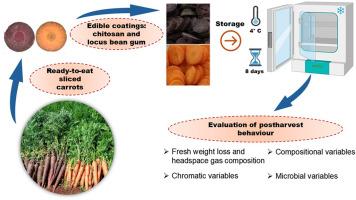
Promoting the consumption of purple carrots, particularly in ready-to-eat products, is justified due to their peculiar composition and health benefits for consumers. However, there is limited literature on the shelf life of ready-to-eat purple carrots and the potential role of edible coatings in mitigating their quality decay. This study examined the postharvest behavior of sliced carrots ‘Dordogne’ (orange) and ‘Purple Sun’ (purple), both uncoated and coated with chitosan (CH) or locust bean gum (LBG), stored for 0 (S0), 4 (S4), and 8 (S8) days at 4.0 °C. ‘Purple Sun’ proved a high fresh weight loss (up to 7.57 g 100 g−1 FW) and respiration metabolism. Compared to controls, CH reduced total color difference in ‘Dordogne’ (−70 %) but increased it in ‘Purple Sun’ (+68 %) due to the occurrence of tissue browning. Compared to uncoated controls, at the end of storage, total phenolic and ascorbic acid contents were lower in CH-coated ‘Purple Sun’ (−14 % and −20 %, respectively), while CH preserved total carotenoid content in ‘Dordogne’ (up to 1000 mg kg−1 DW). Moreover, compared to controls, LBG promoted Pseudomonas spp. (+23 % and +22 % in ‘Dordogne’ and ‘Purple Sun’, respectively) and yeasts and molds (+26 % and +24 %, respectively). Overall, these results indicate that issues of ready-to-eat carrots are significantly affected by carrot type, with the gas-barrier effect (in the case of CH for ‘Purple Sun’) and the antimicrobial properties of LBG (for both cultivars) seeming the most critical aspects to enhance the shelf life of the tested carrots.





 京公网安备 11010802042870号
京ICP备2023020795号-1
京公网安备 11010802042870号
京ICP备2023020795号-1

 分享
分享
 求助内容:
求助内容: 应助结果提醒方式:
 扫码关注我们
