Yang-yang Sun , Zheng-shen Yan , Yuan Gao , Xiao-xue Liang , Ying-ying Dong , Xiao-yun Yang , Meng-ya Dang , Dong Bai , Xiao-xia Wu
{"title":"以酒曲发酵为基础的藏药五味甘露镇痛抗炎作用的物质基础及发酵机制研究","authors":"Yang-yang Sun , Zheng-shen Yan , Yuan Gao , Xiao-xue Liang , Ying-ying Dong , Xiao-yun Yang , Meng-ya Dang , Dong Bai , Xiao-xia Wu","doi":"10.1016/j.jep.2025.119565","DOIUrl":null,"url":null,"abstract":"<div><h3>Ethnopharmacological relevance</h3><div>Wuwei Ganlu, as an integral part of the Tibetan medical system known as \"Sowa Rigpa\" originates from the formulations documented in the \"Four Tantras\". It is recognized by UNESCO as an intangible cultural heritage, representing a body of traditional knowledge and practice. Fermentation, a crucial step in the preparation of Wuwei Ganlu, has not been fully understood in terms of its mechanisms and its impact on the material basis and pharmacological efficacy of the medicine.</div></div><div><h3>Aim of the study</h3><div>By investigating the effects of fermentation on the chemical components and pharmacological activities of Tibetan medicine Wuwei Ganlu, this study aims to reveal the scientific basis for the enhanced efficacy induced by fermentation.</div></div><div><h3>Materials and methods</h3><div>An analgesic and anti-inflammatory animal model was employed to investigate the effects of Tibetan medicine Wuwei Ganlu at different fermentation stages (from 0 to 5 days) on the number of twisting and serum IL-6 levels in mice, aiming to explore the influence of fermentation on the potentiation of its analgesic and anti-inflammatory effects. Based on this, a systematic analysis of the substance basis of Wuwei Ganlu before and after fermentation was conducted using UPLC-Q-Exactive Orbitrap MS and HPLC-MS/MS methods, identifying key differences in the substance composition and determining the indicative components. Additionally, fungal community changes before and after fermentation were studied using ITS rRNA sequencing, which revealed the differences in the fungal community. The integrity of the plant cell walls in Wuwei Ganlu before and after fermentation was examined under a microscope, and the effects of fermentation on the plant cell walls and cellulase activity were assessed by measuring the enzyme activity during the fermentation process. Finally, the fermentation mechanism of Wuwei Ganlu was further corroborated by studying the changes in content and transformation patterns of specific components, including Rutin, Quercitrin, Hyperoside, Quercetin, and Ephedrine, under the same fermentation conditions.</div></div><div><h3>Results</h3><div>The analgesic and anti-inflammatory experiments indicated that fermentation significantly enhanced the analgesic and anti-inflammatory effects of Tibetan medicine Wuwei Ganlu, as evidenced by a marked reduction in the number of twisting and IL-6 levels (<em>P < 0.05</em>). Fermentation caused significant changes in the Chemical Compotents of Wuwei Ganlu, increasing the levels of Ephedrine (19.69%), Rutin (16.71%), Quercitrin (21.54%), Quercetin (132.54%), and Hyperoside (110.16%). Fungal community analysis revealed that <em>Saccharomycetaceae</em> was the dominant fungal genus during fermentation, with its abundance significantly increasing after fermentation, while <em>Aspergillus</em> showed relatively low abundance on day 3 of fermentation. The cellulase produced by <em>Saccharomycetaceae</em> promoted the hydrolysis of the plant cell walls. Microscopic observation demonstrated that fermentation led to plant cell walls rupture and fiber structure transparency in the raw materials, which enhanced cellulase activity between days 1 and 3, promoting the release of Ephedrine, Rutin, Quercitrin, Quercetin, and Hyperoside. Under the catalytic action of JiuQu fermentation starter, Rutin, Quercitrin, and Hyperoside were hydrolyzed into Quercetin, while Ephedrine was transformed into Methylephedrone and Cathinone, confirming the fermentation-induced transformation pathways of these compotents. The heatmap of the correlation between chemical components, microbial community, and pharmacological indicators showed that the abundance of <em>Saccharomycetaceae</em> in the fermented samples was significantly correlated with the Twisting inhibition rate and IL-6 levels in mice, as well as Ephedrine and Quercetin, suggesting that Ephedrine and Quercetin may have potential analgesic and anti-inflammatory effects.</div></div><div><h3>Conclusion</h3><div>The fermentation process significantly enhances the analgesic and anti-inflammatory effects, primarily due to the chemical components changes in Tibetan medicine Wuwei Ganlu induced by fermentation. Fermentation regulates the abundance of dominant microbial communities, particularly <em>Saccharomycetaceae</em> species, and enhances cellulase activity. This enhances the breakdown of plant cell walls, promoting the release of chemical components. Additionally, fermentation facilitates the conversion of glycosides (water-soluble) into aglycones (lipid-soluble), such as the hydrolysis of Rutin, Hyperoside, and hypericin into Quercetin. In summary, the fermentation mechanism of Wuwei Ganlu involves an increase in <em>Saccharomycetaceae</em> abundance and enhanced cellulase activity under the influence of JiuQu fermentation, leading to plant cell walls breakdown and the subsequent release of chemical components. Moreover, the conversion of glycosides to lipid-soluble aglycones during fermentation enhances transdermal absorption, which may also contribute to the potentiation of its effects.</div></div>","PeriodicalId":15761,"journal":{"name":"Journal of ethnopharmacology","volume":"344 ","pages":"Article 119565"},"PeriodicalIF":5.4000,"publicationDate":"2025-03-26","publicationTypes":"Journal Article","fieldsOfStudy":null,"isOpenAccess":false,"openAccessPdf":"","citationCount":"0","resultStr":"{\"title\":\"Substance basis and fermentation mechanism study of the analgesic and anti-inflammatory effects of Tibetan medicine Wuwei Ganlu based on JiuQu fermentation\",\"authors\":\"Yang-yang Sun , Zheng-shen Yan , Yuan Gao , Xiao-xue Liang , Ying-ying Dong , Xiao-yun Yang , Meng-ya Dang , Dong Bai , Xiao-xia Wu\",\"doi\":\"10.1016/j.jep.2025.119565\",\"DOIUrl\":null,\"url\":null,\"abstract\":\"<div><h3>Ethnopharmacological relevance</h3><div>Wuwei Ganlu, as an integral part of the Tibetan medical system known as \\\"Sowa Rigpa\\\" originates from the formulations documented in the \\\"Four Tantras\\\". It is recognized by UNESCO as an intangible cultural heritage, representing a body of traditional knowledge and practice. Fermentation, a crucial step in the preparation of Wuwei Ganlu, has not been fully understood in terms of its mechanisms and its impact on the material basis and pharmacological efficacy of the medicine.</div></div><div><h3>Aim of the study</h3><div>By investigating the effects of fermentation on the chemical components and pharmacological activities of Tibetan medicine Wuwei Ganlu, this study aims to reveal the scientific basis for the enhanced efficacy induced by fermentation.</div></div><div><h3>Materials and methods</h3><div>An analgesic and anti-inflammatory animal model was employed to investigate the effects of Tibetan medicine Wuwei Ganlu at different fermentation stages (from 0 to 5 days) on the number of twisting and serum IL-6 levels in mice, aiming to explore the influence of fermentation on the potentiation of its analgesic and anti-inflammatory effects. Based on this, a systematic analysis of the substance basis of Wuwei Ganlu before and after fermentation was conducted using UPLC-Q-Exactive Orbitrap MS and HPLC-MS/MS methods, identifying key differences in the substance composition and determining the indicative components. Additionally, fungal community changes before and after fermentation were studied using ITS rRNA sequencing, which revealed the differences in the fungal community. The integrity of the plant cell walls in Wuwei Ganlu before and after fermentation was examined under a microscope, and the effects of fermentation on the plant cell walls and cellulase activity were assessed by measuring the enzyme activity during the fermentation process. Finally, the fermentation mechanism of Wuwei Ganlu was further corroborated by studying the changes in content and transformation patterns of specific components, including Rutin, Quercitrin, Hyperoside, Quercetin, and Ephedrine, under the same fermentation conditions.</div></div><div><h3>Results</h3><div>The analgesic and anti-inflammatory experiments indicated that fermentation significantly enhanced the analgesic and anti-inflammatory effects of Tibetan medicine Wuwei Ganlu, as evidenced by a marked reduction in the number of twisting and IL-6 levels (<em>P < 0.05</em>). Fermentation caused significant changes in the Chemical Compotents of Wuwei Ganlu, increasing the levels of Ephedrine (19.69%), Rutin (16.71%), Quercitrin (21.54%), Quercetin (132.54%), and Hyperoside (110.16%). Fungal community analysis revealed that <em>Saccharomycetaceae</em> was the dominant fungal genus during fermentation, with its abundance significantly increasing after fermentation, while <em>Aspergillus</em> showed relatively low abundance on day 3 of fermentation. The cellulase produced by <em>Saccharomycetaceae</em> promoted the hydrolysis of the plant cell walls. Microscopic observation demonstrated that fermentation led to plant cell walls rupture and fiber structure transparency in the raw materials, which enhanced cellulase activity between days 1 and 3, promoting the release of Ephedrine, Rutin, Quercitrin, Quercetin, and Hyperoside. Under the catalytic action of JiuQu fermentation starter, Rutin, Quercitrin, and Hyperoside were hydrolyzed into Quercetin, while Ephedrine was transformed into Methylephedrone and Cathinone, confirming the fermentation-induced transformation pathways of these compotents. The heatmap of the correlation between chemical components, microbial community, and pharmacological indicators showed that the abundance of <em>Saccharomycetaceae</em> in the fermented samples was significantly correlated with the Twisting inhibition rate and IL-6 levels in mice, as well as Ephedrine and Quercetin, suggesting that Ephedrine and Quercetin may have potential analgesic and anti-inflammatory effects.</div></div><div><h3>Conclusion</h3><div>The fermentation process significantly enhances the analgesic and anti-inflammatory effects, primarily due to the chemical components changes in Tibetan medicine Wuwei Ganlu induced by fermentation. Fermentation regulates the abundance of dominant microbial communities, particularly <em>Saccharomycetaceae</em> species, and enhances cellulase activity. This enhances the breakdown of plant cell walls, promoting the release of chemical components. Additionally, fermentation facilitates the conversion of glycosides (water-soluble) into aglycones (lipid-soluble), such as the hydrolysis of Rutin, Hyperoside, and hypericin into Quercetin. In summary, the fermentation mechanism of Wuwei Ganlu involves an increase in <em>Saccharomycetaceae</em> abundance and enhanced cellulase activity under the influence of JiuQu fermentation, leading to plant cell walls breakdown and the subsequent release of chemical components. Moreover, the conversion of glycosides to lipid-soluble aglycones during fermentation enhances transdermal absorption, which may also contribute to the potentiation of its effects.</div></div>\",\"PeriodicalId\":15761,\"journal\":{\"name\":\"Journal of ethnopharmacology\",\"volume\":\"344 \",\"pages\":\"Article 119565\"},\"PeriodicalIF\":5.4000,\"publicationDate\":\"2025-03-26\",\"publicationTypes\":\"Journal Article\",\"fieldsOfStudy\":null,\"isOpenAccess\":false,\"openAccessPdf\":\"\",\"citationCount\":\"0\",\"resultStr\":null,\"platform\":\"Semanticscholar\",\"paperid\":null,\"PeriodicalName\":\"Journal of ethnopharmacology\",\"FirstCategoryId\":\"3\",\"ListUrlMain\":\"https://www.sciencedirect.com/science/article/pii/S0378874125002491\",\"RegionNum\":2,\"RegionCategory\":\"医学\",\"ArticlePicture\":[],\"TitleCN\":null,\"AbstractTextCN\":null,\"PMCID\":null,\"EPubDate\":\"2025/2/25 0:00:00\",\"PubModel\":\"Epub\",\"JCR\":\"Q1\",\"JCRName\":\"CHEMISTRY, MEDICINAL\",\"Score\":null,\"Total\":0}","platform":"Semanticscholar","paperid":null,"PeriodicalName":"Journal of ethnopharmacology","FirstCategoryId":"3","ListUrlMain":"https://www.sciencedirect.com/science/article/pii/S0378874125002491","RegionNum":2,"RegionCategory":"医学","ArticlePicture":[],"TitleCN":null,"AbstractTextCN":null,"PMCID":null,"EPubDate":"2025/2/25 0:00:00","PubModel":"Epub","JCR":"Q1","JCRName":"CHEMISTRY, MEDICINAL","Score":null,"Total":0}
Substance basis and fermentation mechanism study of the analgesic and anti-inflammatory effects of Tibetan medicine Wuwei Ganlu based on JiuQu fermentation
Ethnopharmacological relevance
Wuwei Ganlu, as an integral part of the Tibetan medical system known as "Sowa Rigpa" originates from the formulations documented in the "Four Tantras". It is recognized by UNESCO as an intangible cultural heritage, representing a body of traditional knowledge and practice. Fermentation, a crucial step in the preparation of Wuwei Ganlu, has not been fully understood in terms of its mechanisms and its impact on the material basis and pharmacological efficacy of the medicine.
Aim of the study
By investigating the effects of fermentation on the chemical components and pharmacological activities of Tibetan medicine Wuwei Ganlu, this study aims to reveal the scientific basis for the enhanced efficacy induced by fermentation.
Materials and methods
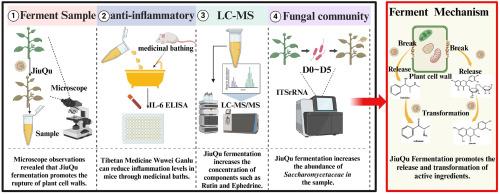
An analgesic and anti-inflammatory animal model was employed to investigate the effects of Tibetan medicine Wuwei Ganlu at different fermentation stages (from 0 to 5 days) on the number of twisting and serum IL-6 levels in mice, aiming to explore the influence of fermentation on the potentiation of its analgesic and anti-inflammatory effects. Based on this, a systematic analysis of the substance basis of Wuwei Ganlu before and after fermentation was conducted using UPLC-Q-Exactive Orbitrap MS and HPLC-MS/MS methods, identifying key differences in the substance composition and determining the indicative components. Additionally, fungal community changes before and after fermentation were studied using ITS rRNA sequencing, which revealed the differences in the fungal community. The integrity of the plant cell walls in Wuwei Ganlu before and after fermentation was examined under a microscope, and the effects of fermentation on the plant cell walls and cellulase activity were assessed by measuring the enzyme activity during the fermentation process. Finally, the fermentation mechanism of Wuwei Ganlu was further corroborated by studying the changes in content and transformation patterns of specific components, including Rutin, Quercitrin, Hyperoside, Quercetin, and Ephedrine, under the same fermentation conditions.
Results
The analgesic and anti-inflammatory experiments indicated that fermentation significantly enhanced the analgesic and anti-inflammatory effects of Tibetan medicine Wuwei Ganlu, as evidenced by a marked reduction in the number of twisting and IL-6 levels (P < 0.05). Fermentation caused significant changes in the Chemical Compotents of Wuwei Ganlu, increasing the levels of Ephedrine (19.69%), Rutin (16.71%), Quercitrin (21.54%), Quercetin (132.54%), and Hyperoside (110.16%). Fungal community analysis revealed that Saccharomycetaceae was the dominant fungal genus during fermentation, with its abundance significantly increasing after fermentation, while Aspergillus showed relatively low abundance on day 3 of fermentation. The cellulase produced by Saccharomycetaceae promoted the hydrolysis of the plant cell walls. Microscopic observation demonstrated that fermentation led to plant cell walls rupture and fiber structure transparency in the raw materials, which enhanced cellulase activity between days 1 and 3, promoting the release of Ephedrine, Rutin, Quercitrin, Quercetin, and Hyperoside. Under the catalytic action of JiuQu fermentation starter, Rutin, Quercitrin, and Hyperoside were hydrolyzed into Quercetin, while Ephedrine was transformed into Methylephedrone and Cathinone, confirming the fermentation-induced transformation pathways of these compotents. The heatmap of the correlation between chemical components, microbial community, and pharmacological indicators showed that the abundance of Saccharomycetaceae in the fermented samples was significantly correlated with the Twisting inhibition rate and IL-6 levels in mice, as well as Ephedrine and Quercetin, suggesting that Ephedrine and Quercetin may have potential analgesic and anti-inflammatory effects.
Conclusion
The fermentation process significantly enhances the analgesic and anti-inflammatory effects, primarily due to the chemical components changes in Tibetan medicine Wuwei Ganlu induced by fermentation. Fermentation regulates the abundance of dominant microbial communities, particularly Saccharomycetaceae species, and enhances cellulase activity. This enhances the breakdown of plant cell walls, promoting the release of chemical components. Additionally, fermentation facilitates the conversion of glycosides (water-soluble) into aglycones (lipid-soluble), such as the hydrolysis of Rutin, Hyperoside, and hypericin into Quercetin. In summary, the fermentation mechanism of Wuwei Ganlu involves an increase in Saccharomycetaceae abundance and enhanced cellulase activity under the influence of JiuQu fermentation, leading to plant cell walls breakdown and the subsequent release of chemical components. Moreover, the conversion of glycosides to lipid-soluble aglycones during fermentation enhances transdermal absorption, which may also contribute to the potentiation of its effects.
期刊介绍:
The Journal of Ethnopharmacology is dedicated to the exchange of information and understandings about people''s use of plants, fungi, animals, microorganisms and minerals and their biological and pharmacological effects based on the principles established through international conventions. Early people confronted with illness and disease, discovered a wealth of useful therapeutic agents in the plant and animal kingdoms. The empirical knowledge of these medicinal substances and their toxic potential was passed on by oral tradition and sometimes recorded in herbals and other texts on materia medica. Many valuable drugs of today (e.g., atropine, ephedrine, tubocurarine, digoxin, reserpine) came into use through the study of indigenous remedies. Chemists continue to use plant-derived drugs (e.g., morphine, taxol, physostigmine, quinidine, emetine) as prototypes in their attempts to develop more effective and less toxic medicinals.





 京公网安备 11010802042870号
京ICP备2023020795号-1
京公网安备 11010802042870号
京ICP备2023020795号-1

 分享
分享
 求助内容:
求助内容: 应助结果提醒方式:
 扫码关注我们
