Pradeep Reddy Vanga , D.M. Lakshmi Priyaa , T. Selvalakshmi , R.V. Mangalaraja , M. Ashok , Parthasaradhi Reddy
{"title":"BiPO4:Pr的光致发光和光催化行为研究","authors":"Pradeep Reddy Vanga , D.M. Lakshmi Priyaa , T. Selvalakshmi , R.V. Mangalaraja , M. Ashok , Parthasaradhi Reddy","doi":"10.1016/j.molstruc.2025.141826","DOIUrl":null,"url":null,"abstract":"<div><div>The hydrothermal method was used to synthesize BiPO<sub>4</sub> and BiPO<sub>4</sub> with varying concentrations of praseodymium. X-ray diffraction confirmed the crystal structure of the samples as low-temperature monoclinic, and substituting the Pr<sup>3+</sup> ion in the Bi<sup>3+</sup> site did not affect the crystal structure. Functional group analyses showed vibrational modes corresponding to Bi<img>O and PO<sub>4</sub> bonds. UV–vis DRS spectra indicated the presence of bands corresponding to Bi<img>O transition, and a minor reduction in band gap was seen with the substitution of Pr. The excitation and emission spectra of BiPO<sub>4</sub>:Pr<sup>3+</sup> were recorded to study the luminescene behavior of Pr ion in BiPO<sub>4</sub>. Emission intensity quenching occurred at Pr concentrations greater than 1.5 %. The samples' photocatalytic performance was examined by degrading the organic dye rhodamine B under a UV light source. Pr concentration of 1.5 % sample exhibited a better degradation rate when compared to BiPO<sub>4</sub> and other Pr-doped BiPO<sub>4</sub> samples. The stability of the photocatalyst was confirmed using the XRD pattern.</div></div>","PeriodicalId":16414,"journal":{"name":"Journal of Molecular Structure","volume":"1334 ","pages":"Article 141826"},"PeriodicalIF":4.9000,"publicationDate":"2025-07-05","publicationTypes":"Journal Article","fieldsOfStudy":null,"isOpenAccess":false,"openAccessPdf":"","citationCount":"0","resultStr":"{\"title\":\"Investigation on photoluminescence and photocatalytic behavior of BiPO4:Pr\",\"authors\":\"Pradeep Reddy Vanga , D.M. Lakshmi Priyaa , T. Selvalakshmi , R.V. Mangalaraja , M. Ashok , Parthasaradhi Reddy\",\"doi\":\"10.1016/j.molstruc.2025.141826\",\"DOIUrl\":null,\"url\":null,\"abstract\":\"<div><div>The hydrothermal method was used to synthesize BiPO<sub>4</sub> and BiPO<sub>4</sub> with varying concentrations of praseodymium. X-ray diffraction confirmed the crystal structure of the samples as low-temperature monoclinic, and substituting the Pr<sup>3+</sup> ion in the Bi<sup>3+</sup> site did not affect the crystal structure. Functional group analyses showed vibrational modes corresponding to Bi<img>O and PO<sub>4</sub> bonds. UV–vis DRS spectra indicated the presence of bands corresponding to Bi<img>O transition, and a minor reduction in band gap was seen with the substitution of Pr. The excitation and emission spectra of BiPO<sub>4</sub>:Pr<sup>3+</sup> were recorded to study the luminescene behavior of Pr ion in BiPO<sub>4</sub>. Emission intensity quenching occurred at Pr concentrations greater than 1.5 %. The samples' photocatalytic performance was examined by degrading the organic dye rhodamine B under a UV light source. Pr concentration of 1.5 % sample exhibited a better degradation rate when compared to BiPO<sub>4</sub> and other Pr-doped BiPO<sub>4</sub> samples. The stability of the photocatalyst was confirmed using the XRD pattern.</div></div>\",\"PeriodicalId\":16414,\"journal\":{\"name\":\"Journal of Molecular Structure\",\"volume\":\"1334 \",\"pages\":\"Article 141826\"},\"PeriodicalIF\":4.9000,\"publicationDate\":\"2025-07-05\",\"publicationTypes\":\"Journal Article\",\"fieldsOfStudy\":null,\"isOpenAccess\":false,\"openAccessPdf\":\"\",\"citationCount\":\"0\",\"resultStr\":null,\"platform\":\"Semanticscholar\",\"paperid\":null,\"PeriodicalName\":\"Journal of Molecular Structure\",\"FirstCategoryId\":\"92\",\"ListUrlMain\":\"https://www.sciencedirect.com/science/article/pii/S0022286025005125\",\"RegionNum\":2,\"RegionCategory\":\"化学\",\"ArticlePicture\":[],\"TitleCN\":null,\"AbstractTextCN\":null,\"PMCID\":null,\"EPubDate\":\"2025/2/21 0:00:00\",\"PubModel\":\"Epub\",\"JCR\":\"Q2\",\"JCRName\":\"CHEMISTRY, PHYSICAL\",\"Score\":null,\"Total\":0}","platform":"Semanticscholar","paperid":null,"PeriodicalName":"Journal of Molecular Structure","FirstCategoryId":"92","ListUrlMain":"https://www.sciencedirect.com/science/article/pii/S0022286025005125","RegionNum":2,"RegionCategory":"化学","ArticlePicture":[],"TitleCN":null,"AbstractTextCN":null,"PMCID":null,"EPubDate":"2025/2/21 0:00:00","PubModel":"Epub","JCR":"Q2","JCRName":"CHEMISTRY, PHYSICAL","Score":null,"Total":0}
Investigation on photoluminescence and photocatalytic behavior of BiPO4:Pr
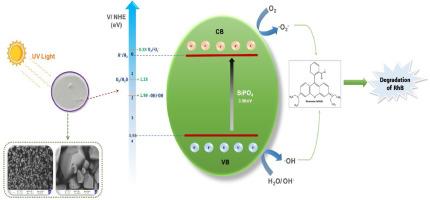
The hydrothermal method was used to synthesize BiPO4 and BiPO4 with varying concentrations of praseodymium. X-ray diffraction confirmed the crystal structure of the samples as low-temperature monoclinic, and substituting the Pr3+ ion in the Bi3+ site did not affect the crystal structure. Functional group analyses showed vibrational modes corresponding to BiO and PO4 bonds. UV–vis DRS spectra indicated the presence of bands corresponding to BiO transition, and a minor reduction in band gap was seen with the substitution of Pr. The excitation and emission spectra of BiPO4:Pr3+ were recorded to study the luminescene behavior of Pr ion in BiPO4. Emission intensity quenching occurred at Pr concentrations greater than 1.5 %. The samples' photocatalytic performance was examined by degrading the organic dye rhodamine B under a UV light source. Pr concentration of 1.5 % sample exhibited a better degradation rate when compared to BiPO4 and other Pr-doped BiPO4 samples. The stability of the photocatalyst was confirmed using the XRD pattern.
期刊介绍:
The Journal of Molecular Structure is dedicated to the publication of full-length articles and review papers, providing important new structural information on all types of chemical species including:
• Stable and unstable molecules in all types of environments (vapour, molecular beam, liquid, solution, liquid crystal, solid state, matrix-isolated, surface-absorbed etc.)
• Chemical intermediates
• Molecules in excited states
• Biological molecules
• Polymers.
The methods used may include any combination of spectroscopic and non-spectroscopic techniques, for example:
• Infrared spectroscopy (mid, far, near)
• Raman spectroscopy and non-linear Raman methods (CARS, etc.)
• Electronic absorption spectroscopy
• Optical rotatory dispersion and circular dichroism
• Fluorescence and phosphorescence techniques
• Electron spectroscopies (PES, XPS), EXAFS, etc.
• Microwave spectroscopy
• Electron diffraction
• NMR and ESR spectroscopies
• Mössbauer spectroscopy
• X-ray crystallography
• Charge Density Analyses
• Computational Studies (supplementing experimental methods)
We encourage publications combining theoretical and experimental approaches. The structural insights gained by the studies should be correlated with the properties, activity and/ or reactivity of the molecule under investigation and the relevance of this molecule and its implications should be discussed.





 京公网安备 11010802042870号
京ICP备2023020795号-1
京公网安备 11010802042870号
京ICP备2023020795号-1

 分享
分享
 求助内容:
求助内容: 应助结果提醒方式:
 扫码关注我们
