Meiling Yuan , Yajie Wu , Xinyue Zhou , Yikang Cai , Hui Li , Aixin Xia , Xiao Wang , Jianting Wen , Qiangjun Duan , Chenhao Xu , Huibo Cao , Chenggui Miao
{"title":"clematichinen苷AR通过HIF-1α/VEGFA/ANG2轴抑制滑膜血管生成,从而缓解类风湿关节炎","authors":"Meiling Yuan , Yajie Wu , Xinyue Zhou , Yikang Cai , Hui Li , Aixin Xia , Xiao Wang , Jianting Wen , Qiangjun Duan , Chenhao Xu , Huibo Cao , Chenggui Miao","doi":"10.1016/j.phymed.2025.156552","DOIUrl":null,"url":null,"abstract":"<div><h3>Background</h3><div>Clematichinenoside AR (CAR) is an effective monomer component of <em>Clematis chinensis Osbeck</em>, which has therapeutic effects on rheumatoid arthritis (RA), but its specific mechanism is still not fully elucidated.</div></div><div><h3>Purpose</h3><div>This study elucidated whether CAR alleviated RA by inhibiting synovial angiogenesis and revealed its molecular mechanism.</div></div><div><h3>Methods</h3><div>Arthritis indicators and H&E staining were used to evaluate the therapeutic effects of CAR on collagen-induced arthritis (CIA) rats, and the IHC, IF, EdU-Hoechst, tunel, flow cytometry, wound healing and transwell assay were used to investigate the effects of CAR on synovial angiogenesis. The co-culture model of RA fibroblast-like synoviocytes (FLSs) and human umbilical vein endothelial cells (HUVECs) was established. Tube formation, western blot, RT-qPCR and other related methods were used to evaluate the specific mechanism of CAR.</div></div><div><h3>Results</h3><div>CAR alleviated arthritis pathology and inhibited angiogenesis in CIA rats. CAR inhibited the proliferation, migration and invasion of RA FLSs, and promoted their apoptosis. Importantly, overexpression of HIF-1α inversed the inhibitory impact of CAR on the expression of HIF-1α, VEGFA, VEGFR2, and ANG2, as well as the inhibitory effects of CAR on the expression of CD31/34 and the HUVEC tube formation. Molecular docking, molecular dynamics, and experimental verification confirmed that CAR has a strong binding affinity with HIF-1α, further indicating that HIF-1α was a target of CAR for anti-angiogenesis.</div></div><div><h3>Conclusion</h3><div>CAR had a good inhibitory effect on RA, and its mechanism was inhibition of synovial angiogenesis through the HIF-1α/VEGF/ANG2 axis.</div></div>","PeriodicalId":20212,"journal":{"name":"Phytomedicine","volume":"139 ","pages":"Article 156552"},"PeriodicalIF":8.3000,"publicationDate":"2025-04-01","publicationTypes":"Journal Article","fieldsOfStudy":null,"isOpenAccess":false,"openAccessPdf":"","citationCount":"0","resultStr":"{\"title\":\"Clematichinenoside AR alleviates rheumatoid arthritis by inhibiting synovial angiogenesis through the HIF-1α/VEGFA/ANG2 axis\",\"authors\":\"Meiling Yuan , Yajie Wu , Xinyue Zhou , Yikang Cai , Hui Li , Aixin Xia , Xiao Wang , Jianting Wen , Qiangjun Duan , Chenhao Xu , Huibo Cao , Chenggui Miao\",\"doi\":\"10.1016/j.phymed.2025.156552\",\"DOIUrl\":null,\"url\":null,\"abstract\":\"<div><h3>Background</h3><div>Clematichinenoside AR (CAR) is an effective monomer component of <em>Clematis chinensis Osbeck</em>, which has therapeutic effects on rheumatoid arthritis (RA), but its specific mechanism is still not fully elucidated.</div></div><div><h3>Purpose</h3><div>This study elucidated whether CAR alleviated RA by inhibiting synovial angiogenesis and revealed its molecular mechanism.</div></div><div><h3>Methods</h3><div>Arthritis indicators and H&E staining were used to evaluate the therapeutic effects of CAR on collagen-induced arthritis (CIA) rats, and the IHC, IF, EdU-Hoechst, tunel, flow cytometry, wound healing and transwell assay were used to investigate the effects of CAR on synovial angiogenesis. The co-culture model of RA fibroblast-like synoviocytes (FLSs) and human umbilical vein endothelial cells (HUVECs) was established. Tube formation, western blot, RT-qPCR and other related methods were used to evaluate the specific mechanism of CAR.</div></div><div><h3>Results</h3><div>CAR alleviated arthritis pathology and inhibited angiogenesis in CIA rats. CAR inhibited the proliferation, migration and invasion of RA FLSs, and promoted their apoptosis. Importantly, overexpression of HIF-1α inversed the inhibitory impact of CAR on the expression of HIF-1α, VEGFA, VEGFR2, and ANG2, as well as the inhibitory effects of CAR on the expression of CD31/34 and the HUVEC tube formation. Molecular docking, molecular dynamics, and experimental verification confirmed that CAR has a strong binding affinity with HIF-1α, further indicating that HIF-1α was a target of CAR for anti-angiogenesis.</div></div><div><h3>Conclusion</h3><div>CAR had a good inhibitory effect on RA, and its mechanism was inhibition of synovial angiogenesis through the HIF-1α/VEGF/ANG2 axis.</div></div>\",\"PeriodicalId\":20212,\"journal\":{\"name\":\"Phytomedicine\",\"volume\":\"139 \",\"pages\":\"Article 156552\"},\"PeriodicalIF\":8.3000,\"publicationDate\":\"2025-04-01\",\"publicationTypes\":\"Journal Article\",\"fieldsOfStudy\":null,\"isOpenAccess\":false,\"openAccessPdf\":\"\",\"citationCount\":\"0\",\"resultStr\":null,\"platform\":\"Semanticscholar\",\"paperid\":null,\"PeriodicalName\":\"Phytomedicine\",\"FirstCategoryId\":\"3\",\"ListUrlMain\":\"https://www.sciencedirect.com/science/article/pii/S0944711325001928\",\"RegionNum\":1,\"RegionCategory\":\"医学\",\"ArticlePicture\":[],\"TitleCN\":null,\"AbstractTextCN\":null,\"PMCID\":null,\"EPubDate\":\"2025/2/21 0:00:00\",\"PubModel\":\"Epub\",\"JCR\":\"Q1\",\"JCRName\":\"CHEMISTRY, MEDICINAL\",\"Score\":null,\"Total\":0}","platform":"Semanticscholar","paperid":null,"PeriodicalName":"Phytomedicine","FirstCategoryId":"3","ListUrlMain":"https://www.sciencedirect.com/science/article/pii/S0944711325001928","RegionNum":1,"RegionCategory":"医学","ArticlePicture":[],"TitleCN":null,"AbstractTextCN":null,"PMCID":null,"EPubDate":"2025/2/21 0:00:00","PubModel":"Epub","JCR":"Q1","JCRName":"CHEMISTRY, MEDICINAL","Score":null,"Total":0}
引用次数: 0
摘要
背景clematichinenoside AR (CAR)是铁线莲(Clematis chinensis Osbeck)中有效的单体成分,具有治疗类风湿性关节炎(RA)的作用,但其具体机制尚不完全清楚。目的研究CAR是否通过抑制滑膜血管生成来缓解RA,并揭示其分子机制。方法采用关节炎指标和H&;E染色评价CAR对胶原性关节炎(CIA)大鼠的治疗作用,采用免疫组化(IHC)、IF、eduh - hoechst、隧道、流式细胞术、创面愈合和transwell法观察CAR对滑膜血管生成的影响。建立RA成纤维细胞样滑膜细胞(FLSs)与人脐静脉内皮细胞(HUVECs)共培养模型。采用成管、western blot、RT-qPCR等相关方法评价CAR的特异性机制。结果scar减轻CIA大鼠关节炎病理,抑制血管生成。CAR抑制RA FLSs的增殖、迁移和侵袭,促进其凋亡。重要的是,过表达HIF-1α逆转了CAR对HIF-1α、VEGFA、VEGFR2和ANG2表达的抑制作用,以及CAR对CD31/34表达和HUVEC管形成的抑制作用。分子对接、分子动力学和实验验证证实了CAR与HIF-1α具有较强的结合亲和力,进一步表明HIF-1α是CAR抗血管生成的靶点。结论car对RA有良好的抑制作用,其机制是通过HIF-1α/VEGF/ANG2轴抑制滑膜血管生成。
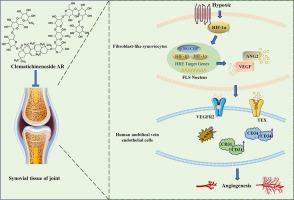
Clematichinenoside AR alleviates rheumatoid arthritis by inhibiting synovial angiogenesis through the HIF-1α/VEGFA/ANG2 axis
Background
Clematichinenoside AR (CAR) is an effective monomer component of Clematis chinensis Osbeck, which has therapeutic effects on rheumatoid arthritis (RA), but its specific mechanism is still not fully elucidated.
Purpose
This study elucidated whether CAR alleviated RA by inhibiting synovial angiogenesis and revealed its molecular mechanism.
Methods
Arthritis indicators and H&E staining were used to evaluate the therapeutic effects of CAR on collagen-induced arthritis (CIA) rats, and the IHC, IF, EdU-Hoechst, tunel, flow cytometry, wound healing and transwell assay were used to investigate the effects of CAR on synovial angiogenesis. The co-culture model of RA fibroblast-like synoviocytes (FLSs) and human umbilical vein endothelial cells (HUVECs) was established. Tube formation, western blot, RT-qPCR and other related methods were used to evaluate the specific mechanism of CAR.
Results
CAR alleviated arthritis pathology and inhibited angiogenesis in CIA rats. CAR inhibited the proliferation, migration and invasion of RA FLSs, and promoted their apoptosis. Importantly, overexpression of HIF-1α inversed the inhibitory impact of CAR on the expression of HIF-1α, VEGFA, VEGFR2, and ANG2, as well as the inhibitory effects of CAR on the expression of CD31/34 and the HUVEC tube formation. Molecular docking, molecular dynamics, and experimental verification confirmed that CAR has a strong binding affinity with HIF-1α, further indicating that HIF-1α was a target of CAR for anti-angiogenesis.
Conclusion
CAR had a good inhibitory effect on RA, and its mechanism was inhibition of synovial angiogenesis through the HIF-1α/VEGF/ANG2 axis.
期刊介绍:
Phytomedicine is a therapy-oriented journal that publishes innovative studies on the efficacy, safety, quality, and mechanisms of action of specified plant extracts, phytopharmaceuticals, and their isolated constituents. This includes clinical, pharmacological, pharmacokinetic, and toxicological studies of herbal medicinal products, preparations, and purified compounds with defined and consistent quality, ensuring reproducible pharmacological activity. Founded in 1994, Phytomedicine aims to focus and stimulate research in this field and establish internationally accepted scientific standards for pharmacological studies, proof of clinical efficacy, and safety of phytomedicines.





 京公网安备 11010802042870号
京ICP备2023020795号-1
京公网安备 11010802042870号
京ICP备2023020795号-1

 分享
分享
 求助内容:
求助内容: 应助结果提醒方式:
 扫码关注我们
