{"title":"高密度,超柔性有机电化学晶体管阵列脑活动映射†","authors":"Wei Xu, Yanlan Zhu, Xiaolin Zhou, Haoyue Guo, Jingxin Wang, Ruiqi Zhu, Zhengwei Hu, Wei Ma, Xing Ma, Xiaojian Li and Xiaomin Xu","doi":"10.1039/D4TC02839B","DOIUrl":null,"url":null,"abstract":"<p >Organic electrochemical transistors (OECTs) are emerging as promising neural electrodes due to their capabilities for on-site signal amplification, customizable mechanical flexibility, biocompatibility, and stability in biotic conditions. However, documented flexible OECT arrays face limitations in channel count and spatiotemporal resolution. Here, we report a high-density, ultraflexible OECT array designed explicitly for the high-resolution electrocorticogram (ECoG) signal recording. Featuring vertically stacked source and drain electrodes, the array incorporates 1024 channels in a compact form factor, only 4.2 μm thick, achieving a density of 10 000 transistors per square centimeter. A 16 × 16 segment of the 1024-channel array was utilized to map whisker-related signals in a mouse model, effectively locating neural activities in response to tactile stimulation. Besides, it demonstrates high mechanical compliance and long-term stability, remaining effective for three months post-implantation and beyond. With its excellent resolution and durability, the ultraflexible OECT array promises to enhance the monitoring and understanding of neural dynamics across a wide spatiotemporal scale.</p>","PeriodicalId":84,"journal":{"name":"Journal of Materials Chemistry C","volume":" 9","pages":" 4385-4397"},"PeriodicalIF":5.1000,"publicationDate":"2025-01-20","publicationTypes":"Journal Article","fieldsOfStudy":null,"isOpenAccess":false,"openAccessPdf":"https://pubs.rsc.org/en/content/articlepdf/2025/tc/d4tc02839b?page=search","citationCount":"0","resultStr":"{\"title\":\"High-density, ultraflexible organic electrochemical transistor array for brain activity mapping†\",\"authors\":\"Wei Xu, Yanlan Zhu, Xiaolin Zhou, Haoyue Guo, Jingxin Wang, Ruiqi Zhu, Zhengwei Hu, Wei Ma, Xing Ma, Xiaojian Li and Xiaomin Xu\",\"doi\":\"10.1039/D4TC02839B\",\"DOIUrl\":null,\"url\":null,\"abstract\":\"<p >Organic electrochemical transistors (OECTs) are emerging as promising neural electrodes due to their capabilities for on-site signal amplification, customizable mechanical flexibility, biocompatibility, and stability in biotic conditions. However, documented flexible OECT arrays face limitations in channel count and spatiotemporal resolution. Here, we report a high-density, ultraflexible OECT array designed explicitly for the high-resolution electrocorticogram (ECoG) signal recording. Featuring vertically stacked source and drain electrodes, the array incorporates 1024 channels in a compact form factor, only 4.2 μm thick, achieving a density of 10 000 transistors per square centimeter. A 16 × 16 segment of the 1024-channel array was utilized to map whisker-related signals in a mouse model, effectively locating neural activities in response to tactile stimulation. Besides, it demonstrates high mechanical compliance and long-term stability, remaining effective for three months post-implantation and beyond. With its excellent resolution and durability, the ultraflexible OECT array promises to enhance the monitoring and understanding of neural dynamics across a wide spatiotemporal scale.</p>\",\"PeriodicalId\":84,\"journal\":{\"name\":\"Journal of Materials Chemistry C\",\"volume\":\" 9\",\"pages\":\" 4385-4397\"},\"PeriodicalIF\":5.1000,\"publicationDate\":\"2025-01-20\",\"publicationTypes\":\"Journal Article\",\"fieldsOfStudy\":null,\"isOpenAccess\":false,\"openAccessPdf\":\"https://pubs.rsc.org/en/content/articlepdf/2025/tc/d4tc02839b?page=search\",\"citationCount\":\"0\",\"resultStr\":null,\"platform\":\"Semanticscholar\",\"paperid\":null,\"PeriodicalName\":\"Journal of Materials Chemistry C\",\"FirstCategoryId\":\"1\",\"ListUrlMain\":\"https://pubs.rsc.org/en/content/articlelanding/2025/tc/d4tc02839b\",\"RegionNum\":2,\"RegionCategory\":\"材料科学\",\"ArticlePicture\":[],\"TitleCN\":null,\"AbstractTextCN\":null,\"PMCID\":null,\"EPubDate\":\"\",\"PubModel\":\"\",\"JCR\":\"Q2\",\"JCRName\":\"MATERIALS SCIENCE, MULTIDISCIPLINARY\",\"Score\":null,\"Total\":0}","platform":"Semanticscholar","paperid":null,"PeriodicalName":"Journal of Materials Chemistry C","FirstCategoryId":"1","ListUrlMain":"https://pubs.rsc.org/en/content/articlelanding/2025/tc/d4tc02839b","RegionNum":2,"RegionCategory":"材料科学","ArticlePicture":[],"TitleCN":null,"AbstractTextCN":null,"PMCID":null,"EPubDate":"","PubModel":"","JCR":"Q2","JCRName":"MATERIALS SCIENCE, MULTIDISCIPLINARY","Score":null,"Total":0}
High-density, ultraflexible organic electrochemical transistor array for brain activity mapping†
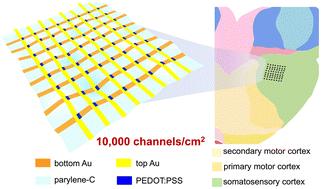
Organic electrochemical transistors (OECTs) are emerging as promising neural electrodes due to their capabilities for on-site signal amplification, customizable mechanical flexibility, biocompatibility, and stability in biotic conditions. However, documented flexible OECT arrays face limitations in channel count and spatiotemporal resolution. Here, we report a high-density, ultraflexible OECT array designed explicitly for the high-resolution electrocorticogram (ECoG) signal recording. Featuring vertically stacked source and drain electrodes, the array incorporates 1024 channels in a compact form factor, only 4.2 μm thick, achieving a density of 10 000 transistors per square centimeter. A 16 × 16 segment of the 1024-channel array was utilized to map whisker-related signals in a mouse model, effectively locating neural activities in response to tactile stimulation. Besides, it demonstrates high mechanical compliance and long-term stability, remaining effective for three months post-implantation and beyond. With its excellent resolution and durability, the ultraflexible OECT array promises to enhance the monitoring and understanding of neural dynamics across a wide spatiotemporal scale.
期刊介绍:
The Journal of Materials Chemistry is divided into three distinct sections, A, B, and C, each catering to specific applications of the materials under study:
Journal of Materials Chemistry A focuses primarily on materials intended for applications in energy and sustainability.
Journal of Materials Chemistry B specializes in materials designed for applications in biology and medicine.
Journal of Materials Chemistry C is dedicated to materials suitable for applications in optical, magnetic, and electronic devices.
Example topic areas within the scope of Journal of Materials Chemistry C are listed below. This list is neither exhaustive nor exclusive.
Bioelectronics
Conductors
Detectors
Dielectrics
Displays
Ferroelectrics
Lasers
LEDs
Lighting
Liquid crystals
Memory
Metamaterials
Multiferroics
Photonics
Photovoltaics
Semiconductors
Sensors
Single molecule conductors
Spintronics
Superconductors
Thermoelectrics
Topological insulators
Transistors




 京公网安备 11010802042870号
京ICP备2023020795号-1
京公网安备 11010802042870号
京ICP备2023020795号-1

 分享
分享
 求助内容:
求助内容: 应助结果提醒方式:
 扫码关注我们
