Ajith Nix ESR, Pujalin Biswal, W. Prellier, D. Samal and Bhaskar Chandra Behera
{"title":"利用临界指数分析揭示了焦绿石α-Cu2V2O7的一维海森堡反铁磁态","authors":"Ajith Nix ESR, Pujalin Biswal, W. Prellier, D. Samal and Bhaskar Chandra Behera","doi":"10.1039/D4TC04888A","DOIUrl":null,"url":null,"abstract":"<p >Low-dimensional magnets provide avenues to explore novel excitations and critical behaviour that are not typically found in their higher-dimension analogues. Herein, we investigate the critical behaviour of the canted antiferromagnet α-Cu<small><sub>2</sub></small>V<small><sub>2</sub></small>O<small><sub>7</sub></small> in the vicinity of magnetic phase transition by measuring isothermal magnetization curves. The α-Cu<small><sub>2</sub></small>V<small><sub>2</sub></small>O<small><sub>7</sub></small> sample is synthesized using the conventional solid-state route, and it stabilizes in an orthorhombic crystal structure with the <em>Fdd</em>2 space group, as determined from X-ray diffraction analysis. Critical exponents (<em>β</em> = 0.283(8), <em>γ</em> = 2.418(6) and <em>δ</em> = 9.16) obtained using the modified Arrott plot (MAP) suggest that α-Cu<small><sub>2</sub></small>V<small><sub>2</sub></small>O<small><sub>7</sub></small> does not belong to any of the existing magnetic universality classes. The reliability and self-consistency of the estimated exponents are further validated using Widom scaling relation and scaling analysis equations. To link the above obtained critical exponents to the underlying spatial-dimensionality (<em>d</em>) and spin-dimensionality (<em>n</em>) of the system, we used the renormalization group theory approach to estimate a set of critical exponents spanning various spin and spatial dimensions. Notably, the critical exponents obtained from renormalization group theory analysis by considering that (<em>d</em>(spatial-dimensionality) : <em>n</em>(spin-dimensionality)) = (1 : 3) closely matches with the value derived from MAP, revealing that α-Cu<small><sub>2</sub></small>V<small><sub>2</sub></small>O<small><sub>7</sub></small> can be considered a 1-D Heisenberg antiferromagnetic system. Finally, critical behaviour analysis testifies that α-Cu<small><sub>2</sub></small>V<small><sub>2</sub></small>O<small><sub>7</sub></small> exhibits long-range type exchange interaction <em>J</em>(<em>r</em>), which decays with <em>r</em> as <em>J</em>(<em>r</em>) ∼ <em>r</em><small><sup>−1.84</sup></small>.</p>","PeriodicalId":84,"journal":{"name":"Journal of Materials Chemistry C","volume":" 9","pages":" 4451-4460"},"PeriodicalIF":5.1000,"publicationDate":"2025-01-20","publicationTypes":"Journal Article","fieldsOfStudy":null,"isOpenAccess":false,"openAccessPdf":"","citationCount":"0","resultStr":"{\"title\":\"Revealing the one-dimensional (1-D) Heisenberg antiferromagnetic state in pyrochlore α-Cu2V2O7 from critical exponent analysis\",\"authors\":\"Ajith Nix ESR, Pujalin Biswal, W. Prellier, D. Samal and Bhaskar Chandra Behera\",\"doi\":\"10.1039/D4TC04888A\",\"DOIUrl\":null,\"url\":null,\"abstract\":\"<p >Low-dimensional magnets provide avenues to explore novel excitations and critical behaviour that are not typically found in their higher-dimension analogues. Herein, we investigate the critical behaviour of the canted antiferromagnet α-Cu<small><sub>2</sub></small>V<small><sub>2</sub></small>O<small><sub>7</sub></small> in the vicinity of magnetic phase transition by measuring isothermal magnetization curves. The α-Cu<small><sub>2</sub></small>V<small><sub>2</sub></small>O<small><sub>7</sub></small> sample is synthesized using the conventional solid-state route, and it stabilizes in an orthorhombic crystal structure with the <em>Fdd</em>2 space group, as determined from X-ray diffraction analysis. Critical exponents (<em>β</em> = 0.283(8), <em>γ</em> = 2.418(6) and <em>δ</em> = 9.16) obtained using the modified Arrott plot (MAP) suggest that α-Cu<small><sub>2</sub></small>V<small><sub>2</sub></small>O<small><sub>7</sub></small> does not belong to any of the existing magnetic universality classes. The reliability and self-consistency of the estimated exponents are further validated using Widom scaling relation and scaling analysis equations. To link the above obtained critical exponents to the underlying spatial-dimensionality (<em>d</em>) and spin-dimensionality (<em>n</em>) of the system, we used the renormalization group theory approach to estimate a set of critical exponents spanning various spin and spatial dimensions. Notably, the critical exponents obtained from renormalization group theory analysis by considering that (<em>d</em>(spatial-dimensionality) : <em>n</em>(spin-dimensionality)) = (1 : 3) closely matches with the value derived from MAP, revealing that α-Cu<small><sub>2</sub></small>V<small><sub>2</sub></small>O<small><sub>7</sub></small> can be considered a 1-D Heisenberg antiferromagnetic system. Finally, critical behaviour analysis testifies that α-Cu<small><sub>2</sub></small>V<small><sub>2</sub></small>O<small><sub>7</sub></small> exhibits long-range type exchange interaction <em>J</em>(<em>r</em>), which decays with <em>r</em> as <em>J</em>(<em>r</em>) ∼ <em>r</em><small><sup>−1.84</sup></small>.</p>\",\"PeriodicalId\":84,\"journal\":{\"name\":\"Journal of Materials Chemistry C\",\"volume\":\" 9\",\"pages\":\" 4451-4460\"},\"PeriodicalIF\":5.1000,\"publicationDate\":\"2025-01-20\",\"publicationTypes\":\"Journal Article\",\"fieldsOfStudy\":null,\"isOpenAccess\":false,\"openAccessPdf\":\"\",\"citationCount\":\"0\",\"resultStr\":null,\"platform\":\"Semanticscholar\",\"paperid\":null,\"PeriodicalName\":\"Journal of Materials Chemistry C\",\"FirstCategoryId\":\"1\",\"ListUrlMain\":\"https://pubs.rsc.org/en/content/articlelanding/2025/tc/d4tc04888a\",\"RegionNum\":2,\"RegionCategory\":\"材料科学\",\"ArticlePicture\":[],\"TitleCN\":null,\"AbstractTextCN\":null,\"PMCID\":null,\"EPubDate\":\"\",\"PubModel\":\"\",\"JCR\":\"Q2\",\"JCRName\":\"MATERIALS SCIENCE, MULTIDISCIPLINARY\",\"Score\":null,\"Total\":0}","platform":"Semanticscholar","paperid":null,"PeriodicalName":"Journal of Materials Chemistry C","FirstCategoryId":"1","ListUrlMain":"https://pubs.rsc.org/en/content/articlelanding/2025/tc/d4tc04888a","RegionNum":2,"RegionCategory":"材料科学","ArticlePicture":[],"TitleCN":null,"AbstractTextCN":null,"PMCID":null,"EPubDate":"","PubModel":"","JCR":"Q2","JCRName":"MATERIALS SCIENCE, MULTIDISCIPLINARY","Score":null,"Total":0}
Revealing the one-dimensional (1-D) Heisenberg antiferromagnetic state in pyrochlore α-Cu2V2O7 from critical exponent analysis
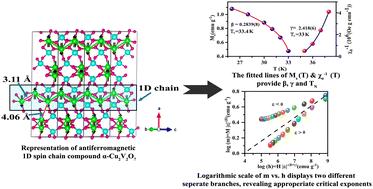
Low-dimensional magnets provide avenues to explore novel excitations and critical behaviour that are not typically found in their higher-dimension analogues. Herein, we investigate the critical behaviour of the canted antiferromagnet α-Cu2V2O7 in the vicinity of magnetic phase transition by measuring isothermal magnetization curves. The α-Cu2V2O7 sample is synthesized using the conventional solid-state route, and it stabilizes in an orthorhombic crystal structure with the Fdd2 space group, as determined from X-ray diffraction analysis. Critical exponents (β = 0.283(8), γ = 2.418(6) and δ = 9.16) obtained using the modified Arrott plot (MAP) suggest that α-Cu2V2O7 does not belong to any of the existing magnetic universality classes. The reliability and self-consistency of the estimated exponents are further validated using Widom scaling relation and scaling analysis equations. To link the above obtained critical exponents to the underlying spatial-dimensionality (d) and spin-dimensionality (n) of the system, we used the renormalization group theory approach to estimate a set of critical exponents spanning various spin and spatial dimensions. Notably, the critical exponents obtained from renormalization group theory analysis by considering that (d(spatial-dimensionality) : n(spin-dimensionality)) = (1 : 3) closely matches with the value derived from MAP, revealing that α-Cu2V2O7 can be considered a 1-D Heisenberg antiferromagnetic system. Finally, critical behaviour analysis testifies that α-Cu2V2O7 exhibits long-range type exchange interaction J(r), which decays with r as J(r) ∼ r−1.84.
期刊介绍:
The Journal of Materials Chemistry is divided into three distinct sections, A, B, and C, each catering to specific applications of the materials under study:
Journal of Materials Chemistry A focuses primarily on materials intended for applications in energy and sustainability.
Journal of Materials Chemistry B specializes in materials designed for applications in biology and medicine.
Journal of Materials Chemistry C is dedicated to materials suitable for applications in optical, magnetic, and electronic devices.
Example topic areas within the scope of Journal of Materials Chemistry C are listed below. This list is neither exhaustive nor exclusive.
Bioelectronics
Conductors
Detectors
Dielectrics
Displays
Ferroelectrics
Lasers
LEDs
Lighting
Liquid crystals
Memory
Metamaterials
Multiferroics
Photonics
Photovoltaics
Semiconductors
Sensors
Single molecule conductors
Spintronics
Superconductors
Thermoelectrics
Topological insulators
Transistors




 京公网安备 11010802042870号
京ICP备2023020795号-1
京公网安备 11010802042870号
京ICP备2023020795号-1

 分享
分享
 求助内容:
求助内容: 应助结果提醒方式:
 扫码关注我们
