Daihui Zhang, Chunqing Yang, Jun Wang, Yukun Liu, Jiahui Shao and Dongzhi Zhang
{"title":"高度疏水性MXene/PS@polypropylene织物,用于机器学习辅助的人体姿势识别","authors":"Daihui Zhang, Chunqing Yang, Jun Wang, Yukun Liu, Jiahui Shao and Dongzhi Zhang","doi":"10.1039/D4TC04781H","DOIUrl":null,"url":null,"abstract":"<p >In recent years, flexible wearable pressure sensors have emerged as a pivotal technology in the realms of intelligent health monitoring and artificial intelligence, steadily gaining traction as a prominent research focus. However, the conventional production process for conductive fillers is often cumbersome and costly, which limits their widespread application and large-scale manufacturing. In this study, a flexible pressure sensor based on polypropylene fluted woven fabric MXene/PS was proposed. The flexible pressure sensor uses spin-coated PS surface encapsulation technology to make the fabric surface hydrophobic, in order to improve the stability of the sensor. The sensor exhibits a wide strain range (0–565 kPa), excellent repeatability and stability (over 15 000 s), and a fast response–recovery time (75/159 ms), which can be attributed to the superior mechanical properties of the polypropylene-potted woven fabric. The MXene/PS pressure sensor can detect subtle deformations of small and medium-sized joints, making it suitable for detecting human motion signals. Additionally, combined with the deep belief network (DBN) algorithm, it can efficiently and accurately recognize human yoga postures, which shows its great application potential in human motion posture monitoring and low-cost flexible electronic products.</p>","PeriodicalId":84,"journal":{"name":"Journal of Materials Chemistry C","volume":" 9","pages":" 4533-4542"},"PeriodicalIF":5.1000,"publicationDate":"2025-01-17","publicationTypes":"Journal Article","fieldsOfStudy":null,"isOpenAccess":false,"openAccessPdf":"","citationCount":"0","resultStr":"{\"title\":\"Highly hydrophobic MXene/PS@polypropylene fabric for human posture recognition assisted by machine learning\",\"authors\":\"Daihui Zhang, Chunqing Yang, Jun Wang, Yukun Liu, Jiahui Shao and Dongzhi Zhang\",\"doi\":\"10.1039/D4TC04781H\",\"DOIUrl\":null,\"url\":null,\"abstract\":\"<p >In recent years, flexible wearable pressure sensors have emerged as a pivotal technology in the realms of intelligent health monitoring and artificial intelligence, steadily gaining traction as a prominent research focus. However, the conventional production process for conductive fillers is often cumbersome and costly, which limits their widespread application and large-scale manufacturing. In this study, a flexible pressure sensor based on polypropylene fluted woven fabric MXene/PS was proposed. The flexible pressure sensor uses spin-coated PS surface encapsulation technology to make the fabric surface hydrophobic, in order to improve the stability of the sensor. The sensor exhibits a wide strain range (0–565 kPa), excellent repeatability and stability (over 15 000 s), and a fast response–recovery time (75/159 ms), which can be attributed to the superior mechanical properties of the polypropylene-potted woven fabric. The MXene/PS pressure sensor can detect subtle deformations of small and medium-sized joints, making it suitable for detecting human motion signals. Additionally, combined with the deep belief network (DBN) algorithm, it can efficiently and accurately recognize human yoga postures, which shows its great application potential in human motion posture monitoring and low-cost flexible electronic products.</p>\",\"PeriodicalId\":84,\"journal\":{\"name\":\"Journal of Materials Chemistry C\",\"volume\":\" 9\",\"pages\":\" 4533-4542\"},\"PeriodicalIF\":5.1000,\"publicationDate\":\"2025-01-17\",\"publicationTypes\":\"Journal Article\",\"fieldsOfStudy\":null,\"isOpenAccess\":false,\"openAccessPdf\":\"\",\"citationCount\":\"0\",\"resultStr\":null,\"platform\":\"Semanticscholar\",\"paperid\":null,\"PeriodicalName\":\"Journal of Materials Chemistry C\",\"FirstCategoryId\":\"1\",\"ListUrlMain\":\"https://pubs.rsc.org/en/content/articlelanding/2025/tc/d4tc04781h\",\"RegionNum\":2,\"RegionCategory\":\"材料科学\",\"ArticlePicture\":[],\"TitleCN\":null,\"AbstractTextCN\":null,\"PMCID\":null,\"EPubDate\":\"\",\"PubModel\":\"\",\"JCR\":\"Q2\",\"JCRName\":\"MATERIALS SCIENCE, MULTIDISCIPLINARY\",\"Score\":null,\"Total\":0}","platform":"Semanticscholar","paperid":null,"PeriodicalName":"Journal of Materials Chemistry C","FirstCategoryId":"1","ListUrlMain":"https://pubs.rsc.org/en/content/articlelanding/2025/tc/d4tc04781h","RegionNum":2,"RegionCategory":"材料科学","ArticlePicture":[],"TitleCN":null,"AbstractTextCN":null,"PMCID":null,"EPubDate":"","PubModel":"","JCR":"Q2","JCRName":"MATERIALS SCIENCE, MULTIDISCIPLINARY","Score":null,"Total":0}
Highly hydrophobic MXene/PS@polypropylene fabric for human posture recognition assisted by machine learning
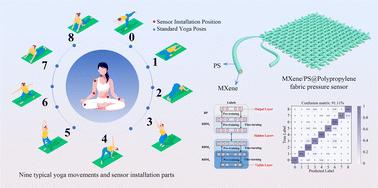
In recent years, flexible wearable pressure sensors have emerged as a pivotal technology in the realms of intelligent health monitoring and artificial intelligence, steadily gaining traction as a prominent research focus. However, the conventional production process for conductive fillers is often cumbersome and costly, which limits their widespread application and large-scale manufacturing. In this study, a flexible pressure sensor based on polypropylene fluted woven fabric MXene/PS was proposed. The flexible pressure sensor uses spin-coated PS surface encapsulation technology to make the fabric surface hydrophobic, in order to improve the stability of the sensor. The sensor exhibits a wide strain range (0–565 kPa), excellent repeatability and stability (over 15 000 s), and a fast response–recovery time (75/159 ms), which can be attributed to the superior mechanical properties of the polypropylene-potted woven fabric. The MXene/PS pressure sensor can detect subtle deformations of small and medium-sized joints, making it suitable for detecting human motion signals. Additionally, combined with the deep belief network (DBN) algorithm, it can efficiently and accurately recognize human yoga postures, which shows its great application potential in human motion posture monitoring and low-cost flexible electronic products.
期刊介绍:
The Journal of Materials Chemistry is divided into three distinct sections, A, B, and C, each catering to specific applications of the materials under study:
Journal of Materials Chemistry A focuses primarily on materials intended for applications in energy and sustainability.
Journal of Materials Chemistry B specializes in materials designed for applications in biology and medicine.
Journal of Materials Chemistry C is dedicated to materials suitable for applications in optical, magnetic, and electronic devices.
Example topic areas within the scope of Journal of Materials Chemistry C are listed below. This list is neither exhaustive nor exclusive.
Bioelectronics
Conductors
Detectors
Dielectrics
Displays
Ferroelectrics
Lasers
LEDs
Lighting
Liquid crystals
Memory
Metamaterials
Multiferroics
Photonics
Photovoltaics
Semiconductors
Sensors
Single molecule conductors
Spintronics
Superconductors
Thermoelectrics
Topological insulators
Transistors





 京公网安备 11010802042870号
京ICP备2023020795号-1
京公网安备 11010802042870号
京ICP备2023020795号-1

 分享
分享
 求助内容:
求助内容: 应助结果提醒方式:
 扫码关注我们
