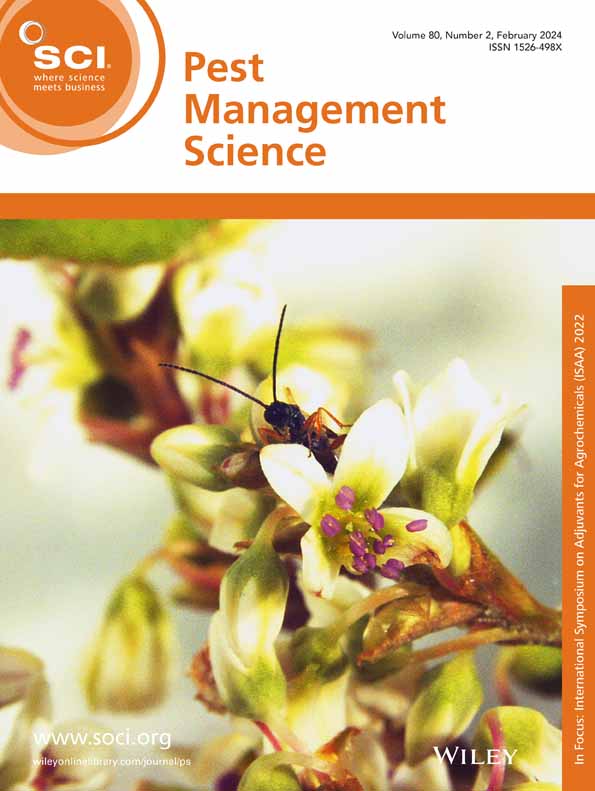
棉花微囊化信息素对夜蛾(鳞翅目:夜蛾科)交配干扰的研究。

IF 4.2 1区 农林科学 Q1 AGRONOMY Pest Management Science Pub Date : 2025-02-27 DOI:10.1002/ps.8680
Rodrigo Soares Ramos, Alexandra Peter Kruger, Bruna Magda Favetti, Fabiano Gonçalves Schirmer, Erick Cordeiro, Alexandre Develey, Ricardo Miranda, Tederson Galvan, Khai Tran, Kristin Broms, Thomas Clark
{"title":"棉花微囊化信息素对夜蛾(鳞翅目:夜蛾科)交配干扰的研究。","authors":"Rodrigo Soares Ramos,&nbsp;Alexandra Peter Kruger,&nbsp;Bruna Magda Favetti,&nbsp;Fabiano Gonçalves Schirmer,&nbsp;Erick Cordeiro,&nbsp;Alexandre Develey,&nbsp;Ricardo Miranda,&nbsp;Tederson Galvan,&nbsp;Khai Tran,&nbsp;Kristin Broms,&nbsp;Thomas Clark","doi":"10.1002/ps.8680","DOIUrl":null,"url":null,"abstract":"<div>\n \n \n <section>\n \n <h3> BACKGROUND</h3>\n \n <p>The fall armyworm (FAW), <i>Spodoptera frugiperda</i>, has increased in importance as a pest over the past decade in Brazilian cotton fields. The limited efficacy of conventional management tools and rapid development of insecticide/ insecticidal proteins resistance is forcing growers to search for new and more sustainable solutions. Here, we report the results from two studies utilizing a microencapsulated sprayable pheromone formulation in Brazilian cotton fields. The first study aimed to define optimal timing to initiate spray applications, optimal number of spray applications and appropriate intervals between spray applications. The second study was a large-scale effort to estimate the efficacy provided by the pheromone sprayable formulation in reducing mating (using trapping reduction as a surrogate measure) and subsequent damage to cotton plants.</p>\n </section>\n \n <section>\n \n <h3> RESULTS</h3>\n \n <p>The highest FAW male moth suppression was achieved when pheromone was sprayed 10 times at an interval of 7–10 days between applications starting at the cotton first headpin square. In large-scale plots (e.g. 40–200 ha), overall median trapping reduction was estimated as 82% (95% CI: 76–87%) in pheromone-treated areas compared to the control plot, over the evaluated period. Additionally, pheromone treatment resulted in an overall median of 27% less damaged reproductive structures (95% CI: 17–37%) when compared to nontreated areas.</p>\n </section>\n \n <section>\n \n <h3> CONCLUSIONS</h3>\n \n <p>Our results demonstrate the effectiveness and feasibility of mating disruption as a selective and nontoxic behavioral tool to manage FAW in cotton as an area-wide approach. It represents a key step for developing more sustainable methods for pest management. © 2025 Society of Chemical Industry.</p>\n </section>\n </div>","PeriodicalId":218,"journal":{"name":"Pest Management Science","volume":"81 6","pages":"3048-3054"},"PeriodicalIF":4.2000,"publicationDate":"2025-02-27","publicationTypes":"Journal Article","fieldsOfStudy":null,"isOpenAccess":false,"openAccessPdf":"","citationCount":"0","resultStr":"{\"title\":\"Mating disruption of Spodoptera frugiperda (Smith, 1797) (Lepidoptera: Noctuidae) using microencapsulated pheromone in cotton\",\"authors\":\"Rodrigo Soares Ramos,&nbsp;Alexandra Peter Kruger,&nbsp;Bruna Magda Favetti,&nbsp;Fabiano Gonçalves Schirmer,&nbsp;Erick Cordeiro,&nbsp;Alexandre Develey,&nbsp;Ricardo Miranda,&nbsp;Tederson Galvan,&nbsp;Khai Tran,&nbsp;Kristin Broms,&nbsp;Thomas Clark\",\"doi\":\"10.1002/ps.8680\",\"DOIUrl\":null,\"url\":null,\"abstract\":\"<div>\\n \\n \\n <section>\\n \\n <h3> BACKGROUND</h3>\\n \\n <p>The fall armyworm (FAW), <i>Spodoptera frugiperda</i>, has increased in importance as a pest over the past decade in Brazilian cotton fields. The limited efficacy of conventional management tools and rapid development of insecticide/ insecticidal proteins resistance is forcing growers to search for new and more sustainable solutions. Here, we report the results from two studies utilizing a microencapsulated sprayable pheromone formulation in Brazilian cotton fields. The first study aimed to define optimal timing to initiate spray applications, optimal number of spray applications and appropriate intervals between spray applications. The second study was a large-scale effort to estimate the efficacy provided by the pheromone sprayable formulation in reducing mating (using trapping reduction as a surrogate measure) and subsequent damage to cotton plants.</p>\\n </section>\\n \\n <section>\\n \\n <h3> RESULTS</h3>\\n \\n <p>The highest FAW male moth suppression was achieved when pheromone was sprayed 10 times at an interval of 7–10 days between applications starting at the cotton first headpin square. In large-scale plots (e.g. 40–200 ha), overall median trapping reduction was estimated as 82% (95% CI: 76–87%) in pheromone-treated areas compared to the control plot, over the evaluated period. Additionally, pheromone treatment resulted in an overall median of 27% less damaged reproductive structures (95% CI: 17–37%) when compared to nontreated areas.</p>\\n </section>\\n \\n <section>\\n \\n <h3> CONCLUSIONS</h3>\\n \\n <p>Our results demonstrate the effectiveness and feasibility of mating disruption as a selective and nontoxic behavioral tool to manage FAW in cotton as an area-wide approach. It represents a key step for developing more sustainable methods for pest management. © 2025 Society of Chemical Industry.</p>\\n </section>\\n </div>\",\"PeriodicalId\":218,\"journal\":{\"name\":\"Pest Management Science\",\"volume\":\"81 6\",\"pages\":\"3048-3054\"},\"PeriodicalIF\":4.2000,\"publicationDate\":\"2025-02-27\",\"publicationTypes\":\"Journal Article\",\"fieldsOfStudy\":null,\"isOpenAccess\":false,\"openAccessPdf\":\"\",\"citationCount\":\"0\",\"resultStr\":null,\"platform\":\"Semanticscholar\",\"paperid\":null,\"PeriodicalName\":\"Pest Management Science\",\"FirstCategoryId\":\"97\",\"ListUrlMain\":\"https://scijournals.onlinelibrary.wiley.com/doi/10.1002/ps.8680\",\"RegionNum\":1,\"RegionCategory\":\"农林科学\",\"ArticlePicture\":[],\"TitleCN\":null,\"AbstractTextCN\":null,\"PMCID\":null,\"EPubDate\":\"\",\"PubModel\":\"\",\"JCR\":\"Q1\",\"JCRName\":\"AGRONOMY\",\"Score\":null,\"Total\":0}","platform":"Semanticscholar","paperid":null,"PeriodicalName":"Pest Management Science","FirstCategoryId":"97","ListUrlMain":"https://scijournals.onlinelibrary.wiley.com/doi/10.1002/ps.8680","RegionNum":1,"RegionCategory":"农林科学","ArticlePicture":[],"TitleCN":null,"AbstractTextCN":null,"PMCID":null,"EPubDate":"","PubModel":"","JCR":"Q1","JCRName":"AGRONOMY","Score":null,"Total":0}
引用次数: 0

摘要

背景:在过去的十年中,巴西棉田中的秋粘虫(FAW),即Spodoptera frugiperda,作为一种害虫的重要性日益增加。传统管理工具的有限功效和杀虫剂/杀虫蛋白抗性的快速发展迫使种植者寻找新的和更可持续的解决方案。在这里,我们报告了两项研究的结果,利用微胶囊喷雾信息素配方在巴西棉田。第一项研究旨在确定启动喷雾应用的最佳时间,喷雾应用的最佳数量和喷雾应用之间的适当间隔。第二项研究是一项大规模的努力,以估计信息素喷雾制剂在减少交配(使用诱捕减少作为替代措施)和随后对棉花植株的损害方面所提供的功效。结果:从棉花首穗方开始,每隔7 ~ 10 d喷施10次信息素,对FAW雄蛾的抑制效果最好。在评估期间,在大规模地块(例如40-200公顷),与对照地块相比,信息素处理区域的总体捕集减少中位数估计为82% (95% CI: 76-87%)。此外,与未处理区域相比,信息素处理导致生殖结构受损的总体中位数减少27% (95% CI: 17-37%)。结论:我们的研究结果证明了交配中断作为一种选择性和无毒的行为工具在棉花中管理一汽虫的有效性和可行性。这是发展更可持续的有害生物管理方法的关键一步。©2025化学工业协会。
本文章由计算机程序翻译,如有差异,请以英文原文为准。

摘要图片

摘要图片

摘要图片

摘要图片

查看原文
分享 分享
微信好友 朋友圈 QQ好友 复制链接
本刊更多论文
Mating disruption of Spodoptera frugiperda (Smith, 1797) (Lepidoptera: Noctuidae) using microencapsulated pheromone in cotton

BACKGROUND

The fall armyworm (FAW), Spodoptera frugiperda, has increased in importance as a pest over the past decade in Brazilian cotton fields. The limited efficacy of conventional management tools and rapid development of insecticide/ insecticidal proteins resistance is forcing growers to search for new and more sustainable solutions. Here, we report the results from two studies utilizing a microencapsulated sprayable pheromone formulation in Brazilian cotton fields. The first study aimed to define optimal timing to initiate spray applications, optimal number of spray applications and appropriate intervals between spray applications. The second study was a large-scale effort to estimate the efficacy provided by the pheromone sprayable formulation in reducing mating (using trapping reduction as a surrogate measure) and subsequent damage to cotton plants.

RESULTS

The highest FAW male moth suppression was achieved when pheromone was sprayed 10 times at an interval of 7–10 days between applications starting at the cotton first headpin square. In large-scale plots (e.g. 40–200 ha), overall median trapping reduction was estimated as 82% (95% CI: 76–87%) in pheromone-treated areas compared to the control plot, over the evaluated period. Additionally, pheromone treatment resulted in an overall median of 27% less damaged reproductive structures (95% CI: 17–37%) when compared to nontreated areas.

CONCLUSIONS

Our results demonstrate the effectiveness and feasibility of mating disruption as a selective and nontoxic behavioral tool to manage FAW in cotton as an area-wide approach. It represents a key step for developing more sustainable methods for pest management. © 2025 Society of Chemical Industry.

求助全文
通过发布文献求助,成功后即可免费获取论文全文。 去求助
来源期刊
Pest Management Science
Pest Management Science 农林科学-昆虫学
CiteScore
7.90
自引率
9.80%
发文量
553
审稿时长
4.8 months
期刊介绍: Pest Management Science is the international journal of research and development in crop protection and pest control. Since its launch in 1970, the journal has become the premier forum for papers on the discovery, application, and impact on the environment of products and strategies designed for pest management. Published for SCI by John Wiley & Sons Ltd.
期刊最新文献
An integrated above-belowground biological control strategy against Phyllotreta striolata using entomopathogenic nematodes and fungi. Catalases act as putative oral secretion effectors in Tuta absoluta, suppressing tomato oxidative defenses and providing safe RNAi targets for pest control. Meta-analysis of corm yield responses to chemical and biological approaches for managing taro leaf blight disease. ASVLB-Net: A lightweight network for multispectral weed segmentation with NDVI-guided adaptive fusion. Design and synthesis of oxathiapiprolin derivatives containing acetal fragments as potent fungicide candidates.
×
引用
GB/T 7714-2015
复制
MLA
复制
APA
复制
导出至
BibTeX EndNote RefMan NoteFirst NoteExpress
×
×
提示
您的信息不完整,为了账户安全,请先补充。
现在去补充
×
提示
您因"违规操作"
具体请查看互助需知
我知道了
×
提示
现在去查看 取消
×
提示
确定
0
微信
客服QQ
Book学术公众号 扫码关注我们
反馈
×
意见反馈
请填写您的意见或建议
请填写您的手机或邮箱
已复制链接
已复制链接
快去分享给好友吧!
我知道了
×
扫码分享
扫码分享
Book学术官方微信
Book学术官方微信
Book学术文献互助
Book学术文献互助群
群 号:604180095
Book学术
文献互助 智能选刊 最新文献 互助须知 联系我们:info@booksci.cn
Book学术提供免费学术资源搜索服务,方便国内外学者检索中英文文献。致力于提供最便捷和优质的服务体验。
Copyright © 2023 Book学术 All rights reserved.
ghs 京公网安备 11010802042870号 京ICP备2023020795号-1