Portia Smallbone, Terri Lynn Shigle, Oren Paslovsky, Chitra Hosing, Amin Alousi, Qaiser Bashir, Yosra Aljawai, Jeremy Ramdial, Uday Popat, Richard Champlin, Elizabeth J Shpall, Betül Oran
{"title":"异基因干细胞移植治疗骨髓增生异常综合征后口服地西他滨加塞达脲定的维持治疗。","authors":"Portia Smallbone, Terri Lynn Shigle, Oren Paslovsky, Chitra Hosing, Amin Alousi, Qaiser Bashir, Yosra Aljawai, Jeremy Ramdial, Uday Popat, Richard Champlin, Elizabeth J Shpall, Betül Oran","doi":"10.3324/haematol.2024.287177","DOIUrl":null,"url":null,"abstract":"<p><p>Disease relapse remains the primary challenge for patients undergoing allogeneic hematopoietic stem cell transplantation (HSCT) for myelodysplastic syndromes. Maintenance therapies with hypomethylating agents are under investigation for use in mitigating relapse in high-risk patients. In this retrospective study, we assessed the safety and efficacy of oral decitabine- cedazuridine maintenance in 18 high-risk myelodysplastic syndromes patients post-HSCT. A total of 66.7% (N=12) received decitabine/cedazuridine (35/100 mg) on days 1 and 3, while 33.3% (N=6) received therapy on days 1-3. Patients completed a median of six treatment cycles (range, 1-20), with one third of patients completing all planned cycles. No unexpected adverse events were observed, with the primary toxicity being myelosuppression. Grade 1-2 upper respiratory tract infections occurred in four patients, and fungal pneumonia in one patient. Overall, patients achieved a median 2-year relapse- free survival of 66.7% (95% confidence interval [CI]: 40.4-83.4) and 2-year overall survival of 72.2% (95% CI: 45.6-87.4), with relapses occurring predominantly in TP53-mutated cases. Prospective clinical trials are essential to confirm the best tolerated dose with potential to improve transplant outcomes.</p>","PeriodicalId":12964,"journal":{"name":"Haematologica","volume":" ","pages":"1798-1807"},"PeriodicalIF":7.9000,"publicationDate":"2025-08-01","publicationTypes":"Journal Article","fieldsOfStudy":null,"isOpenAccess":false,"openAccessPdf":"https://www.ncbi.nlm.nih.gov/pmc/articles/PMC12358787/pdf/","citationCount":"0","resultStr":"{\"title\":\"Maintenance therapy with oral decitabine plus cedazuridine after allogeneic stem cell transplantation for myelodysplastic syndrome.\",\"authors\":\"Portia Smallbone, Terri Lynn Shigle, Oren Paslovsky, Chitra Hosing, Amin Alousi, Qaiser Bashir, Yosra Aljawai, Jeremy Ramdial, Uday Popat, Richard Champlin, Elizabeth J Shpall, Betül Oran\",\"doi\":\"10.3324/haematol.2024.287177\",\"DOIUrl\":null,\"url\":null,\"abstract\":\"<p><p>Disease relapse remains the primary challenge for patients undergoing allogeneic hematopoietic stem cell transplantation (HSCT) for myelodysplastic syndromes. Maintenance therapies with hypomethylating agents are under investigation for use in mitigating relapse in high-risk patients. In this retrospective study, we assessed the safety and efficacy of oral decitabine- cedazuridine maintenance in 18 high-risk myelodysplastic syndromes patients post-HSCT. A total of 66.7% (N=12) received decitabine/cedazuridine (35/100 mg) on days 1 and 3, while 33.3% (N=6) received therapy on days 1-3. Patients completed a median of six treatment cycles (range, 1-20), with one third of patients completing all planned cycles. No unexpected adverse events were observed, with the primary toxicity being myelosuppression. Grade 1-2 upper respiratory tract infections occurred in four patients, and fungal pneumonia in one patient. Overall, patients achieved a median 2-year relapse- free survival of 66.7% (95% confidence interval [CI]: 40.4-83.4) and 2-year overall survival of 72.2% (95% CI: 45.6-87.4), with relapses occurring predominantly in TP53-mutated cases. Prospective clinical trials are essential to confirm the best tolerated dose with potential to improve transplant outcomes.</p>\",\"PeriodicalId\":12964,\"journal\":{\"name\":\"Haematologica\",\"volume\":\" \",\"pages\":\"1798-1807\"},\"PeriodicalIF\":7.9000,\"publicationDate\":\"2025-08-01\",\"publicationTypes\":\"Journal Article\",\"fieldsOfStudy\":null,\"isOpenAccess\":false,\"openAccessPdf\":\"https://www.ncbi.nlm.nih.gov/pmc/articles/PMC12358787/pdf/\",\"citationCount\":\"0\",\"resultStr\":null,\"platform\":\"Semanticscholar\",\"paperid\":null,\"PeriodicalName\":\"Haematologica\",\"FirstCategoryId\":\"3\",\"ListUrlMain\":\"https://doi.org/10.3324/haematol.2024.287177\",\"RegionNum\":1,\"RegionCategory\":\"医学\",\"ArticlePicture\":[],\"TitleCN\":null,\"AbstractTextCN\":null,\"PMCID\":null,\"EPubDate\":\"2025/2/27 0:00:00\",\"PubModel\":\"Epub\",\"JCR\":\"Q1\",\"JCRName\":\"HEMATOLOGY\",\"Score\":null,\"Total\":0}","platform":"Semanticscholar","paperid":null,"PeriodicalName":"Haematologica","FirstCategoryId":"3","ListUrlMain":"https://doi.org/10.3324/haematol.2024.287177","RegionNum":1,"RegionCategory":"医学","ArticlePicture":[],"TitleCN":null,"AbstractTextCN":null,"PMCID":null,"EPubDate":"2025/2/27 0:00:00","PubModel":"Epub","JCR":"Q1","JCRName":"HEMATOLOGY","Score":null,"Total":0}
Maintenance therapy with oral decitabine plus cedazuridine after allogeneic stem cell transplantation for myelodysplastic syndrome.
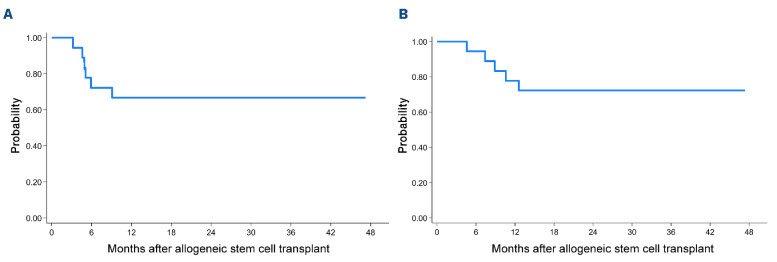
Disease relapse remains the primary challenge for patients undergoing allogeneic hematopoietic stem cell transplantation (HSCT) for myelodysplastic syndromes. Maintenance therapies with hypomethylating agents are under investigation for use in mitigating relapse in high-risk patients. In this retrospective study, we assessed the safety and efficacy of oral decitabine- cedazuridine maintenance in 18 high-risk myelodysplastic syndromes patients post-HSCT. A total of 66.7% (N=12) received decitabine/cedazuridine (35/100 mg) on days 1 and 3, while 33.3% (N=6) received therapy on days 1-3. Patients completed a median of six treatment cycles (range, 1-20), with one third of patients completing all planned cycles. No unexpected adverse events were observed, with the primary toxicity being myelosuppression. Grade 1-2 upper respiratory tract infections occurred in four patients, and fungal pneumonia in one patient. Overall, patients achieved a median 2-year relapse- free survival of 66.7% (95% confidence interval [CI]: 40.4-83.4) and 2-year overall survival of 72.2% (95% CI: 45.6-87.4), with relapses occurring predominantly in TP53-mutated cases. Prospective clinical trials are essential to confirm the best tolerated dose with potential to improve transplant outcomes.
期刊介绍:
Haematologica is a journal that publishes articles within the broad field of hematology. It reports on novel findings in basic, clinical, and translational research.
Scope:
The scope of the journal includes reporting novel research results that:
Have a significant impact on understanding normal hematology or the development of hematological diseases.
Are likely to bring important changes to the diagnosis or treatment of hematological diseases.





 京公网安备 11010802042870号
京ICP备2023020795号-1
京公网安备 11010802042870号
京ICP备2023020795号-1

 分享
分享
 求助内容:
求助内容: 应助结果提醒方式:
 扫码关注我们
