{"title":"调节-收敛/调节比正常儿童的调节功能不全患病率及其与屈光不正的关系:一项横断面研究。","authors":"Shoubhik Chakraborty, Shrutakirty Parida, Soumya K Mohanty, Matuli Das, Shovna Dash","doi":"10.7759/cureus.79683","DOIUrl":null,"url":null,"abstract":"<p><strong>Objective: </strong>With the increasing use of digital devices among the pediatric population, asthenopia has become increasingly common. While refractive errors are the most prevalent cause, they can sometimes be linked to undiagnosed or underdiagnosed binocular vision disorders, such as accommodative insufficiency (AI). In many cases, simple refractive correction alone does not alleviate asthenopia. This study aims to determine the prevalence of AI in children with a normal accommodative-convergence/accommodation (AC/A) ratio and to investigate the correlation between accommodative amplitude and refractive errors.</p><p><strong>Methods: </strong> The cross-sectional study was conducted from April 2024 to December 2024 to assess the prevalence of AI in children aged between six and 18 years with normal AC/A ratios. The study was approved by the Ethics Committee of Kalinga Institute of Medical Sciences, Bhubaneswar, India. The minimum required sample was 384, assuming a 50% prevalence, and was increased to 500 participants to account for a 20% non-response rate. Uncorrected distance visual acuity (UCVA) was assessed using a Snellen chart. Refraction included objective retinoscopy, subjective refraction, and cycloplegic refraction using 1% cyclopentolate. Binocular vision was evaluated using the Hirschberg test, ocular motility assessment, slit-lamp biomicroscopy, intraocular pressure measurement, ophthalmoscopy, and heterophoria testing. The AC/A ratio was calculated following the calculated method. Amplitude of accommodation (AA) was measured using the push-up method with a Royal Air Force (RAF) ruler. Hofstetter's formula, 15 - (Age/4), was used to determine the minimum expected AA. Participants with AA at least 2.00 D below this threshold were diagnosed with accommodative insufficiency. Participants were categorized into groups of six to 11 years and 12 to 18 years to account for age-related variations in accommodation. Statistical analysis included the chi-square test for categorical comparisons and Spearman's correlation for assessing relationships between AA and refractive error.</p><p><strong>Results: </strong>Out of the 500 participants, 238 were male and 262 were female, ranging in the age range of six to 18 years, with a mean age of 12.78 ± 3.12 years. It was discovered that 162 individuals (32.4%) lacked adequate accommodations. The mean AA for our study participants was 11.09 ± 2.60 years. The prevalence of AI was 32.4% overall, with 32.6% (95% confidence interval: 27.1-38.4) in females and 32.2% (95% confidence interval: 26.5-38.3) in male patients. We found no discernible relationship between the AA and refractive error in our study.</p><p><strong>Conclusion: </strong>In this study, with an overall AI prevalence of 32.4%, the ability to maintain comfortable, clear, and effective vision is notably affected by accommodative dysfunction alone, even when AI and convergence insufficiency (CI) coexist. Our investigation found no correlation between refractive error and the AA.</p>","PeriodicalId":93960,"journal":{"name":"Cureus","volume":"17 2","pages":"e79683"},"PeriodicalIF":1.3000,"publicationDate":"2025-02-26","publicationTypes":"Journal Article","fieldsOfStudy":null,"isOpenAccess":false,"openAccessPdf":"https://www.ncbi.nlm.nih.gov/pmc/articles/PMC11863991/pdf/","citationCount":"0","resultStr":"{\"title\":\"Prevalence of Accommodative Insufficiency in Children With Normal Accommodative-Convergence/Accommodation Ratio and Its Association With Refractive Error: A Cross-Sectional Study.\",\"authors\":\"Shoubhik Chakraborty, Shrutakirty Parida, Soumya K Mohanty, Matuli Das, Shovna Dash\",\"doi\":\"10.7759/cureus.79683\",\"DOIUrl\":null,\"url\":null,\"abstract\":\"<p><strong>Objective: </strong>With the increasing use of digital devices among the pediatric population, asthenopia has become increasingly common. While refractive errors are the most prevalent cause, they can sometimes be linked to undiagnosed or underdiagnosed binocular vision disorders, such as accommodative insufficiency (AI). In many cases, simple refractive correction alone does not alleviate asthenopia. This study aims to determine the prevalence of AI in children with a normal accommodative-convergence/accommodation (AC/A) ratio and to investigate the correlation between accommodative amplitude and refractive errors.</p><p><strong>Methods: </strong> The cross-sectional study was conducted from April 2024 to December 2024 to assess the prevalence of AI in children aged between six and 18 years with normal AC/A ratios. The study was approved by the Ethics Committee of Kalinga Institute of Medical Sciences, Bhubaneswar, India. The minimum required sample was 384, assuming a 50% prevalence, and was increased to 500 participants to account for a 20% non-response rate. Uncorrected distance visual acuity (UCVA) was assessed using a Snellen chart. Refraction included objective retinoscopy, subjective refraction, and cycloplegic refraction using 1% cyclopentolate. Binocular vision was evaluated using the Hirschberg test, ocular motility assessment, slit-lamp biomicroscopy, intraocular pressure measurement, ophthalmoscopy, and heterophoria testing. The AC/A ratio was calculated following the calculated method. Amplitude of accommodation (AA) was measured using the push-up method with a Royal Air Force (RAF) ruler. Hofstetter's formula, 15 - (Age/4), was used to determine the minimum expected AA. Participants with AA at least 2.00 D below this threshold were diagnosed with accommodative insufficiency. Participants were categorized into groups of six to 11 years and 12 to 18 years to account for age-related variations in accommodation. Statistical analysis included the chi-square test for categorical comparisons and Spearman's correlation for assessing relationships between AA and refractive error.</p><p><strong>Results: </strong>Out of the 500 participants, 238 were male and 262 were female, ranging in the age range of six to 18 years, with a mean age of 12.78 ± 3.12 years. It was discovered that 162 individuals (32.4%) lacked adequate accommodations. The mean AA for our study participants was 11.09 ± 2.60 years. The prevalence of AI was 32.4% overall, with 32.6% (95% confidence interval: 27.1-38.4) in females and 32.2% (95% confidence interval: 26.5-38.3) in male patients. We found no discernible relationship between the AA and refractive error in our study.</p><p><strong>Conclusion: </strong>In this study, with an overall AI prevalence of 32.4%, the ability to maintain comfortable, clear, and effective vision is notably affected by accommodative dysfunction alone, even when AI and convergence insufficiency (CI) coexist. Our investigation found no correlation between refractive error and the AA.</p>\",\"PeriodicalId\":93960,\"journal\":{\"name\":\"Cureus\",\"volume\":\"17 2\",\"pages\":\"e79683\"},\"PeriodicalIF\":1.3000,\"publicationDate\":\"2025-02-26\",\"publicationTypes\":\"Journal Article\",\"fieldsOfStudy\":null,\"isOpenAccess\":false,\"openAccessPdf\":\"https://www.ncbi.nlm.nih.gov/pmc/articles/PMC11863991/pdf/\",\"citationCount\":\"0\",\"resultStr\":null,\"platform\":\"Semanticscholar\",\"paperid\":null,\"PeriodicalName\":\"Cureus\",\"FirstCategoryId\":\"1085\",\"ListUrlMain\":\"https://doi.org/10.7759/cureus.79683\",\"RegionNum\":0,\"RegionCategory\":null,\"ArticlePicture\":[],\"TitleCN\":null,\"AbstractTextCN\":null,\"PMCID\":null,\"EPubDate\":\"2025/2/1 0:00:00\",\"PubModel\":\"eCollection\",\"JCR\":\"Q3\",\"JCRName\":\"MEDICINE, GENERAL & INTERNAL\",\"Score\":null,\"Total\":0}","platform":"Semanticscholar","paperid":null,"PeriodicalName":"Cureus","FirstCategoryId":"1085","ListUrlMain":"https://doi.org/10.7759/cureus.79683","RegionNum":0,"RegionCategory":null,"ArticlePicture":[],"TitleCN":null,"AbstractTextCN":null,"PMCID":null,"EPubDate":"2025/2/1 0:00:00","PubModel":"eCollection","JCR":"Q3","JCRName":"MEDICINE, GENERAL & INTERNAL","Score":null,"Total":0}
Prevalence of Accommodative Insufficiency in Children With Normal Accommodative-Convergence/Accommodation Ratio and Its Association With Refractive Error: A Cross-Sectional Study.
Objective: With the increasing use of digital devices among the pediatric population, asthenopia has become increasingly common. While refractive errors are the most prevalent cause, they can sometimes be linked to undiagnosed or underdiagnosed binocular vision disorders, such as accommodative insufficiency (AI). In many cases, simple refractive correction alone does not alleviate asthenopia. This study aims to determine the prevalence of AI in children with a normal accommodative-convergence/accommodation (AC/A) ratio and to investigate the correlation between accommodative amplitude and refractive errors.
Methods: The cross-sectional study was conducted from April 2024 to December 2024 to assess the prevalence of AI in children aged between six and 18 years with normal AC/A ratios. The study was approved by the Ethics Committee of Kalinga Institute of Medical Sciences, Bhubaneswar, India. The minimum required sample was 384, assuming a 50% prevalence, and was increased to 500 participants to account for a 20% non-response rate. Uncorrected distance visual acuity (UCVA) was assessed using a Snellen chart. Refraction included objective retinoscopy, subjective refraction, and cycloplegic refraction using 1% cyclopentolate. Binocular vision was evaluated using the Hirschberg test, ocular motility assessment, slit-lamp biomicroscopy, intraocular pressure measurement, ophthalmoscopy, and heterophoria testing. The AC/A ratio was calculated following the calculated method. Amplitude of accommodation (AA) was measured using the push-up method with a Royal Air Force (RAF) ruler. Hofstetter's formula, 15 - (Age/4), was used to determine the minimum expected AA. Participants with AA at least 2.00 D below this threshold were diagnosed with accommodative insufficiency. Participants were categorized into groups of six to 11 years and 12 to 18 years to account for age-related variations in accommodation. Statistical analysis included the chi-square test for categorical comparisons and Spearman's correlation for assessing relationships between AA and refractive error.
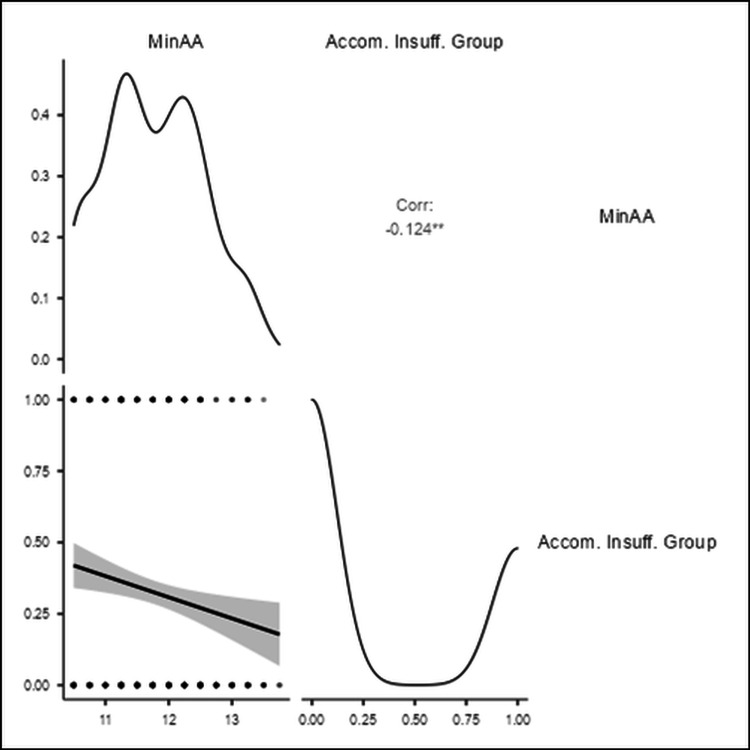
Results: Out of the 500 participants, 238 were male and 262 were female, ranging in the age range of six to 18 years, with a mean age of 12.78 ± 3.12 years. It was discovered that 162 individuals (32.4%) lacked adequate accommodations. The mean AA for our study participants was 11.09 ± 2.60 years. The prevalence of AI was 32.4% overall, with 32.6% (95% confidence interval: 27.1-38.4) in females and 32.2% (95% confidence interval: 26.5-38.3) in male patients. We found no discernible relationship between the AA and refractive error in our study.
Conclusion: In this study, with an overall AI prevalence of 32.4%, the ability to maintain comfortable, clear, and effective vision is notably affected by accommodative dysfunction alone, even when AI and convergence insufficiency (CI) coexist. Our investigation found no correlation between refractive error and the AA.





 京公网安备 11010802042870号
京ICP备2023020795号-1
京公网安备 11010802042870号
京ICP备2023020795号-1

 分享
分享

 求助内容:
求助内容: 应助结果提醒方式:
 扫码关注我们
