Zhenzhen Zhou , Minghui Xie , Zongji Zhuo , Yalin Wang , Fabao Zhao , Sining Tao , Zhening Liang , Erik De Clercq , Christophe Pannecouque , Peng Zhan , Dongwei Kang , Xinyong Liu
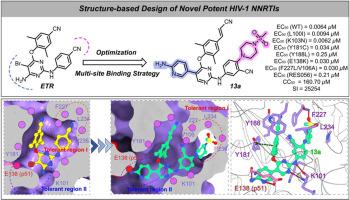
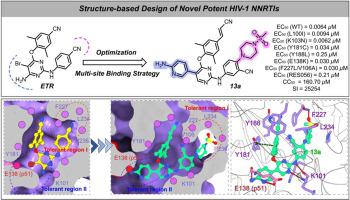
{"title":"利用 NNTRIs 结合口袋中的耐受区,基于结构设计新型 2,4,5-三取代嘧啶衍生物作为强效 HIV-1 NNRTIs","authors":"Zhenzhen Zhou , Minghui Xie , Zongji Zhuo , Yalin Wang , Fabao Zhao , Sining Tao , Zhening Liang , Erik De Clercq , Christophe Pannecouque , Peng Zhan , Dongwei Kang , Xinyong Liu","doi":"10.1016/j.ejmech.2025.117464","DOIUrl":null,"url":null,"abstract":"<div><div>To promote the development of the new generation of HIV-1 non-nucleoside reverse transcriptase inhibitors (NNRTIs), a series of novel 2,4,5-trisubstituted pyrimidine derivatives targeting the “tolerant region I″ and “tolerant region II” of NNRTI binding pocket (NNIBP) were designed through multi-site binding strategy. Among them, <strong>13a</strong> was demonstrated with an improved potency against wild-type (WT) and a panel of mutant HIV-1 strains with EC<sub>50</sub> values ranging from 0.0062 to 0.25 μM, being superior to that of efavirenz (EFV, EC<sub>50</sub> = 0.0080–0.37 μM). In addition, <strong>13a</strong> was proved to have low cytotoxicity (CC<sub>50</sub> = 160.7 μM) and high SI values (SI = 25254). Further HIV-1 RT inhibition assay demonstrated that <strong>13a</strong> is a classical NNRTI with an IC<sub>50</sub> value of 0.41 μM. Molecular docking and molecular dynamics simulations results illustrated its binding mode with HIV-1 RT. Overall, these enchanting results illuminated the potential of <strong>13a</strong> as a promising lead for the development of the new generation HIV-1 NNRTIs drugs.</div></div>","PeriodicalId":314,"journal":{"name":"European Journal of Medicinal Chemistry","volume":"289 ","pages":"Article 117464"},"PeriodicalIF":5.9000,"publicationDate":"2025-05-05","publicationTypes":"Journal Article","fieldsOfStudy":null,"isOpenAccess":false,"openAccessPdf":"","citationCount":"0","resultStr":"{\"title\":\"Structure-based design of novel 2,4,5-trisubstituted pyrimidine derivatives as potent HIV-1 NNRTIs by exploiting the tolerant regions in NNTRIs binding pocket\",\"authors\":\"Zhenzhen Zhou , Minghui Xie , Zongji Zhuo , Yalin Wang , Fabao Zhao , Sining Tao , Zhening Liang , Erik De Clercq , Christophe Pannecouque , Peng Zhan , Dongwei Kang , Xinyong Liu\",\"doi\":\"10.1016/j.ejmech.2025.117464\",\"DOIUrl\":null,\"url\":null,\"abstract\":\"<div><div>To promote the development of the new generation of HIV-1 non-nucleoside reverse transcriptase inhibitors (NNRTIs), a series of novel 2,4,5-trisubstituted pyrimidine derivatives targeting the “tolerant region I″ and “tolerant region II” of NNRTI binding pocket (NNIBP) were designed through multi-site binding strategy. Among them, <strong>13a</strong> was demonstrated with an improved potency against wild-type (WT) and a panel of mutant HIV-1 strains with EC<sub>50</sub> values ranging from 0.0062 to 0.25 μM, being superior to that of efavirenz (EFV, EC<sub>50</sub> = 0.0080–0.37 μM). In addition, <strong>13a</strong> was proved to have low cytotoxicity (CC<sub>50</sub> = 160.7 μM) and high SI values (SI = 25254). Further HIV-1 RT inhibition assay demonstrated that <strong>13a</strong> is a classical NNRTI with an IC<sub>50</sub> value of 0.41 μM. Molecular docking and molecular dynamics simulations results illustrated its binding mode with HIV-1 RT. Overall, these enchanting results illuminated the potential of <strong>13a</strong> as a promising lead for the development of the new generation HIV-1 NNRTIs drugs.</div></div>\",\"PeriodicalId\":314,\"journal\":{\"name\":\"European Journal of Medicinal Chemistry\",\"volume\":\"289 \",\"pages\":\"Article 117464\"},\"PeriodicalIF\":5.9000,\"publicationDate\":\"2025-05-05\",\"publicationTypes\":\"Journal Article\",\"fieldsOfStudy\":null,\"isOpenAccess\":false,\"openAccessPdf\":\"\",\"citationCount\":\"0\",\"resultStr\":null,\"platform\":\"Semanticscholar\",\"paperid\":null,\"PeriodicalName\":\"European Journal of Medicinal Chemistry\",\"FirstCategoryId\":\"3\",\"ListUrlMain\":\"https://www.sciencedirect.com/science/article/pii/S0223523425002296\",\"RegionNum\":2,\"RegionCategory\":\"医学\",\"ArticlePicture\":[],\"TitleCN\":null,\"AbstractTextCN\":null,\"PMCID\":null,\"EPubDate\":\"2025/2/27 0:00:00\",\"PubModel\":\"Epub\",\"JCR\":\"Q1\",\"JCRName\":\"CHEMISTRY, MEDICINAL\",\"Score\":null,\"Total\":0}","platform":"Semanticscholar","paperid":null,"PeriodicalName":"European Journal of Medicinal Chemistry","FirstCategoryId":"3","ListUrlMain":"https://www.sciencedirect.com/science/article/pii/S0223523425002296","RegionNum":2,"RegionCategory":"医学","ArticlePicture":[],"TitleCN":null,"AbstractTextCN":null,"PMCID":null,"EPubDate":"2025/2/27 0:00:00","PubModel":"Epub","JCR":"Q1","JCRName":"CHEMISTRY, MEDICINAL","Score":null,"Total":0}
Structure-based design of novel 2,4,5-trisubstituted pyrimidine derivatives as potent HIV-1 NNRTIs by exploiting the tolerant regions in NNTRIs binding pocket
To promote the development of the new generation of HIV-1 non-nucleoside reverse transcriptase inhibitors (NNRTIs), a series of novel 2,4,5-trisubstituted pyrimidine derivatives targeting the “tolerant region I″ and “tolerant region II” of NNRTI binding pocket (NNIBP) were designed through multi-site binding strategy. Among them, 13a was demonstrated with an improved potency against wild-type (WT) and a panel of mutant HIV-1 strains with EC50 values ranging from 0.0062 to 0.25 μM, being superior to that of efavirenz (EFV, EC50 = 0.0080–0.37 μM). In addition, 13a was proved to have low cytotoxicity (CC50 = 160.7 μM) and high SI values (SI = 25254). Further HIV-1 RT inhibition assay demonstrated that 13a is a classical NNRTI with an IC50 value of 0.41 μM. Molecular docking and molecular dynamics simulations results illustrated its binding mode with HIV-1 RT. Overall, these enchanting results illuminated the potential of 13a as a promising lead for the development of the new generation HIV-1 NNRTIs drugs.
期刊介绍:
The European Journal of Medicinal Chemistry is a global journal that publishes studies on all aspects of medicinal chemistry. It provides a medium for publication of original papers and also welcomes critical review papers.
A typical paper would report on the organic synthesis, characterization and pharmacological evaluation of compounds. Other topics of interest are drug design, QSAR, molecular modeling, drug-receptor interactions, molecular aspects of drug metabolism, prodrug synthesis and drug targeting. The journal expects manuscripts to present the rational for a study, provide insight into the design of compounds or understanding of mechanism, or clarify the targets.




 京公网安备 11010802042870号
京ICP备2023020795号-1
京公网安备 11010802042870号
京ICP备2023020795号-1

 分享
分享
 求助内容:
求助内容: 应助结果提醒方式:
 扫码关注我们
