Xueyang Xu, Qingyuan Jiang, Qinghong Bai, Yan Sun, Xutao Ding, Dingwu Pan, Xi Zeng, Zhu Tao, Xin Xiao
{"title":"一种用于氰化物视觉和定量检测的新型瓜bbb_uril超分子荧光探针","authors":"Xueyang Xu, Qingyuan Jiang, Qinghong Bai, Yan Sun, Xutao Ding, Dingwu Pan, Xi Zeng, Zhu Tao, Xin Xiao","doi":"10.1016/j.molstruc.2025.141864","DOIUrl":null,"url":null,"abstract":"<div><div>Cyanide is a matter with high toxicity. Cyanide abuse and illegal industrial cyanide-containing waste-water discharge cause huge damage to human health and living environment of human beings. Therefore, it is urgently important to find an accessible and effective method for monitoring and detecting cyanide. Herein, we developed a novel water-soluble supramolecular fluorescent probe, CQU@Q[7], to detect cyanide ion (CN<sup>−</sup>). This probe was constructed by assembly of host-guest interaction between cucurbit[7]uril (Q[7]) and quinoline derivative (CQU). The fluorescence intensity of CQU@Q[7] was almost unchanged in the presence of tested anions, and gradually quenched only upon addition of CN<sup>−</sup>with fluorescence intensity decreasing from 906.16 a.u. to 112.47 a.u.. The limit of detection of CN<sup>−</sup> is 0.145 µM. Moreover, a stable complex between CQU@Q[7] and CN<sup>−</sup> was formed in 25 s. The probe's color in solution changes from yellow to brown and finally to burgundy under daylight with increasing amounts of CN<sup>−</sup>. The fluorescent probe reported here was applied to determine CN<sup>−</sup> in actual water samples with recovery rates of 98.3 %-105.8 % and less than 2 % RSD, and was made into a portal test strips which enable facile detection of CN<sup>−</sup>.</div></div>","PeriodicalId":16414,"journal":{"name":"Journal of Molecular Structure","volume":"1334 ","pages":"Article 141864"},"PeriodicalIF":4.9000,"publicationDate":"2025-07-05","publicationTypes":"Journal Article","fieldsOfStudy":null,"isOpenAccess":false,"openAccessPdf":"","citationCount":"0","resultStr":"{\"title\":\"A novel cucurbit[7]uril-based supramolecular fluorescent probe for the visual and quantitative detection of cyanide\",\"authors\":\"Xueyang Xu, Qingyuan Jiang, Qinghong Bai, Yan Sun, Xutao Ding, Dingwu Pan, Xi Zeng, Zhu Tao, Xin Xiao\",\"doi\":\"10.1016/j.molstruc.2025.141864\",\"DOIUrl\":null,\"url\":null,\"abstract\":\"<div><div>Cyanide is a matter with high toxicity. Cyanide abuse and illegal industrial cyanide-containing waste-water discharge cause huge damage to human health and living environment of human beings. Therefore, it is urgently important to find an accessible and effective method for monitoring and detecting cyanide. Herein, we developed a novel water-soluble supramolecular fluorescent probe, CQU@Q[7], to detect cyanide ion (CN<sup>−</sup>). This probe was constructed by assembly of host-guest interaction between cucurbit[7]uril (Q[7]) and quinoline derivative (CQU). The fluorescence intensity of CQU@Q[7] was almost unchanged in the presence of tested anions, and gradually quenched only upon addition of CN<sup>−</sup>with fluorescence intensity decreasing from 906.16 a.u. to 112.47 a.u.. The limit of detection of CN<sup>−</sup> is 0.145 µM. Moreover, a stable complex between CQU@Q[7] and CN<sup>−</sup> was formed in 25 s. The probe's color in solution changes from yellow to brown and finally to burgundy under daylight with increasing amounts of CN<sup>−</sup>. The fluorescent probe reported here was applied to determine CN<sup>−</sup> in actual water samples with recovery rates of 98.3 %-105.8 % and less than 2 % RSD, and was made into a portal test strips which enable facile detection of CN<sup>−</sup>.</div></div>\",\"PeriodicalId\":16414,\"journal\":{\"name\":\"Journal of Molecular Structure\",\"volume\":\"1334 \",\"pages\":\"Article 141864\"},\"PeriodicalIF\":4.9000,\"publicationDate\":\"2025-07-05\",\"publicationTypes\":\"Journal Article\",\"fieldsOfStudy\":null,\"isOpenAccess\":false,\"openAccessPdf\":\"\",\"citationCount\":\"0\",\"resultStr\":null,\"platform\":\"Semanticscholar\",\"paperid\":null,\"PeriodicalName\":\"Journal of Molecular Structure\",\"FirstCategoryId\":\"92\",\"ListUrlMain\":\"https://www.sciencedirect.com/science/article/pii/S0022286025005502\",\"RegionNum\":2,\"RegionCategory\":\"化学\",\"ArticlePicture\":[],\"TitleCN\":null,\"AbstractTextCN\":null,\"PMCID\":null,\"EPubDate\":\"2025/2/24 0:00:00\",\"PubModel\":\"Epub\",\"JCR\":\"Q2\",\"JCRName\":\"CHEMISTRY, PHYSICAL\",\"Score\":null,\"Total\":0}","platform":"Semanticscholar","paperid":null,"PeriodicalName":"Journal of Molecular Structure","FirstCategoryId":"92","ListUrlMain":"https://www.sciencedirect.com/science/article/pii/S0022286025005502","RegionNum":2,"RegionCategory":"化学","ArticlePicture":[],"TitleCN":null,"AbstractTextCN":null,"PMCID":null,"EPubDate":"2025/2/24 0:00:00","PubModel":"Epub","JCR":"Q2","JCRName":"CHEMISTRY, PHYSICAL","Score":null,"Total":0}
A novel cucurbit[7]uril-based supramolecular fluorescent probe for the visual and quantitative detection of cyanide
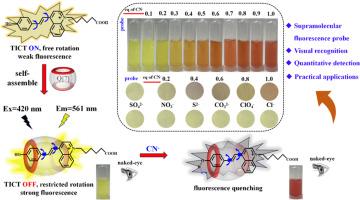
Cyanide is a matter with high toxicity. Cyanide abuse and illegal industrial cyanide-containing waste-water discharge cause huge damage to human health and living environment of human beings. Therefore, it is urgently important to find an accessible and effective method for monitoring and detecting cyanide. Herein, we developed a novel water-soluble supramolecular fluorescent probe, CQU@Q[7], to detect cyanide ion (CN−). This probe was constructed by assembly of host-guest interaction between cucurbit[7]uril (Q[7]) and quinoline derivative (CQU). The fluorescence intensity of CQU@Q[7] was almost unchanged in the presence of tested anions, and gradually quenched only upon addition of CN−with fluorescence intensity decreasing from 906.16 a.u. to 112.47 a.u.. The limit of detection of CN− is 0.145 µM. Moreover, a stable complex between CQU@Q[7] and CN− was formed in 25 s. The probe's color in solution changes from yellow to brown and finally to burgundy under daylight with increasing amounts of CN−. The fluorescent probe reported here was applied to determine CN− in actual water samples with recovery rates of 98.3 %-105.8 % and less than 2 % RSD, and was made into a portal test strips which enable facile detection of CN−.
期刊介绍:
The Journal of Molecular Structure is dedicated to the publication of full-length articles and review papers, providing important new structural information on all types of chemical species including:
• Stable and unstable molecules in all types of environments (vapour, molecular beam, liquid, solution, liquid crystal, solid state, matrix-isolated, surface-absorbed etc.)
• Chemical intermediates
• Molecules in excited states
• Biological molecules
• Polymers.
The methods used may include any combination of spectroscopic and non-spectroscopic techniques, for example:
• Infrared spectroscopy (mid, far, near)
• Raman spectroscopy and non-linear Raman methods (CARS, etc.)
• Electronic absorption spectroscopy
• Optical rotatory dispersion and circular dichroism
• Fluorescence and phosphorescence techniques
• Electron spectroscopies (PES, XPS), EXAFS, etc.
• Microwave spectroscopy
• Electron diffraction
• NMR and ESR spectroscopies
• Mössbauer spectroscopy
• X-ray crystallography
• Charge Density Analyses
• Computational Studies (supplementing experimental methods)
We encourage publications combining theoretical and experimental approaches. The structural insights gained by the studies should be correlated with the properties, activity and/ or reactivity of the molecule under investigation and the relevance of this molecule and its implications should be discussed.





 京公网安备 11010802042870号
京ICP备2023020795号-1
京公网安备 11010802042870号
京ICP备2023020795号-1

 分享
分享
 求助内容:
求助内容: 应助结果提醒方式:
 扫码关注我们
