{"title":"外加磁场作用下Zn-MnO2电池的性能","authors":"Sagnik Sarma Choudhury, Nitish Katiyar, Abhishek Sarkar, Ranamay Saha, Shantanu Bhattacharya","doi":"10.1016/j.surfin.2025.106100","DOIUrl":null,"url":null,"abstract":"<div><div>Zn-MnO<sub>2</sub> batteries offer high theoretical capacity, low cost, safety, and environmental benefits. However, their commercial potential is limited by zinc dendrite formation and manganese dissolution. Typically, these issues are addressed through internal modifications of the cell. In this study, an external magnetic field is applied to induce Lorentz forces on the Zn<sup>2+</sup> ions, promoting uniform zinc dissolution and deposition, thereby suppressing dendrite formation. Initially, the morphology evolution of the Zn electrode and the specific discharge capacity of the battery was analysed at different magnetic field strengths. Then the optimum magnetic field strength was used to study the Zn deposition/dissolution and the charge storage behavior at different current densities. UV–Vis spectroscopy and ICP-MS analysis was done to study the electrolyte content during charge/discharge in the presence of the magnetic field. With a 2.91 kG magnetic field, substantial mitigation of dendrite formation and enhanced electrochemical performance was observed, particularly at high charge/discharge rates. Cyclic stability tests showed 83 % capacity retention with the magnetic field after 500 cycles at 1000 mA g<sup>−1</sup>, compared to 52.9 % without it. Additionally, manganese dissolution was reduced as Mn<sup>2+</sup> ions were retained within the positive electrode under the magnetic field. This approach highlights the potential of magnetic field-assisted ZIBs for fast charging applications and suggests exploring the synergy of combining magnetic fields with internal cell modifications to achieve further improved electrochemical performance.</div></div>","PeriodicalId":22081,"journal":{"name":"Surfaces and Interfaces","volume":"61 ","pages":"Article 106100"},"PeriodicalIF":6.3000,"publicationDate":"2025-03-15","publicationTypes":"Journal Article","fieldsOfStudy":null,"isOpenAccess":false,"openAccessPdf":"","citationCount":"0","resultStr":"{\"title\":\"Behaviour of Zn-MnO2 battery under externally applied magnetic field\",\"authors\":\"Sagnik Sarma Choudhury, Nitish Katiyar, Abhishek Sarkar, Ranamay Saha, Shantanu Bhattacharya\",\"doi\":\"10.1016/j.surfin.2025.106100\",\"DOIUrl\":null,\"url\":null,\"abstract\":\"<div><div>Zn-MnO<sub>2</sub> batteries offer high theoretical capacity, low cost, safety, and environmental benefits. However, their commercial potential is limited by zinc dendrite formation and manganese dissolution. Typically, these issues are addressed through internal modifications of the cell. In this study, an external magnetic field is applied to induce Lorentz forces on the Zn<sup>2+</sup> ions, promoting uniform zinc dissolution and deposition, thereby suppressing dendrite formation. Initially, the morphology evolution of the Zn electrode and the specific discharge capacity of the battery was analysed at different magnetic field strengths. Then the optimum magnetic field strength was used to study the Zn deposition/dissolution and the charge storage behavior at different current densities. UV–Vis spectroscopy and ICP-MS analysis was done to study the electrolyte content during charge/discharge in the presence of the magnetic field. With a 2.91 kG magnetic field, substantial mitigation of dendrite formation and enhanced electrochemical performance was observed, particularly at high charge/discharge rates. Cyclic stability tests showed 83 % capacity retention with the magnetic field after 500 cycles at 1000 mA g<sup>−1</sup>, compared to 52.9 % without it. Additionally, manganese dissolution was reduced as Mn<sup>2+</sup> ions were retained within the positive electrode under the magnetic field. This approach highlights the potential of magnetic field-assisted ZIBs for fast charging applications and suggests exploring the synergy of combining magnetic fields with internal cell modifications to achieve further improved electrochemical performance.</div></div>\",\"PeriodicalId\":22081,\"journal\":{\"name\":\"Surfaces and Interfaces\",\"volume\":\"61 \",\"pages\":\"Article 106100\"},\"PeriodicalIF\":6.3000,\"publicationDate\":\"2025-03-15\",\"publicationTypes\":\"Journal Article\",\"fieldsOfStudy\":null,\"isOpenAccess\":false,\"openAccessPdf\":\"\",\"citationCount\":\"0\",\"resultStr\":null,\"platform\":\"Semanticscholar\",\"paperid\":null,\"PeriodicalName\":\"Surfaces and Interfaces\",\"FirstCategoryId\":\"88\",\"ListUrlMain\":\"https://www.sciencedirect.com/science/article/pii/S2468023025003608\",\"RegionNum\":2,\"RegionCategory\":\"材料科学\",\"ArticlePicture\":[],\"TitleCN\":null,\"AbstractTextCN\":null,\"PMCID\":null,\"EPubDate\":\"2025/2/22 0:00:00\",\"PubModel\":\"Epub\",\"JCR\":\"Q2\",\"JCRName\":\"CHEMISTRY, PHYSICAL\",\"Score\":null,\"Total\":0}","platform":"Semanticscholar","paperid":null,"PeriodicalName":"Surfaces and Interfaces","FirstCategoryId":"88","ListUrlMain":"https://www.sciencedirect.com/science/article/pii/S2468023025003608","RegionNum":2,"RegionCategory":"材料科学","ArticlePicture":[],"TitleCN":null,"AbstractTextCN":null,"PMCID":null,"EPubDate":"2025/2/22 0:00:00","PubModel":"Epub","JCR":"Q2","JCRName":"CHEMISTRY, PHYSICAL","Score":null,"Total":0}
引用次数: 0
摘要
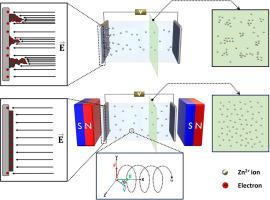
锌-二氧化锰电池具有理论容量高、成本低、安全、环保等优点。然而,它们的商业潜力受到锌枝晶形成和锰溶解的限制。通常,这些问题是通过细胞的内部修改来解决的。本研究通过外加磁场对Zn2+离子诱导洛伦兹力,促进锌的均匀溶解和沉积,从而抑制枝晶的形成。首先,分析了不同磁场强度下锌电极的形态演变和电池的比放电容量。然后利用最佳磁场强度研究了不同电流密度下锌的沉积/溶解和电荷存储行为。通过紫外可见光谱和ICP-MS分析研究了在磁场作用下充放电过程中的电解质含量。在2.91 kG的磁场下,观察到树枝晶形成的显著减缓和电化学性能的增强,特别是在高充放电速率下。循环稳定性测试表明,在1000 mA g−1的磁场下循环500次后,容量保持率为83%,而在没有磁场的情况下,容量保持率为52.9%。此外,在磁场作用下,由于Mn2+离子保留在正极内,锰的溶解减少。这种方法强调了磁场辅助ZIBs在快速充电应用中的潜力,并建议探索将磁场与电池内部修饰相结合的协同作用,以进一步提高电化学性能。
Behaviour of Zn-MnO2 battery under externally applied magnetic field
Zn-MnO2 batteries offer high theoretical capacity, low cost, safety, and environmental benefits. However, their commercial potential is limited by zinc dendrite formation and manganese dissolution. Typically, these issues are addressed through internal modifications of the cell. In this study, an external magnetic field is applied to induce Lorentz forces on the Zn2+ ions, promoting uniform zinc dissolution and deposition, thereby suppressing dendrite formation. Initially, the morphology evolution of the Zn electrode and the specific discharge capacity of the battery was analysed at different magnetic field strengths. Then the optimum magnetic field strength was used to study the Zn deposition/dissolution and the charge storage behavior at different current densities. UV–Vis spectroscopy and ICP-MS analysis was done to study the electrolyte content during charge/discharge in the presence of the magnetic field. With a 2.91 kG magnetic field, substantial mitigation of dendrite formation and enhanced electrochemical performance was observed, particularly at high charge/discharge rates. Cyclic stability tests showed 83 % capacity retention with the magnetic field after 500 cycles at 1000 mA g−1, compared to 52.9 % without it. Additionally, manganese dissolution was reduced as Mn2+ ions were retained within the positive electrode under the magnetic field. This approach highlights the potential of magnetic field-assisted ZIBs for fast charging applications and suggests exploring the synergy of combining magnetic fields with internal cell modifications to achieve further improved electrochemical performance.
期刊介绍:
The aim of the journal is to provide a respectful outlet for ''sound science'' papers in all research areas on surfaces and interfaces. We define sound science papers as papers that describe new and well-executed research, but that do not necessarily provide brand new insights or are merely a description of research results.
Surfaces and Interfaces publishes research papers in all fields of surface science which may not always find the right home on first submission to our Elsevier sister journals (Applied Surface, Surface and Coatings Technology, Thin Solid Films)




 京公网安备 11010802042870号
京ICP备2023020795号-1
京公网安备 11010802042870号
京ICP备2023020795号-1

 分享
分享
 求助内容:
求助内容: 应助结果提醒方式:
 扫码关注我们
